

WHAT THE EXPERTS SAY
:
‘
I find the photographs themselves credible . . . They appear to
represent a real phenomenon
’ —
DR MICHAEL MALIN,
Professor of Planetary Sciences, Arizona State University
(
doctoral dissertation on the analysis of spacecraft
photographs of Mars; four years at NASA
’
s Jet Propulsion
Laboratory
)
‘
I cannot explain the metal sample. By any known
combination of materials I could not put it together myself,
as a scientist. With any technology that I know of, we could
not achieve this on this planet
’
— MARCEL VOGAL, research
chemist
(
22 years at IBM, holder of 32 patents, inventor of
the magnetic disc-coding memory system still used in IBM
systems throughout the world
)
‘
Out of all the scientists I’ve talked to, I’d say the majority
think it’s very credible
’
—
H. DAVID FRONING, JR,
astronautical engineer
(
25 years at McDonnell Douglas
Corporation
)
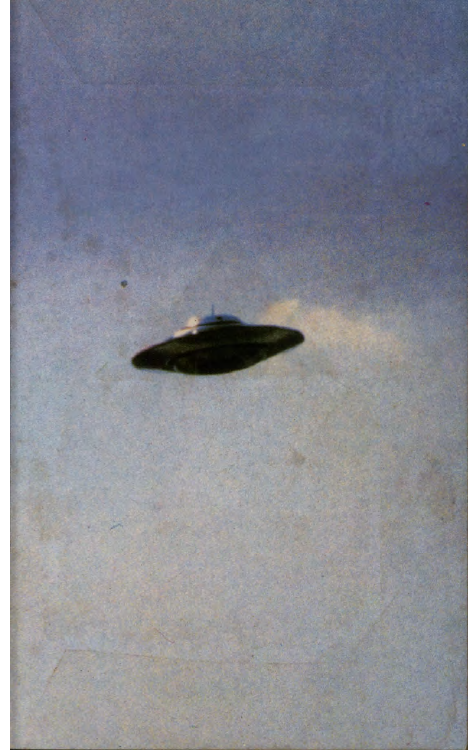


P E N G U I N B O O K S
LIGHT YEARS
Gary Kinder was born in Florida. He has a degree in
law and is a member of the Florida Bar. He taught at
a law school but has now given up legal practice to
be a full-time writer. He is the author of the best-
selling
Victim: the Other Side of Murder
and has
contributed to
Esquire
and other US publications. He
now lives in Sun Valley, Idaho.

GARY KINDER
LIGHT
YEARS
THE BEST-DOCUMENTED UFO CASE EVER
P E N G U I N B O O K S

Penguin Books Ltd, 27 Wrights Lane, London W8 5TZ (Publishing and Editorial)
and
Harmondsworth, Middlesex, England (Distribution and Warehouse)
Viking Penguin Inc., 40 West 23rd Street, New York, New York 10010, USA
Penguin Books Australia Ltd, Ringwood, Victoria, Australia
Penguin Books Canada Ltd, 2801 John Street, Markham, Ontario, Canada L3R 1B4
Penguin Books (NZ) Ltd, 182–190 Wairau Road, Auckland 10, New Zealand
First published in the USA by The Atlantic Monthly Press, New York, and
simultaneously in Canada, 1987
First published in Great Britain by Viking 1987
Published in Penguin Books 1988
Copyright © Gary Kinder and Intercep, 1987
All rights reserved
Filmset in Century Schoolbook
Made and printed in Great Britain by
Richard Clay Ltd, Bungay, Suffolk
Except in the United States of America,
this book is sold subject to the condition
that it shall not, by way of trade or otherwise,
be lent, re-sold, hired out, or otherwise circulated
without the publisher’s prior consent in any form of
binding or cover other than that in which it is
published and without a similar condition
including this condition being imposed
on the subsequent purchaser

A C K N O W L E D G M E N T S
I
t
is
impossible
to
enter
the
field
of
ufology
without
treading
upon many footprints. My research on UFOs and their history has come
from books, doctoral theses, vintage newspaper and magazine arti-
cles, publications from various UFO organizations, government docu-
ments, and correspondence from the files of the National Investigations
Committee on Aerial Phenomena. I would like to single out David
Michael Jacobs’ doctoral thesis, The Controversy over Unidentified
Flying Objects in America: 1896–1973. I found myself referring to it
often. I also traveled to many parts of the country attending UFO
symposia and interviewing ufologists. For their time and patience in
helping me understand the phenomenon, I would like to thank Sherman
Larsen, curator of the now combined archives of the Center for UFO
Studies and the National Investigations Committee on Aerial Phenom-
ena; Walt Andrus, head of the Mutual UFO Network, who graciously
made me feel welcome at his organization’s 1986 convention; Dr. Bruce
Maccabee and the Fund for UFO Research in Washington, D C.,
especially members Larry Bryant and Dick Hall; Coral Lorenzen and
the late Jim Lorenzen of the Aerial Phenomena Research Organization
in Tucson; Dr. Leo Sprinkle, organizer of the contactee convention held
each summer at the University of Wyoming; and Doris Arnold, whose
husband Kenneth started it all.
The primary investigators on the Eduard Meier case—Lee and Brit
Elders, Tom Welch, and Lieutenant Colonel Wendelle Stevens (USAF,
retired)—have given generously of their time and energy in recalling
their experiences with Meier from 1976 to 1982. They will receive a
percentage of royalties for introducing me to Meier, and for supplying
v

me with records, correspondence, interview tapes, and their research
on the Pleiades, plus photographs, sound recordings, video tapes, and
other materials owned and copyrighted by Lee Elders. All materials
were provided for me to use at my discretion, and I have maintained
total control over the contents of the manuscript.
Jim Dilettoso, who assisted the investigators, also has my gratitude
for talking to me of his role in tracking down scientists willing to examine
the evidence.
The Swiss and German citizens whom I interviewed are all men-
tioned by name in the book—Bernadette, Eva, Engelbert, Jakobus, to
name a few—and I thank each of them for taking the time to speak with
me of their experiences. Elsi Moser and Herbert Runkel were especially
accommodating and helpful, as was Timothy Good in London. Popi
Meier, who seems more than any other to have grown from the
experience, always made me feel welcome in her home, though I was
one of thousands to tromp through in search of her husband. A very
special thanks goes to Frank Stuckert, who served not only as my
translator but became my friend as well; Frank and his wife Frida are
warmly remembered for their hospitality.
The scientists and engineers who examined the evidence and
agreed to talk with me on the record did so at some risk to their
reputations. All are mentioned by name in the book. As they were
candid with me, I have tried to be fair in reflecting their complete
opinions, including any reservations they may have had. They have
made clear to me, and I now make clear to the reader: Their observa-
tions and views are their own and in no way are intended to represent
the position of their employers. I sincerely hope they will not be
castigated by their peers or their employers for having the courage to
explore and to wonder.
My editor, Morgan Entrekin, and my agent, Richard Pine, deserve
recognition for backing me as I embarked on an adventure that, after
much time, energy, and money had been expended, could have led
nowhere. They stood by me and had faith that I knew what I was doing
when even I did not know that I knew what I was doing.
I am fortunate to have a brother to whom I am close, and who is
also in the hotel business. Randy, thank you for making the lonely times
on the road first-class. As always my parents, Irving and Peggy Kinder,
and my in-laws, the Ernest Evans family of Seattle, have continued their
support and encouragement.
And last, Theo and George, I have not forgotten.
vi

PART I
EDUARD MEIER

L
ate
on
a
cold
and
rainy
N
ovember
night
in
1976,
a
Volkswagen and a small German-built Ford wound through
the islands of darkened forest in the hills southeast of Zurich.
The rain fell so hard for so long that the back roads had
turned to mud and the rain dripped from the needles of tall
evergreens soaking the forest floor until it was spongy. Then
the temperature cooled and large wet flakes of snow now
mixed with the rain as the Volkswagen, followed by the Ford,
slithered through the mud past the shadowy presence of an
old farmhouse and headed further into the darkness. Wearing
a gray leather jacket, a man with his left arm severed just
above the elbow rode in the passenger seat of the lead car;
though the driver could see nothing save the wet path before
him pelted by silver rain, the man with one arm seemed able
to see past the veil of darkness, to know where he was and
where he was going. Above the muffled beating of the rain, he
directed the driver through the darkness across a swampy
meadow, down a prominent rise, to the edge of another
forest, where he told the driver to stop.
The car engine died quickly, and only the rain splashing
on the metal roof now broke the silence. Then the headlights
of both cars dimmed and went out, and the driver could see
nothing in the blackness. Neither he nor a passenger in the
3

G A R Y K I N D E R
backseat had seen anything since the headlights swept past
the ghostly farmhouse a few miles back. The man with one
arm instructed the driver that they were to wait for him there,
that he would return in perhaps an hour, perhaps longer, he
could never be sure. Then with no further word he opened the
door and they watched his silhouette disappear quickly
through the rain into the dark of the forest.
For over a year the driver had accompanied the one-
armed man to such sites, a half hour, sometimes an hour, from
the village. As months passed the journeys had taken place
later at night and the sites had become increasingly remote.
For someone alone, waiting in the darkness, they could be
frightening. This night the presence of the other people, the
man in the backseat, the man and woman in the Ford, eased
the fear as he waited.
Outside, the rain and wet snow continued to fall, and the
driver realized they would have to mount chains on the rear
tires or they would never be able to drive through the deepen-
ing mud up the rise and back several miles to the main road. If
they bogged down in the mud, they would have to spend the
night in the two cars.
The men got out of the cars, and illuminated by the
headlights, they stood in the rain and mud jacking up first the
Volkswagen then the Ford. The rear tires of each car had to be
raised, one at a time, then lowered, and the jack stand
repositioned again in the mud and pumped again until the
next tire rose inches from the ground. The chains were heavy
and difficult to manipulate, especially with fingers wet and
numb from the cold. The woman sat in one car then the other,
dozing as the men worked.
Before each chain was in place, nearly an hour had
passed, and the three men were now soaked to their skins
and chilled by the icy rain running in rivulets down their faces.
Finally they were satisfied with the tautness of the chains, and
as they began stamping about, trying to get warm, they
suddenly heard a strange sound above the trees.
“A singing noise”, recalled one of the men.
They peered upward into the rain. Except for the constant
4

L I G H T Y E A R S
flow of water dripping from the pine needles, the trees stood
motionless, but still the noise was that of strong wind.
The eerie sound, a high-pitched warble that pierced the
falling rain, moved slowly over their heads. They followed its
course with their eyes, straining to see; then suddenly the
noise began to subside, and the one-armed man stood with
them in the light not two feet away.
“We didn’t see him or hear him walk”, remembered
another. “Just all of a sudden he was there”.
The noise in the trees had awakened the woman, who got
out of the car to see the three men in their darkened and
soggy clothes huddled together in the beam of the headlights
and looking up into the trees. She closed the door and took
one step into the mud, glancing down for only a moment.
When she raised her eyes again quickly, what she saw
startled her: The man with one arm was suddenly standing in
the headlight beam only a few feet away, with his back to her.
“In the time I looked down and up again, a split second”,
she remembered, “he practically grew out of the ground in
front of me”.
The man with one arm appeared almost like an appari-
tion in their midst. They stared at him through the rain and saw
that his hair was dry; they reached for his hand, and his skin
was warm to their touch. As he stood in the bright light saying
nothing, they could see the rain and wet flakes of snow just
beginning to form dark speckles on the bone-dry leather of
his coat.
5

ONE
History first mentions the village of Hinwil, Switzerland,
in a document dated 745. Thirty miles southeast of Zurich,
it nestles in a landscape of rolling green hills pocketed by
large islands of forest a hundred feet tall, with the Alps
rising in the distance. Hinwil itself perhaps would disap-
point the tourist looking for the charm of alpine architec-
ture: Though chalk-white chalets shuttered in green rise
from the village core and scatter among the hills, many
stark buildings constructed of concrete have risen in their
midst. They resemble not so much the quaint cottages in
travel brochures as they do utilitarian apartment buildings
erected in the 1950s and ’60s in the United States.
But a short distance from the village center, along the
street Wihaldenstrasse, stands a three-story farmhouse
built a hundred years ago. During the mid-1970s summer
grape vines climbed the sunny south wall of the old house.
Flowers filled a stone water trough to the north near the
entrance, and small birds fluttered in an aviary built of
wood and wire. To the south and east of the house lay a
small green field, and to the north and west stood more of
the cold, institutional apartment buildings.
The community of Hinwil had acquired the old farm
years before and built the surrounding apartments to house
7

G A R Y K I N D E R
senior citizens. Though the farmhouse someday soon would
be torn down to make room for more apartments, the
community now rented the house for a nominal sum to an
unemployed night watchman, Eduard Meier. Meier lived in
the house with his Greek wife, Kaliope, nicknamed Popi,
and three small children—a girl, Nina, a boy, Atlantis, and
the baby, Bashenko. They had been living in the house
since December 1973, though they had lived elsewhere in
Hinwil for two years.
Meier, a man of thirty-seven, had a sixth-grade educa-
tion. He was not a very big man, maybe five feet seven
inches tall, but he was thick-chested and strong. His face
was handsome, set off by unusual greenish-hazel eyes.
According to village records, Meier’s professions were
“birdbreeder, iron layer, night watchman”. He held a per-
mit to carry a gun because he had once worked as night
security in a factory.
In a former house, a tiny three-room row house contig-
uous to the Hinwil village museum, Meier had kept a cage
out back filled with nearly two hundred birds. He had been
employed then as a night guard and consequently was often
at home during the day. But many people in the neighbor-
hood avoided talking to Meier because he was “different”.
He spoke a great deal about Moses and said things other
people did not understand. Julios and Erika Kägi knew the
Meiers better than other neighbors did because they had a
daughter the same age as Nina and the two girls often
played together. “He had a terrific fantasy”, remembered
Erika Kägi, “and I could not agree with his philosophy. But
he was not a bad person. He was not even odd; he just had
his own ideas and believed whatever he said”. Said another
neighbor, “Meier lives the way he wants to and does not
adapt to anyone else
’
s way of living”.
Meier had only one arm. His left arm had been severed
just above the elbow in a bus accident in 1965, as he
traveled from India, through Turkey, back to Switzerland.
Still, when part of the barn adjacent to the small house
collapsed,
Julios Kägi saw Meier rebuild the wall alone by
8

L I G H T Y E A R S
holding the boards in place with his shoulder stump while
he positioned and pounded nails with his one hand. “He was
faster with one hand than other people are with two”,
recalled Kägi.
Again out of a job, Meier now supported his family on
the 700 francs provided him every month by the govern-
ment for the loss of his arm. To supplement their income
the Meiers kept chickens in the attic of the old farmhouse,
and Popi sold eggs to the neighbors.
To neighbors living in the apartment buildings over-
looking the front door of the farmhouse, Meier seemed to be
always home. In a culture that values hard work and
conformity, the neighbors saw him as a singular and idle
man, often lost in thought, as though the weight of the
world rested upon his shoulders, and they began to talk.
Then on the afternoon of January 28, 1975, a cold day,
but warmer than most at that time of the year, Eduard
Meier left the farmhouse on his moped, towing a tiny
wagon behind him. He wound through the streets of
Hinwil, steering with one hand, the empty left sleeve of his
leather jacket jerking in the wind. Working his way out of
town, he eventually came to a country road, which he
followed for a time, then disappeared into the forest of a
nature conservancy. A few hours later he returned to the
farmhouse without telling anyone where he had been.
Several days passed, during which the neighbors saw
Meier dawdling around the house, seemingly as always
without purpose. Then one afternoon he again pulled his
moped from a storage room, pedaled it down the driveway
until the tiny motor kicked over, and rode through the
village out into the country. Soon he was lost from view in
another of the islands of forest surrounding Hinwil. When
he returned, as before, he told no one where he had been or
why he had been there. But the Swiss are observant and
curious people, and the neighbors noted his peculiar com-
ings and goings.
Within weeks Meier was traveling regularly into the
forest, guiding his moped with one hand, the tiny wagon
9

G A R Y K I N D E R
behind. Each trip seemed to take him along a new path in a
new direction through town and out onto the country high-
ways, often for as long as an hour. Later, many of his trips
took him into the hills. Sometimes he would disappear in
the early afternoon and not be seen again before supper;
other times he would sneak from the house at one or two in
the morning and not return till dawn.
“He had to go away again and again”, Popi remembered.
“He would come home for five minutes, fix himself a cup of
coffee, and, hop, he was gone again. It was bad at night.
You’d be sleeping peacefully and the kids were quiet in bed.
All of a sudden he would get up, get dressed, and be gone.
You know? You think your husband is lying in bed next to
you, but he is gone. I did not know anything. All he said
was that he was going to work”.
As the weeks passed, Meier’s journeys through town
and into the forests began to occur three, four, even five
times a week. And his frequent departures rubbed against
the grain of order and routine so conscientiously observed
by his neighbors. The more he disappeared, the more they
talked.
“The people in the neighborhood didn’t know anything
about what was going on”, said Popi, “but they were very
curious. They could tell me to the minute when he left on
his moped and when he came back. It was always the same
questions. ‘Why did he come home so late?’ Sometimes he
got up in the middle of the night and left, so they would
hear the moped. And when he did this, it was even worse
with the people the next day. ‘Why did he leave last night?’
‘Where did he go?’ I would say nothing. I wasn’t interested.
They are just
Schnuriwiiber
[gossips]”.
On clear nights neighbors living in the apartment
building just above the farmhouse saw Meier standing in
the alleyway to the west and watching the sky through
binoculars for hours. On nights when he did not leave the
house, neighbors to the east saw a light burning on the
second floor late into the night.
A week, a month, maybe two months passed, Popi
10

L I G H T Y E A R S
could not remember. Then one afternoon, as the two of
them stood in the small living room on the second floor of
the house, her husband handed her photographs.
“What do you think of this?” he asked.
But Popi only stared at the pictures.
“I was shocked”, she recalled, “because I saw something
completely new, and I did not want to believe that this
existed. He said nothing at all. Didn’t explain. Not one
word”. Her husband merely picked up the pictures and left
the room, as Popi yelled at him for wasting his time taking
pictures when money for the family was so scarce.
Meier next took the photographs to his friend Jakobus
Bertschinger, whom he had met while working at the Piatti
gravel pit years earlier. Though Jakobus was twelve years
younger than Meier, the two men had struck up a lasting
friendship. They spent much time together, talking about
Meier’s experiences during the twelve years he had
traveled back and forth through India and the Middle East.
But Jakobus, too, seemed confused by the photographs
Meier showed to him. He even laughed, but he promised to
help his friend in any way he could.
With a loan from Jakobus, Meier placed a small classi-
fied ad in the German publication
Esotera.
The ad solicited
people interested in forming a group to discuss natural life,
logic, and truth—things “metaphysical”.
Several more months passed. Through the summer and
fall of 1975, the neighbors along Wihaldenstrasse watched
Meier continue his frequent trips into the foothills and
forests at all times of the day and night. On his little green
moped he often was seen at the edge of the open road, putt-
putting along, twenty, maybe twenty-five miles an hour,
passed constantly by the much larger and faster automo-
biles. But then something new entered Meier’s routine: One
Saturday afternoon a half-dozen cars appeared at the farm-
house and remained till late at night.
The neighbors did not understand why people came to
see this man. He was poor and handicapped, with an
unkempt wife who spoke little of their language. He did not
11

G A R Y
K I N D E R
work and his habits seemed strange. But over the weeks
and months, not only did the visitors continue to come, but
their numbers increased. In the tiny parlor on the second
story, the man with the single arm and unusual hazel eyes
spoke to these people for hours. When they left, the neigh-
bors heard Popi screaming at him.
For many months the neighbors watched Meier disap-
pear frequently at odd hours, and saw the cars on Saturday
afternoons filling the narrow alleyway running alongside
No. 10 Wihaldenstrasse and spilling onto the streets of
Hinwil.
12

TWO
Ilse von Jacobi, a journalist living in Munich who wrote
frequently about metaphysics and the paranormal, had
read about Eduard Meier in a newsletter printed and circu-
lated by a self-study group in Munich in the summer of
1975. Interested, she contacted the young man who edited
the newsletter and through him began to monitor develop-
ments in the Meier story as reported by witnesses. A few
months later, after seeing photographs Meier had taken,
she decided to interview him for publication.
When von Jacobi arrived in Hinwil in December 1975,
she found herself one of about eighteen people who had
come to the Meier home to listen to the man speak. She
stayed for two days.
“I was impressed”, she recalled. “I was convinced that
he had had the experiences he talked about. The facts he
gave me, the pictures, the personal impression he created,
there was nothing wrong. I wanted to make him known,
and to put his story in the papers, because it was real. But
something made him mad, and he told me I should not
publish anything about him, so I left. But it was for his own
good that he become known”.
13

G A R Y K I N D E R
Von Jacobi took her article to
Quick
magazine, one of
the two largest slicks published weekly in Germany, with
circulation in Switzerland and Austria as well. Hesitant to
run such a story without verification, the magazine editors
assigned a staff member to Hinwil to interview Meier.
When the writer returned with substantially the same
information von Jacobi had given to them, the editors set
the article for publication on July 8, 1976.
The magazine circulated rapidly through the town of
Hinwil, carrying a story that astonished Meier’s neighbors.
For nearly a year and a half they had observed and disap-
proved of his constant comings and goings at all hours of
the day and night, but not one had confronted Meier about
his purpose or attended one of the meetings at his home.
The reason he now gave for his behavior made them angry
and made them laugh all at once: Meier claimed that he
had been telepathically contacted by alien beings from a
planet in a star cluster known as the Pleiades. Through
telepathy, said the article, the Pleiadians frequently had
directed Meier to remote locations near Hinwil, where they
landed a seven-meter silvery beamship, disembarked, and
met with him face-to-face. Most of Meier’s contacts were
with a female named Semjase, for the Pleiadians, according
to Meier, had found that females seemed to be far less
intimidating to earth humans. Meier met with her often,
and she allowed him to photograph her beamship as it
approached for landing and again as it ascended.
Many people laughed. But others seemed awed by the
clear, color daylight photographs of the beamships, and
captivated by the thought of space beings alighting on
earth in a gentle and peaceful fashion. The July article in
Quick
led to a series of articles in various European maga-
zines that appeared throughout the summer and fall of
1976.
Il Giornale die Misteri
in Italy published von Jacobi’s
original piece on Meier in August; then in September the
largest tabloid in Switzerland,
Blick,
ran the front-page
title
“Zürcher verblüffte Erich von Däniken
”—“Zurich Man
Amazes Erich von Däniken”. More articles followed in the
14

L I G H T Y E A R S
German magazines
Echo der Frau
in October and
Neue
Welt
in November. One of Meier’s neighbors had a son
living in South Africa who even read of Meier in a newspa-
per there.
The neighbors scoffed at the articles, certain that
Meier somehow had perpetrated a hoax with his strange
and seemingly purposeless perambulations about the coun-
tryside. But for those who visited the Hinwil house to
investigate the claims further, Meier presented evidence
that looked convincing. He showed scores of bright color
photographs of Semjase’s ship hovering just above a jagged
line of evergreens or edged into the branches of a giant
leafless birch. In his journal he had recorded each of his
meetings with the Pleiadians; detailed conversations, some
thirty minutes, some longer than an hour. The journal now
consumed several hundred pages and continued to grow
rapidly.
One afternoon, at their request, Meier took a small
group into a meadow completely surrounded by tall ever-
greens. He told them that several nights earlier he had met
with the Pleiadians in the same meadow, and that he and
Semjase had sat in the grass by the trees and talked for an
hour. The people imagined the scene—a glowing, almost
weightless craft suddenly descending upon the meadow, the
luminescence from its shell pulsating against the wall of
darkened trees; then the alighting of a lithesome and
humanlike creature, gentle in approach and filled with
wisdom.
And there on the ground where the people now stood
with Meier in the daylight they saw three large circles,
each equidistant to the others, peculiar flattened swirls six
feet across, perfectly symmetrical, perfectly rendered in the
tall grass.
Those who heard Meier speak on Saturday afternoons
in his home and who read parts of his journal found the
writings beautifully conceived, far more complex and so-
phisticated than a man of Meier’s station would be capable
of imagining. Semjase, said Meier, had told him of life
15

G A R Y K I N D E R
elsewhere in the galaxy, the history of her people and that
of the earth. She had taught him to understand earth
humankind’s place in the galaxy. Order exists in the uni-
verse, she said, more advanced civilizations teach the less
advanced, and spiritual evolution must parallel technologi-
cal progress.
“We, too, are still far removed from perfection and have
to evolve constantly”, she explained to Meier. “When we
choose to come in contact with an earth human, we do so
because we feel an obligation to the developing universe,
and to life which is already existing throughout the uni-
verse. We are not missionaries or teachers, but we endeavor
to keep order throughout all areas of space. Now and then
we begin contacts with inhabitants of different worlds by
searching out individuals whom we feel can accept our
existence. We then impart information to those contacts,
but only when their race has developed and begins to think.
Then slowly we and others prepare them for the truth, that
they are not the only thinking beings in the universe”.
* * *
Meier claimed that he continued to meet with the
Pleiadians in the forests of eastern Switzerland, and that
the telepathic signals warning him of an impending contact
could come at any time of the day or night.
“It happens like a shot”, he explained. “Like a cool wind
going across your forehead, very, very weak, though”. Fol-
lowing that came vibrations inside his head that produced
symbols. “On the one hand, it is like pictures which appear,
and on the other hand, it is like a voice. There are no words
for it . . . it is as if you heard a voice in the symbols”.
Meier could be in a room full of people when suddenly
his eyes would close, his skin would grow pale, and he
would begin to perspire faintly. He would then go to his
room and dress in boots, and a jacket if the air was cool, or a
gray leather coat if the weather turned bitter. Popi had
made him a warm hat like those worn in the mountains of
the Middle East, and she would fix him coffee; but if the
16

L I G H T Y E A R S
coffee was not ready in five minutes he would leave without
it. He could be gone a half hour or half a day.
One afternoon Meier told his wife that he was about to
have a contact and that she and the children were to come
with him. Also allowed would be two others who happened
to be at the house, one of whom was Hans Schutzbach, a
man in his late twenties. Skeptical of Meier from the
beginning and watching him closely, Schutzbach had stud-
ied every photograph Meier had taken of the beamships,
and had helped him to catalogue the photos. He also had
driven Meier on many of his night contacts. Although a few
witnesses, including Schutzbach, had seen strange lights at
night that could have been beamships, no one except Meier
had seen one in daylight.
“I put everybody in my car as usual”, recalled Schutz-
bach, “and Billy went ahead on his moped, empty-handed.
He told us to just follow him, and he went every which way.
Outside Hinwil we finally came to a little hill filled with
trees. It was very exciting”.
Meier told them, “All of you wait here”. Then he drove
off.
“I don’t remember how long we were standing there”,
said Popi, “when all of a sudden Atlantis jumped up and
screamed, ‘Look, Mommy, over there!’ We all got up and
there was the ship about a thousand meters away. It was
big and circular. We wanted to see more, but the ship soon
disappeared”.
When the child screamed, Schutzbach jumped up and
saw something rising out of the forest into the air.
“I presume it might have been a balloon”, he said later,
“but I have no proof of that”. He tried to take a picture, but
he was so nervous that at first he forgot, and then he shook
so badly he jerked the camera. “That’s why the picture is
not sharp”, he explained. “All you see is a little dot”.
The neighbors were certain Meier was crazy. “No one
took him seriously”, one of them said later. The mayor of a
nearby village said that Meier’s stories were pure fantasy
because
he,
the
mayor, had never seen a UFO in the
17

G A R Y K I N D E R
vicinity. People in Hinwil laughed at the mention of Meier.
“He is a
Spinner
”, they would say, one who is nuts.
Or they called him “
Verrückte
”, a lunatic.
“Are we blind”, asked one couple, “or are we stupid,
because we don’t see these things and he does?”
Now when they watched him searching the night sky
with binoculars, the neighbors would snicker and say, “He
is looking for his lady from the galaxies”.
But the articles that by now had appeared in several
European countries attracted dozens of curious people from
all over the continent. They came to talk to Meier about the
messages from the Pleiadians. To the surprise of the neigh-
bors, these people appeared to be well-to-do, most of them
driving Mercedes, many all the way from northern Ger-
many. The neighbors could not understand how such people
could be so taken in.
“For us and everybody else in the neighborhood”, said
Franz Hänsler, who lived in an apartment overlooking the
farmhouse, “it was a very questionable situation. We all
thought he was a ‘fantasist’. The whole house was a
strange affair”.
Marie Hänsler often spoke to Popi, the only neighbor
who did. She bought eggs from Popi and considered her “a
very, very nice lady. But”, she added, “I wanted nothing to
do with her husband!” Often Popi came to her crying, and
Hänsler would teach her to sew and knit.
“She was not a woman to be envied”, said Hänsler. “She
suffered”.
Meier himself did nothing directly to offend the neigh-
bors. But his teachings, his telling of fantastic stories that
they felt were untrue, would “aggravate” them. And some-
times so many cars trailed from the Meier driveway into
the street that they blocked traffic. One of the town admin-
istrators, Rudolf Rüegg, thought that all of Meier’s stories
were “imagined, invented. I think he invented it all”. Rüegg
received many calls from neighbors near No. 10 Wihalden-
strasse, most of them complaints about the presence of so
18

L I G H T Y E A R S
many cars. Once, a worried mother called town officials
because her daughter had gone to the Meier home.
In the beginning Popi tried to talk to some of the
neighbors. “But I noticed they didn’t believe me”, she said,
“and I started to ignore them. At that time I had my own
problems”.
One Saturday morning, as she walked in the village with
her two sons, she saw two elderly women in front of the
town hall. “I didn’t know them”, she said later. “The chil-
dren knew them, I think from kindergarten. So they
started to play with the children. Then they asked, ‘What’s
your name?’ Bashenko could not yet say his name, so he
always said Baschel. Then they asked, ‘And your last
name?’ ‘Meier’. One of the women made a long face, and the
other one asked me if I was the wife of
that
Meier. And I
said, ‘Yes’. And she said, ‘Are you as crazy as he is?’
“The children even had problems in school”, continued
Popi, “because the parents of the other children did not
believe in all this. Atlantis went to kindergarten and the
children always made fun of him. They called him ‘Ufo‘
Meier. He came home crying so many times. I told him to go
to the teacher, but the teacher didn’t believe in all this
either. He told me that my husband and I were doing weird
things with UFOs, that this wouldn’t be the best influence
for the kids. I told Billy it would have been better if none of
this had happened”.
* * *
That summer, 1976, just before all of the publicity on
Meier’s alleged contacts with the Pleiadians, Hans Schutz-
bach had accompanied Meier one afternoon to a secluded
meadow not far from Hinwil. There, in the presence of
Schutzbach, Meier held out a tape recorder and captured
the sounds made by one of the beamships. The sound, an
eerie and grating noise, like a high-pitched cross between a
jet engine and a chain saw, thought Schutzbach, seemed to
emanate from a point in open air about thirty feet above
19

G A R Y K I N D E R
Meier. When Meier raised his hand and circled it the sound
increased; when he lowered his hand the sound softened.
Then the two, loud and soft, interlaced in an ethereal
resonance. Suddenly Meier made an angry gesture and the
sounds stopped altogether. Schutzbach turned and saw a
game warden and a policeman, one with binoculars, plus
another policeman with a dog and two men on motorcycles.
Before Schutzbach left the scene, he had “a real good
look around”, combing the nearby landscape, walking to
the few trees dotting the meadow and examining their
branches. He saw no speakers, cables, or balloons, nothing.
Two days later Schutzbach secretly returned to the
same meadow with two friends, and the three of them tried
to re-create the sounds using the tape he had made with
Meier. They hung speakers high in the trees and used
amplifiers, but the apparatus was obvious and the sound
weak and distant.
Hans Schutzbach drove Meier to perhaps twenty of his
contacts in the forests outside Hinwil, many of them on
cold, damp nights. A self-proclaimed nosy person, he
watched Meier closely, but never saw him make anything
or handle any materials that could have been used to
fabricate the sounds or the photographs. Schutzbach’s big-
gest problem, though, was the strange landing tracks.
Whenever the beamships left them in the tall grass, he
would help Meier measure and photograph them. Schutz-
bach thought about them often. He saw many people try to
prove Meier a fraud by duplicating the tracks, but they
always looked much different. “The tracks made by Billy
were perfect”, Schutzbach said. “The ones by other people
were a bad copy”.
On the night of June 13, 1976, several people accompa-
nied Meier to a clearing in the forest where he was to have
a contact with the Pleiadians. It was 2 a.m. when they
arrived. Meier told them that to demonstrate the Pleia-
dians’ existence, Semjase had consented to a light display
where the ships would take on color and fly in erratic
20

L I G H T Y E A R S
patterns. Among those who waited was Guido Moosbrug-
ger, the principal of a small school in Austria.
Moosbrugger had first come in contact with Meier a
few months earlier when he traveled to Munich to attend a
series of monthly lectures on UFOs. At one of the lectures
Meier had been invited to speak and to show some of his
photographs. “I was so fascinated by those pictures”, re-
called Moosbrugger, “I sent a letter immediately to him in
Hinwil and asked him whether I might visit him”. Meier
had consented and Moosbrugger visited Hinwil in mid-May
1976. During his stay, Moosbrugger had followed Meier to a
contact, Meier on his moped, Moosbrugger and Schutzbach
in a car. The three men had driven along a dirt path
through a field until Meier signaled for them to stop. Then
he had told Schutzbach and Moosbrugger to wait there.
“He took off on his motorbike to where the contact
would take place”, remembered Moosbrugger. “After he
left, I thought to myself, I wonder what would happen if I
would follow him to see where he went. When he came back
from the contact he said that Semjase had welcomed him
with the words, ‘You brought two men with you. Mr.
Moosbrugger had a thought for a short moment what would
happen if he would follow you. It didn’t concern me though;
that was just his honest interest’.”
The two men had sat in the car waiting for Meier to
return when high above the tree line two miles away they
saw a fire-red disk “as big as the headlights from a distance
of one hundred meters”. The red disk moved back and forth,
then suddenly disappeared. After a few seconds a rotating
silver ball spun into view, then two smaller silver spheres
appeared beneath the first, also spinning. At the base of the
central and largest of the spinning spheres, a large drop
formed and hung lower and lower until it broke free and
plummeted, disappearing in two or three seconds. Suddenly
all of the lights had disappeared.
“After another pause”, Moosbrugger explained later,
“the very same disk appeared again, became bigger and
21

G A R Y K I N D E R
bigger, and we thought it flew toward us. Then it shrank
and disappeared”.
Moosbrugger had seen exotic fireworks displays before,
but what he saw that night seemed more solid and vivid,
like a color cartoon taking place in the blackened Swiss
sky; not little explosions of gunpowder, but more the bril-
liant illumination of strangely behaving physical objects.
Later he wrote, “Of course, I cannot be angry if somebody
does not believe this story, if they cannot or do not want to
accept it as reality. I don’t mind if people call me crazy or
say I have lots of imagination, but I do not want to be called
a liar”.
Moosbrugger knew nothing about using a 35mm single
lens reflex camera, but he would not return to Hinwil
without one. From a friend he borrowed a Pentax, a tripod,
and a telephoto lens and had his friend load film into the
camera for him, and set the adjustments for nighttime
exposures. Three weeks later Moosbrugger had returned to
Hinwil, and he now stood in the dark beneath tall pines at
the edge of the clearing, his Pentax and his telephoto lens
mounted on the tripod. Out of his sight, Hans Schutzbach
and his brother, Konrad, also had positioned themselves in
the woods, each with a camera. Nearby, the rest of the
group ate cake, sipped hot coffee, and watched the dark sky
from a knoll.
Suddenly, over the forest, they saw first a red disk,
then a silver disk. The lights hovered, then grew, then just
as suddenly disappeared. Moosbrugger got the red disk on
film. He then bent over his tripod to adjust the angle of his
camera when a third disk-shaped object appeared, this one
alternating brilliant colors. When Moosbrugger looked up
again, this disk had gone, but immediately, very high in
the sky, he saw another silver disk edge on, a bar of intense
light, with a “glittering rain of fire falling straight down’.”
Moosbrugger captured this last disk on film, an image that
looked like a huge brilliant jellyfish with tentacles drifting
across the sky. Before and after Moosbrugger photographed
22

L I G H T Y E A R S
the disk, the intense yellow-white bar changed its form
several times, then softened to a glow, and the observers on
the ground saw the luminous ball fly slowly away until it
was only a bright red speck in the distance. Then it as-
cended rapidly and disappeared. Meier had had his fifty-
fifth contact.
* * *
The articles released in the summer and fall of 1976
persuaded more and more people to travel to Hinwil to see
Meier. Every weekend visitors came to the house, some-
times as many as twenty, some of them familiar, some of
them new. All of them wanted to see Meier’s photographs of
the beamships and to hear about life elsewhere in the
universe. What is the Pleiadian culture like? Their govern-
ment? Their society? How advanced is their technology?
How do they communicate with Meier? What do they look
like? Are their intentions peaceful?
According to Meier, the Pleiadians lived to be one
thousand years old; Semjase herself was a comparatively
young 330. Her home planet, Erra, was only slightly
smaller than Earth, yet was populated by far fewer people,
less than 500 million. Upon discovering Erra’s hospitable
but young environment, the Pleiadians themselves had
engineered the planet to support life, and today its land-
scape looked much like the countryside found on Earth,
with hills, grass, trees, and running water. They located
production and processing facilities in remote regions,
away from the population, and utilized nearby uninhabited
planets for mining. The Pleiadians told Meier that were he
to travel to Erra, he would find species similar to the horse,
cow, rabbit, and fish.
Robots and androids performed most physical labor on
Erra. The androids looked and acted so human the only way
to distinguish them from humans was by their dress. Each
wore a uniform, the color indicating the job the android was
assigned to perform. They appeared unusually lifelike be-
23

G A R Y K I N D E R
cause their skin was made of living protoplasm, and their
brain, too, was an organism capable of natural responses
and conversation.
Families not only existed on Erra, but they were pur-
portedly tight and caring. Though sexually mature in their
early teens, Pleiadians did not marry until after they had
completed their education, a process that began when they
were four years old and lasted until they reached seventy.
By that time they would have acquired specific skills in
fifteen or sixteen disciplines, or, in the case of Semjase, as
many as thirty.
There was no government.
“They have, what you call here, ‘spiritual leaders,‘”
Meier told those who came to see him. “And the highest
form that they have for their leadership they call Horralft.
It’s a form of life that’s not hard face and body, and not a
real spiritual form. It’s a middling between both of them. If
you put your hand into them, it will go through. The
Horralft will not give out orders. They give out something
else, what we call ‘suggestions’. And then each one on the
planet, by his own wisdom in evolution, tries to do his best
out of this”.
* * *
With all of the people coming to her home, to see her
husband, taking up his time, Popi felt as alienated as she
had when she first moved to Switzerland. When she was
only seventeen, Popi had met Meier on Christmas Day,
1965, in the city of Thessaloniki, Greece. Meier was then
nearly twenty-nine. Only a few months earlier he had lost
his left arm. A month after they met, Meier had asked Popi
to marry him, and when the girl’s mother would not con-
sent, the two of them fled to a small town where they were
married on February 13, 1966. For four years afterward
they had traveled from Switzerland to India and back
again, working and living in Pakistan, on the Isle of Crete,
in the mountains of the Middle East, and in India. When
24

L I G H T Y E A R S
they returned to Switzerland, Popi understood little of the
Swiss German spoken in her husband’s country. A few
years later, when the contacts began, she communicated
better in Swiss German, but she still knew so little High
German that she found her husband’s writings about the
contacts difficult to read. “I tried to read them”, she remem-
bered, “but I just didn’t understand anything. So I made
myself a wrong picture of all this.
“It got bad”, she continued, “when all these people
began coming to Hinwil to see my husband. Most of them
were women, and he used to take many of them to the
contact sites. I was very jealous at that time. Not that I was
thinking he would see another woman. It’s just that nobody
ever said they would watch my children so I could go with
him. They just came to him and said, ‘Let’s go!’ So I was
very angry”.
One of those who now attended the meetings regularly
was Bernadette Brand, a computer technician. In July
1976, she was riding the train home from work one eve-
ning, reading
Quick
magazine, when she saw the article on
Meier.
“I remember saying to my colleague”, she later re-
called, “‘Another crazy who says he is having contact with
extraterrestrials’. He asked me whether I believe that
baloney. I said, ‘Of course extraterrestrials exist, but why
would they come here? If they went anywhere it would be to
a place where they could learn something, but not here’. I
thought it was awful that somebody said he was having
‘contact’ and fooling people. You should put them behind
bars. All of them”.
Brand knew the Schutzbach brothers, Hans and
Konrad. When they told her about an invalid they knew
who claimed to have contact with beings from another star
system, she failed to connect their story with the article she
had seen in
Quick.
She said to them, “Another crazy around
here!”
Konrad tried to tell Bernadette about Meier, but she
would not listen. “Don’t be so stupid”, she said.
25

G A R Y K I N D E R
“You don’t understand”, said Konrad, “you have no
idea”.
And the two of them argued about Meier for the rest of
the summer.
One Saturday evening in the fall, Konrad brought his
friend Jakobus Bertschinger to Bernadette’s apartment for
dinner. ‘The whole time”, remembered Bernadette, “they
were talking about some woman, like, ‘Don’t take her
seriously. When she’s jealous she makes everybody crazy’.”
After dinner the three of them drove to Hinwil to see a
“friend” of Konrad’s who lived in an old farmhouse in the
middle of several apartment buildings. He did not tell her
the friend was Eduard Meier, though as they turned off
Wihaldenstrasse
onto
the
long
alleyway
Bernadette
guessed who lived there. By now she was willing to meet
the man.
A woman met them at the front door and said, “Wait
here. You can’t come in yet”. Then she whispered to
Konrad. When they finally entered the house, Konrad told
Bernadette, “We can’t go into the living room; there is a
discussion going on in there”.
In the kitchen, Bernadette brewed coffee for the people
in the living room, and while the coffee percolated, a
woman ran through carrying a large container of water
swirling with coal dust. Most households kept this espe-
cially fine grade of coal dust for emergencies, to induce
vomiting in children. Bernadette wondered, Has someone
tried to commit suicide?
Then Meier himself walked into the kitchen and told
Bernadette to come into the living room with the coffee.
Immediately, she saw a woman with long dark hair
slumped over in a chair, and another woman washing her
arms and forehead with cold water and patting her on her
cheeks to keep her awake. But the woman in the chair was
“white, like snow”, her head drooping. Popi had swallowed
close to fifty sleeping pills. A second woman replaced the
first, continuing to bathe her in cool water and pat her on
26

L I G H T Y E A R S
the cheeks. Bernadette thought, If these people keep on
doing it this way, this woman is going to die.
When the second woman complained of being tired,
Bernadette offered to take her place. She was not as gentle
as the other two. She slapped the woman across the face as
hard as she could. Then she slapped her again, and again.
The woman started to whimper and said to stop hitting her,
her teeth hurt so bad.
“If you keep your eyes open”, said Bernadette, “I won’t
hit you anymore”.
But the woman again nodded off, and Bernadette
slapped her face hard. She wanted to make her angry. For
three hours, Bernadette slapped the woman’s face.
Then suddenly the woman leaped out of the chair,
grabbed Bernadette, and knocked her to the floor. The
woman, though slight, was unbelievably strong, and tossed
the 160-pound Bernadette around the living room until
Meier stepped in and helped Bernadette subdue her. Then
Meier wrestled his wife into a bed and told her if she fell
asleep she would have to come back into the living room.
But she closed her eyes again, and Bernadette slapped her
across the face. The woman hit her back, screaming and
cursing her husband. Using only one hand, Meier whipped
off his belt, got it around her wrists, wrapped it quickly
around the back of her knees, and fastened her to a chair.
Popi continued to curse him and the others, then closed her
eyes and started to nod off again. Bernadette slapped her.
Then again, and again. Suddenly Popi strained against the
leather belt and broke it, but just as suddenly she seemed to
calm down. It was almost 6 a.m. She had last vomited at
midnight, and the toxicology center had told them to keep
her awake for six hours after she had emptied her stomach
of the remaining pills. Bernadette quit, and the other two
women went back to washing the woman’s face and limbs
in cold water.
One Saturday afternoon a few weeks after Popi’s at-
tempted suicide, Bernadette accompanied Konrad to a
27

G A R Y K I N D E R
meeting at the Hinwil house with about fifty other people.
Though she had expected to despise Meier, she found him
gentle and honest, not the
Schwindler
she had imagined
him to be. And this caused confusion, because what the
man said of his contacts and his trips into outer space still
sounded crazy to her. In a short while she was coming often
to the Hinwil house. And late one night, after she had been
to see Meier, she was driving home from Hinwil alone.
“As I was driving I got this feeling all of a sudden that I
had to stop. I thought, You
are
crazy. All these ships and
stuff make you crazy. So I drove on. But that feeling came
again, a very strong feeling that I had to stop, so I stopped
the car and stayed inside, locking all the doors. Then I
waited in the dark, curious what would happen.
“I was looking out the window from my side when I saw
a light rise above the forest. It was snow-white, about the
width of my hand from where I sat. It stopped for a moment,
then went back down, and when it sank back it was fire-red.
I thought somebody was playing with fireworks, but this
was so precise. Rockets don’t do that. I waited awhile and
after one or two minutes it rose again. Then all of a sudden
it was gone.
“I thought, Should I drive on? No, wait a little longer.
And indeed a little farther away, it is hard to estimate,
maybe five or six hundred meters, an orange light rose,
again from behind the forest. It rose very slowly and it was
very big. I would say it was a quarter the size of the moon.
This orange light rose and then looked like it was going up
stairs, zigzag, and then very quietly it flew away. I could
see it for about twenty minutes. From that area you are
able to see the Alps, and I saw it disappear in the Alps. It
got smaller and smaller”,
28

T H R E E
On a Friday night in the early summer of 1976, Herbert
Runkel and Harold Proch, men in their late twenties from
Munich, were cruising the autobahn to Augsburg in an
older cream Mercedes. With the windows rolled up they
listened to “The White Rose”, a radio program from East
Germany that aired every Friday at midnight. Each of
them held a spicy German sausage in one hand and a liter
of Coke in the other. Herbert, who was in charge of quality
control at his father’s insulation factory, smoked his Cam-
els; Harold, a professional photographer with a neatly
trimmed dark beard, cradled a pipe. They had been close
friends now for six years. The Friday night drives on the
autobahn to Augsburg had become a ritual, a time to talk.
As always they talked of many things, but one thing
that Harold specifically wanted to mention that night was
an intriguing article he had recently seen in
Quick
maga-
zine about a man living in Switzerland who claimed to have
had contact with beings from another star system. And the
contacts, said the man, still occurred regularly. The article
even mentioned U.S. presidential candidate Jimmy Carter
as one who had seen a UFO when he was Governor of
Georgia. Harold had had his own unexplained sighting
when he was only five years old. He later told the story:
29

G A R Y K I N D E R
“That was on the island where I was born. We were at
the beach one afternoon, and suddenly from the seaside
there came a flying saucer, two or three, I don’t remember
exactly. They stood still, a little bit in motion for about one
minute, maybe fifty meters high. They were big, it’s diffi-
cult to say how big. They were there for one or two minutes
and like a shot they were gone without acceleration. Gone. I
never forgot that. I asked my mother, I asked other people,
‘What is that? This is not an airplane, what is that?’
Nobody could tell me. Nobody could explain to me what
they were, why they were here, what it meant. That was in
the ’50s, 1953, 1954. I was so fascinated. I will never forget
that picture”.
On their Friday night journeys to Augsburg, Herbert
and Harold often had “philosophized” about the universe,
the existence of extraterrestrial societies, the possibilities
of travel into space over cosmic distances. “As many do, we
were trying to find a truth”, explained Harold, “but without
religion”.
Herbert, a compulsive reader, had read UFO stories
before. One of these was about the most famous “contactee”
ever, the American George Adamski. Adamski had lived on
the southern slope of Mount Palomar. In November 1952 he
claimed he had had a conversation with a man of slight
stature and shoulder-length blond hair who landed in the
California desert in a “Scout Ship” from Venus. The alien
had come to Earth because his people were concerned about
“radiations going out from Earth”, caused by the exploding
of atomic bombs. Adamski had traveled the world, famous
as the first person to claim contact with extraterrestrial
beings. He, of course, was a controversial figure, and his
few murky photographs of the “Scout Ship”, Herbert had
read, actually were superimposures using “part of an icebox
machine” as a model.
“In the other cases”, said Herbert, “the people always
talk about religion, how the space people are sent by God to
help the people on Earth and that’s all crazy. For someone
30

L I G H T Y E A R S
who thinks logically, it is nothing. No”, he told Harold, “I’m
finished with UFOs. I read about Adamski, I believe there
are extraterrestrial people, but all these stories in maga-
zines are hoaxes”.
“Before you say that, you should look at the pictures
from Switzerland”, said Harold. “You have never seen pic-
tures with quality like this”. A photographer with many
years experience, Harold had been impressed with the
pictures in the magazine, and he described each one in
detail for Herbert.
When they returned from their late-night journey to
Augsburg it was early morning though still dark. A night
person requiring little sleep, Herbert regularly went to bed
at three, four, five o’clock in the morning, slept for a few
hours, then was ready to start the day. That night he was
not interested in sleep; he went instead to Harold’s apart-
ment to see the article that had so impressed his friend.
When Harold unfolded the magazine in front of him, Her-
bert saw immediately why the photographs had caught his
eye. The two-page spread featured a black-and-white photo-
graph of a large silvery ship hovering high above a valley
near Hinwil. A series of three smaller pictures showed a
similar ship in various positions around a tall pine. In
another picture in a field of grass stood Meier himself, a
handsome man with hair thinning in the front, and a well-
developed right shoulder and forearm. The left sleeve of his
white shirt drooped and rose, neatly pinned to his shoulder.
When Herbert saw the layout, he grinned. “This is a
better hoax than the rest”.
In the past, nearly every report of unusual sightings or
claims of contact that Herbert had read about had occurred
in South America or the United States, nowhere he could
conveniently investigate himself. But this time the story
was in Europe. Harold spread a map across his desk, and
they found the village of Hinwil to be a little southeast of
Zurich, no more than a four- or five-hour drive from Mu-
nich. The two of them decided they would drive to Hinwil
31

G A R Y K I N D E R
the following weekend and try to find Meier and talk to
him. “It was just curiosity to see if it was true”, Harold said
later.
* * *
On Saturday morning the following weekend, Herbert
and Harold left Munich at daylight and headed south,
crossing the Swiss border just after sunup. Driving to
Winterthur, then down through the villages near the Pfäffi-
kersee, they arrived in Hinwil about ten o’clock. Not know-
ing Meier’s address, they drove to a kiosk in town, where an
old woman selling newspapers and candy told them that
Meier lived in a large farmhouse at No. 10 Wilhalden-
strasse. “Why do you want to see him?” she asked. “He’s
crazy”.
When Herbert and Harold arrived at the farmhouse
Meier was not at home and would not return for at least
two hours. Popi invited them inside for coffee, but they
declined. At two in the afternoon, with Meier still gone,
Hans Schutzbach arrived. A few minutes later Popi came
out to the car and told Herbert and Harold that Schutzbach
could answer some of their questions, since he knew Billy
(her husband’s nickname) well and had been on several
contacts with him. She again invited them inside for coffee,
and this time they accepted.
Inside the old farmhouse, Popi handed them two thick
albums filled with photographs. Harold studied several of
them closely with his professional eye. “As much as I know
about photography”, he said later, “I could not say these
photos were faked somehow. They looked real to me”.
“For ten minutes we could say nothing”, remembered
Herbert, “because our mouths were open. In the magazine
there were only black-and-white photos in two or three
different positions. But these pictures from up and down,
from here and there, clear and in color, were perfect”.
Schutzbach explained to them how Meier had taken
the photographs during his many contacts with the Pleia-
dians. “If you would like to see landing tracks from a ship”,
32

L I G H T Y E A R S
ne added, “actually two ships, there was a contact fourteen
days ago. They are quite fresh, I can show them to you”.
The article in
Quick
had mentioned nothing about
landing tracks; Herbert and Harold had no idea such evi-
dence existed. A few hours earlier they had speculated on
whether they would find Meier, and if they did, whether his
story would hold up or dissolve into nothing but unsup-
ported claims as had all of the others. Now they sat in
Meier’s house, looking at photographs even more incredible
than those they had seen previously. And here was a man
who had been with Meier on several contacts offering to
show them physical evidence supporting the man’s story.
The more they saw in the photo album and heard from
Schutzbach, the more intrigued they became. Shortly after
Schutzbach made his offer, Herbert and Harold were back
in the car again, following him through the streets of
Hinwil, then out into the country, onto a narrow side road
to a place where the road ended. There they got out of the
cars and began to walk.
“We walked almost one hundred meters through the
woods”, remembered Herbert, “and then we came to a place
where the wood was closed all around and there was a
meadow in it. There was very high grass, maybe a little less
than a meter. And there were the six landing tracks from
the two ships. I took a picture of them, and I thought, That’s
not possible, I have never seen anything like that. The
grass was turned counterclockwise, right? The interesting
thing was the grass was not broken. If you break grass it
will lie down, but this grass was not broken. I pulled up
some pieces of it and looked at it and it was not broken. I
could not understand.
“If you stand at a place like that, the first thing you
think is, How did these landing tracks get here? He must
come in with a car or with a helicopter or something to
make them. But that was impossible. The woods were so
close you could not go through with a car”.
Except for the landing tracks from the two beamships,
only a single set of footprints led from one of the tracks to
33

G A R Y K I N D E R
the edge of the woods and back again. Untouched, the rest
of the grass still stood stiff and tall around the six-foot
counterclockwise swirls so precisely pressed into tracks.
And the meadow in which they lay seemed the perfect place
to hold a secret rendezvous: Nearby but secluded and quiet,
a thick growth of trees formed a wall over a hundred feet
tall to hide the landing and departure of a strange lighted
craft.
“The pictures were special”, said Herbert, “but when
we stood in the woods at this surrounded place and saw the
tracks, it was special, special, special. I had never seen that
before. It’s difficult for me to explain”.
Standing at the edge of the forest, Schutzbach ex-
plained to Herbert and Harold how the Pleiadians guided
Meier telepathically to the chosen site, then landed their
ship and disembarked to speak with him unless they de-
sired either to teleport Meier into the ship’s hold or break
him down and reassemble him instantaneously on board.
After Herbert had taken several pictures of the landing
tracks, some at a distance, some up close enough to see into
the swirls of grass, the three men returned through the
forest to the cars and drove back to Hinwil. By that time
Meier had returned, his wife told them, but he could not
meet with them now; he would meet them in the city of
Wetzikon at the Post Restaurant near the railway station
at 5 p.m.
After seeing the many photographs in the albums and
viewing the landing tracks, Herbert and Harold now
thought Eduard Meier was far more intriguing than por-
trayed in the simple article that only several hours earlier
had persuaded them to drive over three hundred miles to
Hinwil. Each was far from accepting the reality of the
contacts, yet the man’s story, from what they had seen, had
some substance to it. More than before, they wanted to
meet Meier and question him to see if this knowledge from
the Pleiadians seemed genuine or was filled with the con-
tradictions of one obviously in touch with no source but his
own earthly imagination. They drove alone to Wetzikon
34

L I G H T Y E A R S
and arrived at the Post Restaurant just before five o’clock.
About thirty minutes later, as they sat talking at an
outside table, Meier walked up in the company of the
Schutzbach brothers and extended his hand to Herbert.
“I never saw him before”, Herbert said later, “only the
picture in the magazine. And he came straight to me,
extended his hand, and said, ‘Hello’. It was a strange feeling
when I looked into his eyes, like, ‘I know this man’. I don’t
know his voice and laughter, but I look at the eyes. ‘I know
this man’.”
For the next three hours on that warm summer eve-
ning the five men sipped hot coffee and iced Coke at a table
under a shade tree. Harold questioned Meier about the
photos they had seen in the albums, but Meier seemed to
know little about photography. His knowledge was
summed up in the phrase, “I push the button . . . and it
works”.
Herbert had read many books on astronomy and space
travel. He was familiar with some of the mythology behind
constellations; he knew about the origins of the universe
and that over 200 billion stars now spin in the slowly
revolving galaxy known as the Milky Way, and that for
every star in the Milky Way there was thought to be an
entire galaxy in the universe; he knew, too, about the
formation of star systems and the conditions necessary for
the evolution of life. He even understood the basic thought
behind Einstein’s theory of relativity and the problems it
presented for faster-than-light travel.
“For three hours I asked questions about these things”,
he later said, “and all the answers came correctly, quickly,
and logically. He would give an answer, and maybe one
hour later he would give another answer to another part
and it was all correct. All such brilliant logic. I read many
books . . . but there is no sequence inside, no logical
connection, and that was the first thing I found fascinating
about the conversation with Billy. He took his time and
always tried to answer a question so I was completely
satisfied.
35

G A R Y K I N D E R
“We talked about his personal life, too, and he said he
had only an elementary school education. I know many
people who have been only to elementary school, and I’ve
never heard any of them speak like someone with a Ph.D.
He speaks like this, and it makes me wonder. When he
speaks of certain things I think, There must be some way
he knows that”.
* * *
A month later, after exchanging letters with Meier,
Herbert, this time alone, drove again to Hinwil to continue
quizzing the man and, he hoped, to see more evidence.
When he arrived on the outskirts of Hinwil, however, he
detoured into the forest where Schutzbach had shown him
the fresh landing tracks.
Despite two weeks of unusually hot August weather
with no rain, the grass that had been pressed into the large
flat swirls continued to be green and springy. And though
they were now six weeks old, the tracks stood out as
distinctly as on the afternoon Herbert had first seen them.
Like Schutzbach and others before him, he could not under-
stand how the large counterclockwise swirls could be so
precisely pressed into the tall grass without crushing it.
But if the grass had been crushed it now would be brown
and dry. And since it was not brown and dry, nor crushed or
broken, why did it not rise up again? For the next five
weekends Herbert would return to that same site, but the
grass never stood; it merely continued to grow round and
round in a peculiar flat swirl. “Then the farmer came and
cut the grass”, said Herbert. “The tracks still were fresh. I
saw that with my own eyes”.
Herbert’s second experience with Meier proved as in-
triguing as the first, and he returned again the following
weekend. For hours he studied the photographs and talked
to Meier about the experiences. His initial cynicism over
the man and his alleged contacts slowly turned to curiosity,
and for the next year he traveled every weekend to Hinwil,
sometimes alone, sometimes accompanied by Harold. He
36

L I G H T Y E A R S
stayed with the Meier family, sleeping in a small bedroom
at the farmhouse and watching Meier closely. He was free
to roam all levels of the house, and he spoke frequently
with Popi, helping her with her German and explaining the
contact notes, which she tried to understand. They devel-
oped a close friendship, as Popi relied on Herbert for the
moral support and understanding her husband now had no
time to give her. But Herbert saw and heard nothing
suspicious. Popi, if she kept any secrets, divulged nothing.
Herbert constantly searched but found no equipment, rig-
ging, or models, not even scientific journals or technical
books from which Meier might glean his knowledge of so
many things. Meier never left the house unless it was to go
on a contact, usually late at night, and no one came to the
house to meet with him secretly.
“I saw Billy from morning to night”, he later recalled,
“and I never saw him making things like maybe speakers. I
never saw him take pictures, I never saw a model. I never
saw anything that looked like a model or balloon. I knew
every room in his house, and I never saw anything. That’s
the reason I went there; I wanted to see him do something.
But I never saw anything. Month after month I stayed in
Hinwil, but he did nothing, no people came, nothing”.
* * *
Herbert had known Meier for several months, when
one night after Meier had had a contact, Herbert saw a
dark red light rise above a secluded wood behind the Hinwil
house. The light stopped. It moved to the left, then to the
right. It changed color from dark red to pale blue and back
to red again. Then it suddenly shot quickly into the sky and
disappeared.
Another time, on a cool summer evening about seven
or eight o’clock, Herbert and some others were working
near the Hinwil house. When Herbert looked up he saw
Meier suddenly smiling.
“What’s happened?” he asked.
Meier replied, “I must go to a contact”.
37

G A R Y K I N D E R
Then he ran quickly toward the woods, some distance
from the house.
“Billy disappeared in seconds, running to the wood”,
Herbert said later, “and then all of us, the Schutzbachs and
I, maybe one other person, heard the sound. It was coming
from the wood”.
The ethereal chords whined above the trees like no
sound Herbert had ever heard. And he knew that Meier
had nothing with him, nothing but a shirt and a pair of
trousers. Nor, he was certain, could the sound have come
from speakers wired in the trees; it seemed to emanate from
no single source. “I am not crazy”, said Herbert. “I listened
to the sound”.
And the contacts continued. Nearly every weekend
when Herbert returned to Hinwil, Meier had added to the
contact notes and shot more film of the beamships. He now
had taken photographs of six variations of Pleiadian space-
craft, singly and in pairs, three, even as many as four,
hovering over a valley or just above the tree line in bright
sunlight. People who heard of Meier and, like Herbert and
Harold, came to investigate for themselves, arrived filled
with doubt and curiosity; but the photographs softened
their skepticism and the contact notes seemed convincing
because they were, in the words of Herbert, “absolutely
logical”. Then Meier began taking others to the actual
contacts, and though none ever participated, each had
stories to tell.
Two years had now passed, and contacts that once
occurred during the day, affording Meier the opportunity to
take his remarkable photographs, now came later and later
at night. The weather often was inclement and Meier
rarely rode his moped alone into the hills. Instead, Jakobus
or one of the others present when the telepathic signal
came through would drive him to the appointed place, wait
in the dark, and then drive him home again. In that first
year since coming to Hinwil, Herbert drove Meier to five
contacts and saw him return from at least ten others.
Late one cold and foggy night, Herbert went with
38

L I G H T Y E A R S
Meier and Jakobus to a contact. Meier wore his boots and a
medium gray leather coat, and Jakobus drove the three of
them in his blue Volkswagen, Herbert sitting in the back-
seat. As always, Meier sat in the front seat, giving direc-
tions as he received telepathic instructions from the Pleia-
dians.
“It was always back and forth, back and forth”, Herbert
remembered. “I never knew this area well, but I did not feel
we actually traveled a very long way. We always went
around and around because he wanted to be sure that no
people were following. After a short time, he said, ‘We must
stop here’, and then we stopped. And then he said, ‘Oh, let’s
go back a little bit’. Then we went back about fifty or a
hundred meters and he said, ‘Okay, now you stop’.
“I remember the place that night”, he continued. “It
was a narrow dirt path, difficult for two cars to pass. At the
left side was a little space, maybe for turning, and we
stopped there. There were small trees on the left, and the
main wood was on the right side. And he went to the right
side over the path, and then a little bit down and into the
woods. We sat in the car, then got out, walked, and looked
up to the sky, but it was full of clouds and it was nighttime
so you could not see anything. It was not raining, but it was
wet and foggy. I stood outside with Jakobus a short time
smoking a cigarette, and all my clothes became wet. We
discussed nothing about the contact and nothing about
Billy; we discussed cars, funny things about life, nothing
special, nothing about the case.
“We were completely in the deepest night in the deep-
est woods. And we stayed with the car two hours waiting for
him. I said, ‘What is he doing?’ Then he finally came back.
“‘You’re crazy’, I said. ‘You stayed a long time, it’s too
cold’.
“He said, ‘I stay in the ship, I’m not cold’.
“I took his hand; it was quite warm. We were freezing. I
said, ‘Was it nice?’
“He said, ‘Yes’.
“Then I saw he was dry. When it’s so wet outside the
39

G A R Y K I N D E R
leather coat should have been wet first. But he was quite
dry.
“And he was very happy”, continued Herbert. “When
he came back he was always happy. Sometimes he was
mad, sometimes he was sad, like everybody else. But when
he came back from a contact he was always happy, very
quiet and peaceful. I think that’s the word”.
When Herbert and Harold returned from a contact
with Meier they would all talk till five, maybe six, in the
morning, Herbert and Harold drinking Pepsi, Meier drink-
ing coffee with cream, and all of them smoking. They talked
about space and the extraterrestrial societies that flourish
there, the power they used to propel their ships, the weap-
ons they employed, their social system and domestic con-
cerns. They also discussed the problems of planet Earth, its
true history, future wars, and prophecies.
“These were the most interesting nights I ever had in
my life”, Herbert recalled. “When I spoke with him I always
had the feeling he knew many, many things that other
people did not know. And he had an especially good way of
explaining things. But I never saw him reading science
books. He never did that. And he never said to me, ‘You
must believe this’ or, ‘If you do not do that you cannot have
this’. He was able to do too many things we never under-
stood”.
Herbert found Meier’s story to be “completely differ-
ent” from what he had read in books about other so-called
contactees. With the others, the writing was always from
an earth perspective.
“Adamski, Howard Menger, and many women say they
have contacts with other intelligences from Mars or Venus”,
explained Herbert. “I read those books, too, but I know that
what’s written inside is totally crazy. They say we have life
on Venus, and if you go to the other side of the moon there
are cows and sunshine. Or the whole Earth is watched by
UFOs that control everything. Or the UFO people are in
the government in different countries. That’s crazy. In
Billy’s writings, especially the first seven hundred pages or
40

L I G H T Y E A R S
so of the contact notes, you always have the feeling this is
not the mind of an earth person. It’s completely different. I
have known Billy too long a time, and Billy is not crazy”.
* * *
Harold traveled to Hinwil less frequently than Her-
bert, though still often. One afternoon in the winter of
1977, he stood in the attic of the old farmhouse helping
Meier print the contact notes. Suddenly, Meier’s forehead
began to glisten and his eyes closed. After a few seconds,
the color returned to his face and his eyes opened once
again. When Harold asked him if he was all right, Meier
said only that there would be a contact later that night.
In the kitchen after dark, Harold and Jakobus waited
for Meier to receive another telepathic contact. About one
o’clock Meier came into the kitchen, saying it was time to
leave. They drove in Jakobus’ old blue Volkswagen for
almost an hour until they reached a narrow dirt road in the
forest, where Meier told Jakobus to stop.
“It was pitch dark”, Harold later remembered. “Billy
said he would leave, and we had to wait there. Jakobus was
so scared he trembled. I still remember that”.
The night was bitter, ten to fifteen degrees below zero
on the Celsius scale. While waiting for Meier to return,
Jakobus stayed close to the car; but Harold, trying to keep
warm, paced back and forth about a hundred feet away.
The two men said little to each other. Meier had not been
gone long when suddenly they heard the sound of the
beamship. Months earlier, Harold had heard the original
cassette of the sounds, the ones recorded the afternoon
Hans Schutzbach had stood in a field with Meier and
listened to the eerie resonance until the police came.
Harold had noted immediately that there were other
sounds as well on the tape—a car horn, a dog barking in the
background. Now, as he stood in the dark and the cold
listening to the strange warbling noise, he strained to hear
the telltale bark of a dog or the honk of a horn, either of
which would have proved to him that Meier was simply
41

G A R Y K I N D E R
rebroadcasting the same recording. Harold had served in
the army for two years, where he had been trained to detect
the origin of sounds in the forest at night. But that night, as
he listened, he had no idea from where the sound came.
“I tried to find out whether it came from above, below,
or the side”, he recalled. “When you hear a sound it reflects
from the sides. But you could not know where this came
from”. Nor did he hear any other sound, only the eerie
pulsating of the beamship somewhere in the sky above
their heads.
When the sound subsided, the walkie-talkie crackled
with Meier’s voice, directing them to a place about a mile
away, where they found him at the side of a road waiting.
As a professional photographer, Harold was even more
intrigued by Meier’s photographs, convinced that if Meier
had faked any of the photos he would be able to detect the
forgery. He studied them constantly. In a darkroom, he
himself had produced many photo montages, juxtaposing
people and figures to make them appear real.
“I know how to do it”, he said. “For a montage to look
real you need a dark background”. Almost all of Meier’s
hundreds of photos showed the beamships in a bright blue
sky, sometimes occupied by white clouds.
Harold picked up one of Meier’s photos as an example.
“I would not know how to do this. I could make a model and
pull it up, but there is somebody coming by for sure, a
farmer, a hunter, tourists, and they would ask, ‘What is
this man doing?’”
Another photo, referred to as the sunlight scene,
showed a beamship hovering next to a large leafless tree at
the edge of a cliff. Light from the setting sun burnished the
bare branches of the tree and highlighted the curved rise of
the ship. “I have enlarged that picture”, explained Harold.
“I also put the slides in the projector and I made them
small, not big, and then I looked at them with a magnifying
glass. You can see more that way. You can see that the
branches are in front of the ship, not behind. You must be
blind not to see that”. With the tree over thirty feet tall and
42

L I G H T Y E A R S
obviously some distance from the camera, this would mean
that the ship behind the branches of the tree was also a
large object, as large as the twenty-one feet Meier had
claimed.
Harold once sneaked into Meier’s locked study and
carefully went through every drawer, box, and shelf,
searching for models, sketches, experimental film, any-
thing to indicate that Meier had somehow fabricated the
photos or any of the other evidence. He found nothing.
* * *
One of the most convincing things Herbert ever wit-
nessed Meier do occurred not in the cold and damp forest,
but in the Hinwil house kitchen with no one else around.
Typically, Herbert had stayed up late, alone, sitting on a
kitchen stool and leafing through a magazine with one
hand. In his other hand he held a knife, carving thin slices
of salami and feeding them to the Meier’s St. Bernard,
Anita.
About three o’clock in the morning, he heard someone
coming down the stairs. Meier appeared in the doorway of
the kitchen in his nightdress.
“What are you doing?” said Herbert. “You should be
sleeping”. He could tell by the lines on the man’s face that
Meier had been stirred from a deep sleep.
“I must go for a contact”, said Meier.
“You’re crazy”, said Herbert.
But Meier said that he had been contacted and he had
to go. After awakening Popi and asking her to fix him some
coffee, he gathered up his clothes, boots, and leather coat,
and walked out into the night. An hour later he returned,
drank another cup of coffee to warm up while he took off his
clothes, then went back to bed.
Why did he do that? Herbert asked himself. Nobody is
here. Only me. He doesn’t need to do it for me. It’s crazy.
When there are many people here maybe he would feel he
must give a demonstration, maybe he would go for a pre-
tend contact. But there is nobody. Nobody.
43

F O U R
In the early fall of 1964, Timothy Good toured India as a
violinist with the London Symphony Orchestra. The son of
a violinist, Good had begun playing the violin at age five
and later trained at the Royal Academy of Music in London
for four years. Now, at age twenty-two, he had been with
the London Symphony Orchestra for a year, playing in the
first violins. The tour of India, his first, was to last several
weeks, taking Good to all of the country’s major cities.
In New Delhi, the orchestra stayed at the Ashoka
Hotel, and one afternoon between rehearsal and the con-
cert Good took some time to browse through an artist’s
boutique that earlier had caught his eye in the lobby of the
hotel. He had been struck by several paintings, especially a
collection of oil portraits of Indian leaders including Gan-
dhi and Nehru, surrounded in pale auras. As he looked
through the glass at the paintings now, a woman in the
shop approached him and invited him in.
Good introduced himself and learned that the woman
was Elizabeth Brunner, the artist who had painted the
unusual portraits. The two of them talked at length about
the paintings and Brunner’s inspiration; then the conversa-
tion led to things metaphysical, and finally to Good’s hobby,
the study of UFOs.
44

L I G H T Y E A R S
In the mid-1950s, while still in his teens, Good had
become fascinated with the existence of flying objects no
one seemed able to explain. Pilots observed them, radar
confirmed the pilots’ observations, yet the objects always
out maneuvered and outpaced the fastest jets. Good won-
dered, as did many people, if the governments of various
countries knew more about these mysterious objects than
they were telling the public. Now traveling all over the
world with the orchestra, he had the opportunity on his
own to investigate reports of strange sightings and claims
of contact. As he explained more of his hobby to Brunner,
he sensed in her someone who also believed in the existence
of extraterrestrial societies and their probable visitation to
the earth. After they had talked on the subject a short
while, Brunner made a suggestion to Good that he found
intriguing.
As Good remembered, “She said, ‘You ought to meet a
chap who’s fallen in love with a spacewoman. He’s just left
India’.”
Unfortunately for Good, the man had been expelled
from the country only a few days earlier, allegedly for
having no money. Brunner surmised that the man was
asked to leave the country for another reason, which she
told to Good;
“She felt it was perhaps because he talked too much”,
he recalled. “It’s a dumb thing to talk about UFOs in India.
She advised me not to do so, publicly at any rate, while I
was there”.
Brunner then showed Good an article from the New
Delhi
Statesman
dated a few days earlier, September 30,
1964: “The Flying Saucer Man Leaves Delhi—Swiss Claims
He Has Visited Three Planets”.
Good began reading. In the article, the writer gave the
flying saucer man the pseudonym Edward Albert. He wrote
that he found Albert “sitting bare-bodied in one of the cave-
like monuments at Mehrauli near the Buddha Vihara”. The
man had been living in the cave for five months, ever since
his arrival in India.
45

G A R Y K I N D E R
“Mr. Albert sounds rather weird”, wrote the reporter.
“But then he clearly is not eager to talk about his experi-
ences which, to say the least, are remarkable. Indeed, the
little that he has to say has to be pried out of him. He
doesn’t want publicity; he doesn’t care if anyone believes
him or not”.
The man had revealed to the reporter, “I have not only
seen the objects from outer space, but have taken photo-
graphs and even traveled in them”. He showed the reporter
about eighty photographs, “all taken with an old folding
camera and neatly kept in an album”. But when the re-
porter asked for two or three of the photos to illustrate his
article, the man “politely” declined his request. He told the
reporter, “I can’t spare them”. He said he had taken over
four hundred such photos, but most of them had been stolen
in Jordan and India.
Since the reporter could show none of the photos to his
readers, he took notes on what he saw as he viewed the
album and used his descriptions to give the readers a feel
for what Albert had photographed. “The objects in the
photographs vary in size and shape”, he wrote. “One is a
globular object with a round disc in the centre; another is
funnel-shaped; a third is like a neon lamp; a fourth is a big,
bright cross and others bright zigzag lines. Some of these
have been taken on the ground and some flying in the sky”.
The man now sitting in the cave claimed he had taken the
photographs in Greece, Jordan, and India.
Good read on. Besides having photographed the ships,
Albert claimed to have been visited frequently by entities
from elsewhere in the galaxy and to have traveled to at
least one other inhabited planet. On this unusual planet,
“All of the objects were white”, he told the reporter. And the
space people themselves looked very much like earth hu-
mans except they were taller, had a certain glow about
them, and were spiritually more advanced. They expressed
themselves through the transmission of thought patterns.
The reporter noted that the man’s belongings consisted
of only a few articles of clothing, his photo album, a folding
46

L I G H T Y E A R S
camera, and two small bags. Traveling with him was a pet
monkey named Emperor. At the conclusion of the interview
Albert and Emperor were to pack up their few belongings
and, with a new friend from Germany who had lent Albert
a small amount of money, to begin hitchhiking back across
the Middle East and eventually return to Switzerland.
Before they parted ways, he told the reporter, “I have a
mission to fulfill”, but he refused to say what it was. “I will
disclose it when the time comes, positively before a year”.
“The story of Mr. Albert is as incredible as it is start-
ling”, the reporter ended his article. “He proposes to relate
to German scientists his experiences, show his photographs
and the objects that he says he has collected from the
planets he visited. Has Mr. Albert created history, or is he a
mystic who has let his imagination run wild? Time alone
will tell”.
Many years after the article appeared in the New
Delhi
Statesman
, the reporter, S. Venkatesh, responded to a
letter inquiring about the mysterious Mr. Albert. He wrote:
“I distinctly remember meeting the man and he seemed, on
recollection, very serious about what he was saying. I for
one would be eager to know what he did later on, whether
he encountered any more space men and ships and whether
he disclosed anything to anyone later, as he promised he
would”.
Timothy Good read the article twice and returned it to
Elizabeth Brunner. She herself had met and spoken to
Albert, but other than suggesting another friend who
might be able to help Good locate the man, she could add
little to what was in the article.
“She said he was obviously full of this girl”, remem-
bered Good, “in love with this girl from outer space”. She
added only that she felt he was “sincere, and very enthusi-
astic”. Not certain of the man’s name and having only the
few clues with which Brunner and her friend could provide
him, Good decided nevertheless that the story was suffi-
ciently interesting for him to pursue.
“I don’t like to make judgments on people until I’ve met
47

G A R Y K I N D E R
them myself”, said Good later, “so in 1965 I eventually
tracked him down. It was very difficult”.
The man lived in eastern Switzerland in the foothills
southeast of Zurich. His real name was Eduard Albert
Meier. During a winter concert tour in 1965 the London
Symphony Orchestra played in Zurich, and while there
Good went looking for Meier and found that he was living
with a sister in a small village not far from Hinwil.
“I actually went out there in the snow and got out to his
house and he wasn’t there”, recalled Good, “so I just had
brief words with his sister, who didn’t speak any English.
She gave me a number where I could contact him, and I
spoke to him on the telephone afterwards. He told me that
he had recently had an accident, the result of which he had
lost an arm. I can’t remember much more than that. He
gave me the impression of sincerity at that time. Subse-
quent to that, I informed Lou Zinsstag about Meier; how-
ever, she didn’t do anything about it for a long while. She
had difficulty getting in touch with him, he was pretty
elusive. But she tracked him down eventually and had lots
of meetings with him”.
* * *
Considered to be the grande dame of European ufology,
Louise Zinsstag, now gray haired and in her early seven-
ties, lived in Basle, Switzerland, along the northern border
where the Rhine separates Germany from France. An ar-
ticulate and cultured woman who wrote and spoke several
languages, including Russian, Zinsstag was diminutive
and energetic. Despite her religious convictions, a col-
league once wrote of her, “A true ‘bon-viveur’, Lou had a
tremendous sense of humour and a healthy appreciation of
good food and wine”. In addition to her consuming interest
in UFOs, Zinsstag pursued her passion for the theater,
cinema, museums, and foreign travel.
Zinsstag’s mother had fourteen brothers and sisters,
nearly as many aunts and uncles, and scores of cousins, one
of whom was the famous Swiss psychiatrist Carl Gustav
48

L I G H T Y E A R S
Jung. Though her second cousin was more than twenty
years her senior, Zinsstag spoke and wrote to him often,
especially in his later years. Perhaps their most common
topic of conversation was one of Jung’s lesser-known works,
a lengthy essay published in 1958 entitled
Flying Saucers:
A Modern Myth of Things Seen in the Sky.
Jung wrote in
his introduction to the book:
These [UFO] rumors, or the possible physical existence
of such objects, seem to me so significant that I feel myself
compelled to sound a note of warning. It is not presumption
that drives me, but my conscience as a psychiatrist that bids
me fulfil my duty and prepare those few who will hear me for
coming events which are in accord with the end of an era.
Taking their cue from the word “myth” in the title,
those who denied the existence of UFOs claimed that
Jung’s essay explained away UFO sightings as “psychic
projections” and “mass hallucination”. But though Jung did
not know what UFOs were, he was certain they did not leap
whole from the human imagination.
“We are dealing with an ostensibly physical phenome-
non”, he wrote, “distinguished on the one hand by its
frequent appearances, and on the other by its strange,
unknown, and indeed contradictory nature”.
Jung himself had studied the subject for ten years
before he published the book.
So far as I know, it remains an established fact, sup-
ported by numerous observations, that Ufos have not only
been seen visually but have also been picked up on the radar
screen and have left traces on the photographic plate. . . . It
boils down to nothing less than this: that either psychic
projections throw back a radar echo, or else the appearance
of real objects affords an opportunity for mythological projec-
tions.
By the time Jung died in 1961, his cousin Lou Zinsstag
had amassed the largest collection of UFO case histories
49

G A R Y K I N D E R
and photographs in Europe. Eventually she would publish
the first UFO journal in central Europe and write two
books on the subject. One of the books would be about the
famed contactee George Adamski, with whom she began a
correspondence in 1957 that lasted for seven years. So
active and outspoken on the topic of UFOs was she that a
senior official of the Swiss Security Services once sum-
moned her to his office and ordered her to publish nothing
more on the subject. On his desk lay a magazine open to the
page on which her most recent article appeared.
Zinsstag had met Timothy Good in 1965, not long after
Good had discovered “Mr. Albert” and tracked him down to
a small village in eastern Switzerland. When Good related
the story to her, she recalled having heard about the man
even before that, but she could remember nothing of the
circumstances, only that in 1956 or 1957, somebody had
written an article about a Swiss boy named Eduard Meier
who had had his first encounter in 1942, when he was only
five years old. In the nearly ten years that had passed since
then, she forgot completely about him.
But after Good passed along what little information he
had on Meier, Zinsstag made no effort to contact him until
the summer of 1976, when news of Meier’s experiences
made its way to Basle before the first article appeared in
Quick.
On June 28, 1976, Good received the first of a long
series of letters from Zinsstag, as she pursued the Meier
case and relayed to Good her impressions of the man and
his story.
“I got in touch with Eduard Meier, having found out his
address through a schoolboy from Bern who came to see
me”, she wrote in her first letter. “I wrote to Ed and received
a very friendly letter with a dozen of his pictures, some of
them quite extraordinarily good. I sent money for more. He
said he has about 250 of them, all shot by himself. He also
has got some films. I wrote him that I shall come to see him
as soon as possible. He says that he is fulfilling a task given
to him almost forty years ago, so I expect him to come as a
high priest, but never mind when you see his photographs”.
50

L I G H T Y E A R S
Less than two weeks later, Zinsstag became one of the
many who began to travel to Hinwil to seek out and speak
to Meier. When she returned from her visit, she again
wrote to Good on July 10, 1976.
“Eduard is a young invalid, 38, who has lost his left
arm in a car accident some ten years ago. He was a truck
driver. He looks intelligent and fit and uses his right hand
with astonishing dexterity. His wife is a Greek girl spiritu-
ally handicapped as far as we found out, but they have
three little children. They live in a very neglected house-
hold in a very old farmhouse with poor furniture, guarded
by an enormous dog who loved me. Eduard goes out very
seldom and never alone, and never without his gun, so he
told me. He has been shot at once or twice. . . . He’s been in
contact with ET since his fifth year. Together with his
father he saw a ufo and met an ET back in 1942. Since then
it happened with some regularity that every eleventh year
he gets new visitors.
“For a hundred francs, I shall get 50 color photos, and
the young man promised me to make a good representative
choice. Besides the ufo pictures and a splendid film of
twenty minutes, he showed us some other pictures which I
have difficulty to describe. Eduard told me that he had been
in outer space several times and he has seen some of our
planets from a rather near viewpoint. First, I could not
believe it and just made polite noises, but then he showed
us those photos. Among them is one which would make a
sensation. In their flying saucer he and his companions
watched the latest Soyuz-Apollo coupling, and for a mo-
ment they were at a distance of three meters. In these
pictures you see the back of a Russian cosmonaut, his
helmet, and the three letters ‘COI’ on his outfit. On another
one you can see the coupling maneuver in action, much
better than on TV. Other pictures I will not describe in the
letter. It’s too difficult.
“I’m still at a loss how to judge the man. His education
is even poorer than the one of George [Adamski], but I don’t
mind that. Yet I don’t like his manner. . . . He is anti-
51

G A R Y K I N D E R
religious, and as far as I can see from a pamphlet of his he
defends the witches, attacking the Roman Church for ig-
noring them, etc. He might very well be a witch himself.
His eyes gave me this impression from the beginning. But
he’s honest, frank, polite up to a certain point, and, I can
understand this very well, very impatient and a bit tired of
being interrogated all the time. While we were there he had
several telephone calls, one from Budapest, others from
Austria and Germany”.
Before a few weeks had passed, Zinsstag had traveled
again to see Meier and again, on August 6, 1976, she wrote
to Good of the latest impressions she garnered during this
second visit.
“I have seen Eduard Meier again, the most intriguing
man I have ever met. He showed me other photographs of
such a nature that I can hardly mention it. When he starts
talking you can well imagine listening to a demented
person, everything he says is so fantastic. But lo, there are
his photos from outer space, which nobody has ever seen,
not even at NASA I’m sure. . . . He sends his respects and
love and looks forward to seeing you sometime in autumn.
He still remembers your telephone call. He is so modest and
sincere he even told me of his time in jail. His life story
sounds so fantastic that I can hardly believe it. But one look
at his photos reassures me every time”.
* * *
For nearly a year, Zinsstag read about Meier in maga-
zines, read his contact notes and teachings, and visited with
him for hours in Hinwil. An intelligent woman who for
twenty years had known and talked at length with numer-
ous “contactees” besides Adamski, Zinsstag was neither
naïve nor gullible, nor was she willing to dismiss all contac-
tee claims as nonsense. Forces exist, she thought, for which
we presently have no explanation. But she clearly did not
know what to make of Meier. After each meeting and often
between her interviews, she wrote to Good about the case.
Another letter, postmarked October 24, 1976, closed: “More
52

L I G H T Y E A R S
than ever I think that he is a good man, although Esther [a
journalist and friend of Zinsstag’s] is afraid that he could be
under a magic spell or even a witch himself. I don’t think
so, but there’s something very unusual about this man, as
you will notice”.
In the fall of 1976, Zinsstag, accompanied by Good, flew
to the United States to speak to various people in ufology,
to interview alleged contactees, and to gather more mate-
rial for the book on Adamski that they would co-author. A
few months after they had returned from the States and she
had had time to visit Hinwil, Zinsstag wrote a letter to
Good dated January 3, 1977.
“Re: Meier. I am now on such good terms with him that
it won’t be a problem to see him anytime I like. However, I
am holding back, because I can’t get rid of the idea that this
woman Semjase does him no good. . . . I am sure that within
a rather short time she will let him drop, because it is out of
the question for him to fulfill her wishes. . . . What he
misses is a name, a good one, and he will never get that
because he was in prison as a youngster. And most of all he
misses a real education, although I must say his technical
knowledge is absolutely astonishing. He seems to have
gotten a certain pre-education in his twenties while he
traveled in Syria and Israel and Jordan, which serves him
very well for understanding the difficult things Semjase
talks through with him. . . ”.
A month later Zinsstag wrote, “If Meier turns out to be
a fake, I shall take my whole collection of photographs to
the ferry boat and drown it in the old man river of Basle”.
* * *
By the fall of 1976, Meier’s contact notes had grown to
over eight hundred pages, and the run of articles in Euro-
pean magazines had aroused the curiosity of hundreds of
people who had traveled to see him. Witnesses later said
they saw people lined up outside the Hinwil house as
though waiting in line to buy tickets for a soccer match.
Perhaps more difficult to know for certain, it seemed that
53

G A R Y K I N D E R
others even followed Meier whenever he left his house,
hoping to glimpse one of the silver beamships or the fair-
haired Semjase, or catch Meier in the act of fabricating his
photographs with models or somehow creating the
strangely swirled landing tracks. Once, Meier and others
swore, he was followed by a Volkswagen with rotating
antennas mounted on the roof.
But the contacts continued, and Meier described to his
visitors what would happen each time the Pleiadians di-
rected him to a contact site in the hills: First, he said, the
silver beamship would appear and wait for him silently a
hundred or two hundred feet off the ground. Then with the
magnetic force field temporarily reduced, Meier would walk
beneath the hovering ship, and in a moment, untouched by
any visible force, his body would begin rising toward the
hold. During the five-second transfer from ground to sky,
Meier could observe the landscape.
“If you have a channel that goes up with the wind, and
you put in a feather, you have exactly the same thing”, he
said, describing the experience.
Those who heard his stories imagined a darkened,
secluded site suddenly aglow, with the inner circle of trees
seeming to undulate in a pure and gently pulsating light.
Though Semjase sometimes landed the ship and met with
Meier in the meadow, she now utilized the “anti-gravity”
system more frequently. A third, even faster, method was
potentially dangerous: Meier could be dematerialized.
Meier called this method the “teleportic”, which
worked only, he said, “if I am clear in my head and heart”.
Using it, the Pleiadians could break down Meier’s molecu-
lar structure as he sat in his office, rematerialize him on
board the ship, converse with him for an hour or two, then
break him down a second time and reassemble him in an
instant inside his office again, or at the edge of a road to be
picked up by Herbert, Jakobus, or one of the others who
might have driven him to the contact. When he was
“upped” by this method, Meier could feel nothing; the
danger lay in the return, for Meier would
again have to be
54

L I G H T Y E A R S
clear in head and heart. According to Meier, if the ship
hovered high in the atmosphere ready to place him back on
earth, and he jumped into the teleportic shaft without his
head and heart being clear, he would “die for sure”.
“You see”, explained Meier, “they take me up in this
way only when they have checked me over and over. And if
there is only a very, very small point which isn’t clear, they
can’t go to it. Then I have to go out on my bicycle or tractor
or by car, and they take me up the other way”.
The opening in the ship through which Meier entered
with the “anti-gravity” method was round and located at
the bottom. Meier had seen it either open or closed and did
not know how it worked. The interior of the craft Meier
described as looking like “a watching central”, or security
observation room with many small television screens. The
windows around the perimeter appeared to be glass and
metal at the same time. As the ship entered different
atmospheres they changed color; in methane they would
turn yellow, in other atmospheres a shade of green, blue, or
red. As the ship traveled through interstellar space, a
scanning device had to be used for navigation, for in space
nothing could be seen through the windows.
Near the ship’s controls were three chairs, “like normal
chairs, but you can use them as very comfortable seats, or
two of them as beds”. The beds, however, were not like those
on earth, not like “a feather bed” where you sleep on top.
The beds in the beamship wrapped around you.
The extensive control panel was dominated by an array
of “metallic blots” accommodating one to four fingers or the
entire hand. The blots were in rows of different colors—
silver, gold, red, blue, yellow—and were never touched; the
hand or fingers were only placed lightly over them. Small
wheels, switches, and rows of levers completed the instru-
ment panels. “The driving of the ships is very, very easy”,
said Meier. “There is a red knob, with a small leg, and with
it you can do every maneuvering thing you like”.
* * *
55

G A R Y K I N D E R
At each rendezvous, Meier learned more about the
Pleiadians, how they viewed themselves and the earth
humans, their purpose in coming to the earth and in
contacting him. During one of their meetings, Meier asked,
“Why do you not appear in mass and show yourselves to the
public, and why do you not contact governments?”
“The masses would merely revere us as gods, as in ages
past”, explained Semjase, “or go off in hysteria. That is why
we regard it as prudent to make contact with individual
persons only for the time being, to disseminate, through
them, the knowledge concerning our existence and our
coming to this planet.
“Furthermore, all earth governments are made up of
human beings for whom power hunger and a thirst for
profits are characteristic. They only want, under cover of
peace and friendship, to occupy our rayships, to exercise
absolute rule over the earth. But they would not stop there.
They would try to capture the cosmos, because they do not
know any limits. They, on the other hand, are not even able
to create peace and friendship among the nations on earth,
not even in their own countries. How then could they be
capable of holding such might in their hands as our ray-
ships? We have no interest in revealing ourselves to the
general public. It is for the present advisable to maintain
contact only with single earth humans, and by them slowly
to allow the knowledge of our existence and mission to
become known, and to prepare others for our coming.
“A further warning: It lies in the frame of evolution
that earth man must develop himself spiritually before he
will solve certain scientific secrets. Even then, the danger
exists, that the barbarous earth man, exercising his techni-
cal knowledge, might use it for evil-minded and power-
hungry motives. He must remember that when he attains
the necessary techniques, he cannot fly to other planets in
the hope that he would always be the victor. Other cosmic
inhabitants are not helplessly exposed to attack from an-
other race. There could follow deadly defeat for earth hu-
mankind and complete slavery, which would equal the
56

L I G H T Y E A R S
falling back to primeval times. When earth man tries to
carry his barbarous greed for power into the cosmos, he
must consider his own complete destruction.
“This all must be told to the earth beings, for their
spiritual reason is still poorly developed. This was the
unfortunate experience of a second race of humans in your
own solar system. Their planet was lost in a vast explosion,
and nothing remained but the desolate asteroids whirling
around your sun”.
* * *
The community of Hinwil had plans to destroy the
farmhouse at No. 10 Wihaldenstrasse to make way for more
apartment buildings. Though the official reason for the
Meiers’ eviction had nothing to do with the constant pres-
ence of so many cars in their driveway, or the strange
comings and goings of Meier himself, or his philosophy, the
neighbors and town administrators felt relieved when they
knew he would be gone soon. In truth, Meier, too, wanted to
find a more secluded and private place to live. By Christ-
mas of 1976, he had found a fifty-acre farm that straddled
both Kanton Zurich and Kanton Thurgau, near the village
of Schmidruti, thirty minutes from Hinwil.
Considerably higher and farther back in the hills,
Schmidruti consisted of a primary school, gardening shop,
shooting range (made compulsory by the Swiss military for
even the tiniest of hamlets), the Gasthaus zum Freihof, a
post office, log business, and Subaru dealership with a
garage but no showroom. The latter four stood side by side
along the cobblestone row bordering the only street wind-
ing through the village. Above the farm, at the top of a hill
undercut by the road, sat a single military building, used as
a barracks, and an underground rocket silo, which occa-
sionally opened its doors and pushed into view a huge and
conventionally armed missile. Seventy-five people, most of
them farmers, lived in and immediately around Schmi-
druti.
57

G A R Y K I N D E R
The Herzog farm, which Meier wanted to purchase, sat
behind Schmidruti, a few hundred yards down the cobble-
stone way, which quickly turned to a dirt and pebble path.
Real estate in Switzerland is difficult to find at any price,
and good farmland is even more rare. The price for the
Herzog farm was 360,000 francs, approximately $240,000.
Meier had no money, but visitors who were impressed by
his teachings eventually raised or mortgaged that amount.
One woman who had recently received an inheritance se-
cured the loan on the farm.
When Meier moved his family in April 1977 from the
Hinwil house to the farm at Schmidruti, Herbert Runkel
and several others came to help. They moved everything
out of the three-story house and put it into cars, trucks, and
a borrowed trailer to haul it up to the farm. Herbert,
always suspicious, took the opportunity to investigate even
more closely the contents of the Meier home.
“We had a big trailer”, he recalled, “and we went, I
don’t know, seven, ten times, up and down. We worked
together several days to bring all the furniture, beds, and
goods to the cars—all the things from his office, all the
books, all the big printing machines. It was a lot of goods.
At that time I looked at everything coming out of the house
because some people said, ‘Maybe he used models, maybe
there is some equipment to make models, or there is an old
model, a special kind of paper, a special kind of aluminum
foil, something like that’. But there was nothing. He had no
equipment to make anything. It was only a house for living
and for writing”.
In a letter to Timothy Good, Lou Zinsstag described the
Herzog farm as “a large estate”. But the reality hardly fit
the description. The Herzog farm was an abandoned fifty
acres of weeds, mud, and outbuildings falling down.
“You could compare it to a battlefield”, Meier’s friend
Jakobus described it.
The house had no electricity and no running water.
Beneath the three-foot flood in the cellar lay two feet of
mud. Old and diseased trees on the land bore little or no
58

L I G H T Y E A R S
fruit, and underbrush grew thick in the surrounding forest.
Water that could have been used for irrigation flowed at
will, eroding the land in some places while leaving other
sections dry.
Meier, with more help from friends, immediately began
to renovate the place. Electricity and plumbing would come
later. First they removed the mud by shovel and replaced it
with dry gravel and poured concrete. Then they put in
vegetable gardens, dammed and directed the water, filled
ponds with irrigation, shored sagging walls on the barns
and farmhouse until they could be rebuilt, and reshingled
the roofs. They cut down the old trees and planted new
ones, provided pasture for cows, and sowed several acres in
crops for the animals. They often worked at night, mixing
cement, and they always worked on Sunday. Meier taught
everyone how to do the work that needed to be done—how
to irrigate, plant, shingle, mix and apply mortar, wire, and
plumb. He always worked in a beige one-piece coverall and
his black cowboy hat, and was often seen at the wheel of an
old green tractor. From midnight to three or four in the
morning, when it was quiet, he would work in his office. In
the middle of the day he often would experience a cooling
perspiration across his forehead, turn pale, and suddenly
disappear.
One afternoon Engelbert Wachter and two other men
climbed a ladder to the top of the old carriage house, whose
rotted walls had been replaced one at a time and which now
was being prepared for a roof. The ladder rose and inter-
sected with the roof at a point about twelve feet off the
ground. The roof itself, a smooth, open surface thirty feet
long by eighteen feet high, angled upward at a pitch of
nearly forty-five degrees. Nothing stood near the building.
Before they began laying shingles, from bottom to top,
Engelbert and the other two men nailed a temporary brace
from one side of the roof to the other near the lower edge, a
simple platform so they would not fall.
Engelbert, with his pile of shingles, stood next to the
ladder, and the other two men were farther over on the roof.
59

G A R Y K I N D E R
As Engelbert lined up the wooden shingles and pounded
them into place, he saw Meier climb the ladder just to his
left and start to pass behind him.
“I looked back to see whether there was enough room
for him”, Engelbert recalled, “and as I turned around Billy
was gone. Not even a second had passed. I presumed that he
fell down. I called the others and we all went looking for
him. We looked out on the road. Nothing. I would have
heard it if he had jumped down. But he had disappeared”.
Engelbert later said to Herbert, “I felt his fingers tap
me on my shoulder. Then I turned and he was gone”.
Herbert had been working down below and had seen
Meier climb the ladder, then step onto the roof. He looked
away for a few moments, then heard Engelbert asking,
“Where’s Billy?” Herbert yelled up, “He’s on the roof”.
“Nobody saw him go”, remembered Herbert, “and no-
body saw him come. And five or six people were always
working around the barn. Always. I saw him go to the barn,
I saw how he went up to the roof. But he never came down.
Nobody saw him come down. Nobody saw him for four
hours”. Meier suddenly reappeared, sitting on a cement
slab by the barn, smoking a cigarette and appearing peace-
ful as he always did when he returned from a contact.
Another time Meier had left on a contact earlier in the
afternoon, simply walking down the dirt path that passed
through the farm and continued into the tall woods. Sev-
eral people had then heard the singing of the ship. No one
had seen him since that moment. Now the sun was about to
set, though daylight would remain for another two hours.
Engaged in more roof repair, Engelbert sat on top of the
chicken coop, a building on the other side of the farmhouse
that looked out over the deep and partially wooded valley
forming the eastern boundary of the farm. He stopped his
pounding long enough to light a cigarette, then exhaled and
looked down the valley to a large nearby meadow.
“I was looking around”, he later said, “looking at the
trees, but somehow my glance was pulled back on that
meadow. And as soon as I looked back Billy stood in the
60

L I G H T Y E A R S
middle. In the middle of the meadow there are no trees. I
looked at that meadow and I could practically see Billy
appear out of nothing”.
For six months, from the spring of 1977 into the fall,
Herbert lived at the farm with the Meier family, the only
one outside the family who slept there. The rest came in
campers and trailers while they worked on weekends, and
Jakobus stayed at his parents’ house forty minutes away.
During the six months he lived at the farm, Herbert con-
stantly looked for but found nothing suspicious, no pictures,
models, or equipment. And Meier never left the farm unless
it was to go on a contact. All day, day after day, Herbert
would see him either supervising the renovation of the
house, barn, and outbuildings or out in the field running
the old green tractor.
* * *
In the fall of 1977, Lou Zinsstag, who had visited Meier
again at the farm, wrote a final letter on the Meier case to
Timothy Good and a few other close friends. She entitled
the lengthy missive, “Personal View of Eduard Meier”.
“I had heard about this extraordinary man long before
I met him”, she began. “In the sixties I refused to believe
the rumors that Eduard Meier was a true contactee. I
rather took him for one of those numerous transmediums
pretending to be in contact with space beings and space-
ships, getting messages through trance. But at last, in
1976, I met him at Hinwil in the Kanton Zurich. It was
because he had sent me some extraordinarily good ufo
photos. I now had a feeling that, at least in thought, I had
wronged the man.
“Instead of meeting a sickly, soft-spoken invalid, as
expected, we found him to be a person full of vigor and
strength, very self-assured with a fantastic story to tell.
Although we had read and heard many exciting stories of
contacts with extraterrestrials, and although we knew well
that truth is often more fantastic than imagination, to hear
Eduard Meier talk was a real shock. His friend who drives a
61

G A R Y K I N D E R
car took us at once to a set of fresh traces, three identical
circles in high wet grass hidden behind a wood in the
neighborhood. Later, we listened for more than an hour to
his story, and heard him explain his approximately three
hundred photographs, including some he said he himself
had shot in space. It was breathtaking. Yet, within me, I
missed the feeling of joy and sympathy which I really
should have felt. Some funny instinct was giving me a kind
of negative pulse, signals which concerned Meier’s person
rather than the things he said and showed us. . . .
“Observing the man more closely, I saw that his fea-
tures were worn out and hard, and that he had cold and
tired eyes. His forehead was deeply lined, and he looked
older than his forty years. But his voice was good and
strong and healthy, and so were his movements. He was
very adept in using his right arm. His smile was sometimes
disconcertingly friendly and pure, but the feeling of discom-
fort never left me. It is still with me.
“This expose is written for a very few friends who know
me well, and also know Meier’s story, so I do not need to go
into details. With frankness, he told us about his girlfriend
Semjase from the Pleiades. At first I felt much sympathy
with her for having contacted a poor handicapped man like
Meier. She seemed to be giving him some extremely inter-
esting information on space and astronomy and to take him
for a ride occasionally. A few months after my visit, Ilse von
Jacobi sent me part of his writings, fifteen conversations
with Semjase. They proved to be rather disappointing to me
and I did not like at all her manner of speech. It sounded
often rather faulty and unfriendly, rather frightening. . . .
“In 1976, Meier started to attack in his magazine
Wassermannzeit
every religion in the world, all churches
and sects, refuting the need for worship or belief in God. It
sounded rather familiar, poison for the people, and so on.
The articles were written in an offhand but spiteful, even
vicious way, and they sounded so superficial I doubt that
either Semjase or Meier knew the difference between reli-
gions and such in the established church institutions. . . .
62

L I G H T Y E A R S
“I liked him less and less, and I stopped writing to him.
But I continued to bring interested friends to his place. He
always liked meeting new people and was always polite,
even friendly, with them. I never talked to him about my
objections, mostly because we were never alone. His story
and his films never failed to impress me. There was, in my
eyes, no reason to doubt his veracity, and soon I found out
that the man suffered from a deep inferiority complex, that
he was haunted by bad childhood memories, by his experi-
ences at school, in a children’s home, in the Foreign Legion,
in jail, in hospitals. I was ready to take this into account
and stayed friendly.
“Due to his lack of diplomacy, prudence, and under-
standing, he lost some very good friends. As he said, they
were replaced immediately by newcomers, but there were
some among his former friends who betrayed him and did a
lot of damage to his image without his being aware of it. A
lot of them even faked some ufo photos, doing pictures on a
windowpane, showing them around and telling everybody
how easy this was. I’ve got two of those fakes. I fell for them
for only a few seconds, but people without training might
readily fall for the trick. I, for one, am sure that Meier’s
pictures are no fakes. There’s too much variety in them. If
indeed he would be able to produce such perfect film materi-
als he would be under contract with the best-paying movie
companies for science fiction films, and he would be paid in
the hundred thousands for each movie to be sure.
“As an invalid Meier draws a state pension of about
700 francs a month. Nobody in this country can live on such
an amount with a wife and three children. Reluctantly, he’s
now asking for money for his interviews and demonstra-
tions, which he did not do earlier. I know that he does not
make money with his photographs, since I bought them for
either 1.50 or 2.00 francs apiece, which barely covers his
costs. He can’t do the copies himself. To fake such extraordi-
nary films anybody would need a lot of money, but obvi-
ously, Eduard Meier is a very poor man. . . .
“It was clear to me from the beginning that in due time
63

G A R Y K I N D E R
Eduard Meier’s pictures would come under heavy attack,
because it has been the fashion for the last two years to
declare all close-up shots, showing clear details, as fakes,
by those ufo researchers who pretend to know most and to
do their research in a purely scientific manner. . . . Some of
those sophisticated ufo researchers, always ready to call
other people hoaxers, fakers and liars, might be helpful in a
conspiracy of defamation. Intending to unmask scoundrels,
they are keeping back curiosity and interest and good
photographic evidence from important people at universi-
ties and in government circles. . . ”. Signed, Lou Zinsstag,
Basle.
In October 1977 a man wearing a sweater and a light
windbreaker walked the leaf-strewn gravel path from the
Freihof in Schmidruti to the Meier farm a quarter mile
away. A handsome man, short in stature, with deep blue
eyes and silver hair, Wendelle C. Stevens had retired a
lieutenant colonel in the United States Air Force. He now
traveled the world investigating unusual UFO sightings
and claims of contact.
64

F I V E
Wendelle Stevens had retired from the Air Force in 1963,
after twenty-three years on active duty, over 4,000 hours of
flying time, and top-secret clearance. Graduated from the
Army Air Corps’ first test pilot training school, Stevens at
age twenty had been a project officer for the development of
the P-47 fighter plane, and during World War II had com-
manded an aircraft maintenance squadron, seeing only
limited combat in the Pacific.
After the war the Air Force assigned Stevens to the Air
Technical Intelligence Center at Wright Field, where he
screened thousands of documents and advanced aeronauti-
cal blueprints captured by the Americans when the Ger-
mans fled their factories and air design centers. Many of
the documents had been seized from the Nazi drawing
board, details of exotic flying machines and rockets. Subse-
quently, Stevens was reassigned to Alaska, briefing and
debriefing air crews of the Ptarmigan Project, a weather
reconnaissance program in which B-29 crews mapped and
photographed the polar surface. Because of encounters with
strange circular aircraft reported by these returning crews,
UFOs had piqued Stevens’ interest even before the term
“flying saucer” was coined in June 1947.
65

G A R Y K I N D E R
Stevens’ first involvement with a UFO came during a
debriefing in which one of his crews claimed it had spotted a
“bogey” flying at an altitude much higher than they were
capable. Before long, Stevens’ B-29 crews inside the Arctic
Circle had reported dozens more such sightings involving
speeds and aeronautical maneuvers unknown to our tech-
nology. Later, Stevens himself clocked one of these “bogeys”
on radar. It was traveling 7,000 miles an hour.
“Based on my previous experience in the Air Intelli-
gence Center”, Stevens said, “I was convinced that there
was no earth technology capable of producing air vehicles
that could fly at thousands of miles per hour and make
sharp angled turns at such high speeds, stop and even
reverse instantly, stand still in the air, descend and ascend
vertically at low and high speeds, land on the ice and water,
and submerge underwater and emerge again and fly away”.
The B-29s on the Ptarmigan Project came outfitted
with still cameras and movie cameras, and many times the
crews who reported witnessing such maneuverability also
captured the exotic craft in photographs and on film.
Stevens himself saw none of the physical evidence, because
as soon as the exposed film arrived in its canister with the
crew back at his base, Stevens sent it with the crew chief
directly to Andrews Air Force Base in Washington, where,
according to Stevens, “the officer was met by Pentagon
intelligence and taken someplace”.
Hearing nothing further about any of the sightings,
Stevens began collecting articles and books on the UFO
phenomenon. In a short while he had acquired some of the
first UFO photographs ever published, and he began to
exchange copies of these photos for new ones taken by
amateurs, as sightings became more prevalent. By 1976,
Stevens’ library on UFOs included 700 books and nearly
3,000 photographs, probably the largest private collection
in the world, and one that was utilized extensively by
documentary filmmakers. For nearly thirty years he had
corresponded and exchanged evidence regularly with most
of the world’s UFO researchers and investigators, and had
66

L I G H T Y E A R S
personally investigated over a hundred cases in Bolivia,
Canada, China, Ecuador, Japan, Mexico, the Netherlands,
Peru, Puerto Rico, Spain, Sweden, Switzerland, and the
United States; he had walked the sites, handled the evi-
dence, and “looked the people in the eye”. Occasionally, he
had been warned by governments not to pry.
“When I first encountered the phenomenon in the Air
Force”, Stevens said, “I thought it was very interesting to
know and I wanted to find out more about it. But then I
found out that the people I was passing information to were
denying that it ever existed. And I was running into trouble
trying to tell my stories to somebody else. That piqued my
curiosity, because of all the energy used to suppress the
information. Why were they covering it up? If there was
nothing to it, why worry about it? Then when I got to
investigating my own cases and found that witnesses had
turned pictures over to authorities, and they never knew
really who these authorities were, and nobody could ever
find the pictures again, I began to worry. Where were they
all going? Who the hell was doing this and how?
“The phenomenon itself seems to be interwoven in our
society from its very beginning, and we don’t even under-
stand that. If you go back through the Old Testament with
different eyes you’ll find some sixty-eight passages that
describe UFOs. Eliza was taken up by a wheel of fire, and
Moses was spoken to out of a burning bush. That’s no more
than a green fireball that hovers in front of the sofa in
somebody’s house and talks to him, which I’ve run into at
least twenty times in my investigations.
“I think part of the reason I chase UFOs is that I find
realities there that are not realities to most other people.
And I wonder why. It’s too widespread to be nothing but a
mental aberration. There are 70,000 cases per year re-
ported worldwide. That’s far too much for accidental story
telling. It’s too much for a bunch of liars to be creating their
own stories for their own prestige or status or whatever
they seek as individuals.
“If I hadn’t spent thirty years doing this I wouldn’t
67

G A R Y K I N D E R
believe it if you told me. But I have come to accept it,
because I have seen so many cases and talked to so many
different people who are not in touch with each other, who
are sane, rational people with no ax to grind, and these
things have happened to them”.
* * *
Lou Zinsstag and Wendelle Stevens had never met,
though they frequently had exchanged photographs and
information on UFO cases. During his thirty years of
collecting and investigating, Stevens had acquired a repu-
tation for having a knowledgeable eye when it came to
analyzing photographs. Zinsstag knew of that reputation,
and in the summer of 1976 she had written to Stevens,
telling him briefly about the Meier case and mentioning the
photographs taken by this one-armed, unemployed security
guard. Prior to her letter, Stevens had heard nothing of the
Meier case, but he knew Zinsstag by reputation as well as
through correspondence, and he doubted her fascination
with the case was unfounded. Though she was vague about
their content, Zinsstag had twelve photographs she wanted
Stevens to see; and instead of sending them by mail as she
had often done in the past, she wanted to bring them herself
from Switzerland to Stevens’ home in Tucson.
In early September 1976, Zinsstag flew to the United
States, accompanied by Timothy Good, to meet with some of
the more prominent figures in American ufology, and to
conduct research on George Adamski. On the prearranged
day, she called Stevens from the Greyhound bus station in
Tucson, and Stevens picked them up, got them checked into
a motel, then drove them out to his house. They first
wanted to see Stevens’ UFO library, which took up an
entire wall of the living room, floor to ceiling, the same wall
on the other side in the dining room, and another wall in
his small study. In addition to the 700 volumes on UFOs
collected from all over the world, thirty blue binders con-
taining Stevens’ collection of nearly 3,000 UFO photo-
graphs stood side by side in three tight rows.
68

L I G H T Y E A R S
Briefly, they discussed various cases, but Zinsstag cut
short the small talk when she pulled a folder from her
satchel. As Timothy Good remembered, “Lou brought a sort
of ‘dossier’ on Meier”. Inside the folder lay a large envelope,
which she opened carefully, then slid out a small stack of
5 × 7 photos. As she began laying out each photograph
neatly on Stevens’ dining room table, Stevens took one
look and whispered, “I have nothing in my collection that
even comes near the quality of these prints”.
When Stevens examined a UFO photograph he looked
first for relative focus, then for distance graying. “Distance
attenuation is what I call it”, he explained. “The further
away an object is the more moisture, smoke, and dust there
will be in the atmosphere between it and the lens.
“Then I would look for evidence of rephotographing. If
it’s got a fingerprint or specks on it, I turn it at an angle in
the light. If what I’m looking at is not on the surface then
it’s printed in the photograph, and that means that some-
thing preceded this picture. Also, the distance light travels
has some relationship to the color that arrives at the lens.
The closer the object is, the more red it appears; the further
it is, the more blue. Another thing to look at is light scatter,
because the curved surface on a larger object scatters light
differently than the sharply curved surface on a nearer
object. A model can be perfectly realistic, but it will cast
light differently”.
Stevens examined each print carefully, holding it up to
the light and tilting it. In thirty years of collecting and
analyzing photographs of UFOs, Meier’s photos were the
most spectacular he had ever seen. Rarely was a UFO
photograph more than a single accidental shot taken with
poor equipment by an amateur who had no time to make
adjustments for proper lighting, speed, and focus. Ex-
tremely rare was the photo taken in daylight, or with the
UFO below the horizon, or with multiple craft in the same
picture. And no one had ever taken a continuing series of
photographs of the same craft.
In the Meier photos, shiny silver disks, glinting from
69

G A R Y K I N D E R
the sun, hovered in a blue sky above nearby hills and trees.
A distinct red band encircled the upper convex rise on many
of the sleekly contoured disks. Others were adorned with
equally spaced knobs around the perimeter and a rococo
dome on top. In all, Meier had photographs of six variations
of spacecraft, each taken in daylight, some below the hori-
zon, and some with two, three, even four spacecraft in the
same picture. And each of the photos was the sharpest and
clearest Stevens had ever seen.
Timothy Good later remembered Stevens’ reaction.
“He became absolutely in seventh heaven when Lou
showed him the photographs. He was thrilled. Absolutely.
Words to the effect, ‘Best pictures I’ve seen’.”
* * *
When Zinsstag and Good had called from the bus
station late that morning, Stevens had been entertaining
friends down from Phoenix, Lee and Brit Elders. Lee Elders
had been a close friend of Stevens for five years and was
aware of Stevens’ reputation as a UFO investigator. He
and Brit were mildly interested themselves, having been
educated in the phenomenon by Stevens. No one could go to
Stevens’ house and see the fat three-ring binders filled
with pictures of flying saucers and not have his curiosity
piqued. That afternoon, though, the Meier photos that Lou
Zinsstag spread across the dining table amazed the Elders
as much as Stevens.
“Photographs of UFOs”, said Brit, “are usually fuzzy
little balls in the sky that have no definition. And they are
so far away and so much out of focus they could be just
about anything”.
She laughed. “Sure, somebody has taken a little tiny
miniature setting, put it together, and filmed it. That’s
what that is”.
“Actually Lee used to laugh at my UFO hobby”, re-
called Stevens. “When he saw the photographs, his position
was, ‘Ah, they’re fakes. Anybody could look at those and
70

L I G H T Y E A R S
tell they’re fakes’. They looked pretty good to me, but I had
run across a lot of good pictures that were fakes, so I kind of
half agreed. But I thought, Man, these are the best fakes
I’ve ever seen. How did he do it?”
For the rest of the afternoon and into the evening,
Stevens studied the photographs and listened to Zinsstag
recount her experiences with Meier. She told him about
Meier’s living conditions in the Hinwil house, his wife and
children, and the many people who came to see him. She
explained her relationship with Meier and how she had
acquired the photos. The man was poor, she said, had only
one arm, and seemed sincere. How many pictures had he
taken of the craft? Stevens wanted to know. Oh, replied
Zinsstag, quite a few more. As he listened, Stevens per-
ceived that Zinsstag was trying to relay a sense of the man
and his experiences without telling the whole story, as
though she were protecting Stevens from some sort of
sensory overload. The pictures spoke for themselves, but it
seemed that much of the story, perhaps most of it, remained
untold. This perception intrigued Stevens.
The following morning Zinsstag and Good left for Los
Angeles. For the next year, Stevens corresponded with
Zinsstag until he made contact with Meier himself and
began a correspondence with him. Slowly, he realized that
Meier had had more than a few contacts, that details of
these contacts had been recorded, that perhaps many more,
even hundreds of photographs existed, and that Meier may
not have been the only one to have seen and experienced
strange things in the forests surrounding Hinwil and now
in the hills outside Schmidruti. In October 1977, a little
over a year after Lou Zinsstag and Timothy Good had come
to Tucson, Stevens decided the case was worth an on-site
investigation, and he made arrangements to fly to Switzer-
land to meet Billy Meier.
“I’m just going to go over real quick and take a look”, he
told the Elders. He hoped to get prints of some of the Meier
photographs for his collection, and mainly “to look the man
in the eye to see if he’s telling the truth”.
71

The Elders laughed. “Tell us what happens when you
get there”, they said.
* * *
Stevens flew to London, then took the train to Wies-
baden, Germany, where he delivered a UFO lecture. The
next day, he took another train to Zurich, where he rented a
car and began his drive to the Meier farm, as picturesque a
drive as one could imagine. In October the green country-
side lay dotted with the bright reds and yellows of turning
leaves, and many tree trunks supported burlap sacks filled
with fresh-picked apples and pears. On nearly every hill-
side roamed light gray dairy cows with the
Glocke
or the
Treichle
dangling from their necks, tinkling as they grazed.
Already the farmers had stacked winter wood head high,
the split logs forming a face as smooth as a puzzle.
The Meier farm stood not so picturesque. Meier and his
family had been living at the farm now for only six months.
Mud still lay everywhere, and Stevens saw outbuildings
standing askew, their roofs sagging. The main house,
which shared a common wall with the barn, had no up-
stairs, only open rafters, and the roof leaked. The only
bathroom facilities sat behind the house, a lean-to built
over a pit. In the kitchen a pressure pump now brought in
cold water from a holding tank, and Meier had wired the
kitchen and the main room of the house with electricity for
only two bare light bulbs. Most of the floors were still of
dirt.
When Stevens arrived at the farm, he saw two cars
with people waiting to see Meier, one from Munich, one
from Berlin. A few young Europeans, hitchhiking, or on
bicycles or motorcycles, had pitched tents on the driest
piece of ground they could find and lived there for a few
days, working in the field or garden during the day, and
talking to Meier in the evenings. Invited by the Meiers to
stay at the farm if he liked, Stevens himself slept in a
bedroll in the rafters above what used to be the barn. He
felt that any case worth investigating deserved time, and it
J
G A R Y K I N D E R
72

L I G H T Y E A R S
appeared that the Meier case deserved more than most. He
wanted to get as close as he could.
A year earlier in Hicson, Zinsstag had told Stevens
only that Meier had had more than one contact and that he
had taken at least a dozen other photographs than the ones
she had brought with her. In his first day at the farm, after
meeting Meier and talking with a few other people, Stevens
confirmed his earlier suspicion that Zinsstag had held back
some of what she knew about the case to avoid overwhelm-
ing him at the outset.
Much to his surprise, Stevens found that Meier not
only spoke passable English, but had a colorful way of
expressing himself. When the two men met, Meier even
offered him a challenge: He said he hoped the colonel would
ask questions not asked by everyone else.
“He had so many different faces coming and going”,
said Stevens, “and he had answered the same questions so
many times for so many different people, he got sick of it.
He didn’t want to talk about it at all to outsiders. Because
he’d explained to somebody else yesterday and somebody
else the day before, and another one the day before, and
another one the day before, and he didn’t care. If you didn’t
ask the right questions, you didn’t get the answers”.
During his four days in Switzerland, Stevens accompa-
nied Meier on several long walks into the forest behind the
farm, and when the weather turned bad he sat with Meier
in the kitchen for hours poring over photo albums and
talking. When Stevens asked about recent pictures of the
beamships, Meier gave him 130 photographic prints, charg-
ing him only for the cost of printing. Through an inter-
preter, Stevens also interviewed Popi, the children, and
half a dozen other witnesses, including Jakobus, Hans
Schutzbach, and Herbert’s friend Harold Proch, who was
visiting with his sister. Each had his or her own stories to
tell, and each was so convinced the contacts were taking
place that when Stevens asked if they believed them, the
common answer was, “I don’t believe. I know”.
* * *
73

G A R Y K I N D E R
With the weather socked in, cold and damp, and visibility
at the sites poor, the Gasthaus zum Freihof in Schmidruti
provided Stevens with a quiet place to get away from the
farm and sit in a warm parlor heated by a large wood stove.
One gray morning, he retired to a table by the French
windows that overlooked the road spiraling through the
village, and began to read the background on the contacts.
Meier’s alleged experiences appeared to be far more compli-
cated than a simple meeting three years earlier.
Stevens thumbed through the voluminous pages of
contact notes, beginning with Meier’s account of his first
contact with Semjase, a Tuesday afternoon, January 28,
1975, in a field not far from Hinwil.
According to the notes, that January had been unsea-
sonably warm in eastern Switzerland, and the winter had
been unusually dry; little snow clung to the lower eleva-
tions. Meier wrote that in the early afternoon he had been
at his house in Hinwil when the twinkle of a thought had
entered his consciousness, and then words and symbols had
formed a message, one he had been expecting but not quite
so soon: He was to leave his house and bring with him a
device for taking pictures.
Responding to the message, Meier had departed on his
moped, taking with him an old Olympus 35mm camera
with a broken viewfinder and a focus that jammed just
short of infinity. He used this camera because the film
advanced with a simple thumbwheel he found easy to
operate with his one hand.
On his motorbike, he had ridden aimlessly through the
village, turning when the glimmer of a command directed
him to. After an hour, he found himself far from the village,
on a remote road bordering a nature conservancy where he
received a final command to stop his motorbike and wait.
After several minutes a sudden stillness descended upon
the meadow, and then a large disk-shaped object shot
soundlessly through light clouds, slowed in a wide graceful
arc, and crossed the meadow four or five hundred feet from
74

L I G H T Y E A R S
where Meier stood aiming his camera. But the moment he
snapped a picture, the disk had vanished.
When the disk reappeared again it hovered above a
truck parked at the edge of the meadow, only a hundred
feet from where Meier stood. He watched the disk sus-
pended quietly no more than three hundred feet off the
ground.
Meier estimated the disk to be about twenty-one feet in
diameter, with reddish rectangles, like windows, encircling
its upper mound. Beneath the craft, the hull, exceedingly
old in appearance, seemed to undulate “as if little waves
ran continuously through the lower side of the ship”. The
waves radiated downward, creating an aura around the
truck. Meier took a second picture, and again the spacecraft
abruptly broke its hovering pattern, rushed toward the
east, and disappeared into the clouds.
Climbing onto his moped, Meier had then headed out
across the meadow in the direction he had last seen the
disk. Only moments passed before he felt a stillness sud-
denly descend upon the meadow. Then the disk came
streaking through the clouds again, faster than any jet
Meier had ever seen. It dropped speed quickly, banked
slowly over the forest, and began its descent toward the
clearing. Meier took two more pictures as the craft, without
a sound, dropped lower and lower, and then landed.
In the warm parlor of the Freihof, Stevens put down
the notes and sipped his hot tea. The encounter Meier was
about to describe in the notes, he now knew, was only the
culmination of a series of phenomena in Meier’s life that
Meier claimed had been set in motion thirty-five years ago.
Before he read further, Stevens wanted to question Meier
about the earlier experiences.
* * *
Back in the kitchen at the farmhouse Meier did not
hesitate to tell Stevens the long story of his involvement
with the Pleiadians, a story that began in his childhood. He
75

G A R Y K I N D E R
said his first sighting of an alien spacecraft occurred one
morning when he was only five and a half years old.
“This was in 1942 together with my father”, said Meier.
“He was behind the house under a walnut tree, it was
summertime. When I saw the ship flying, it didn’t necessar-
ily seem strange to me. It did
look
strange in our world, but
somehow I had the feeling that it was something familiar.
It fell down from the sky, to the tower of the church, and
then it came to us and left westward. It was very, very fast.
Altogether I watched it fall for maybe one and a half
minutes, and then when it left westward there were sec-
onds only”.
The object had reminded Meier of a huge discus, shoot-
ing overhead only 600 feet off the ground, completely
soundless, and disappearing over the Höragenwald.
He asked his father, “Daddy, what’s happened here?”
But his father only replied, “It’s a secret weapon of
Adolf Hitler”.
“I was thinking that can’t be true”, said Meier, “that’s
something else. I don’t know if my father realized what he
saw, because he didn’t bother with it anymore. I started to
watch the sky day and night”.
Meier told Stevens that two months had passed before
he again saw the silvery flying disk, this time descending
slowly toward a field where he was playing alone. But as
the disk neared the grassy surface, suddenly, without a
sound, it had vanished. Within moments of the disk’s van-
ishing, something “similar to a voice” arose inside Meier’s
head. Accompanied by the drawing of vivid pictures in his
mind, the voice thereafter spoke to Meier once a day. It
requested that he answer, and seek answers of his own.
“In the beginning I didn’t receive entire words or
sentences”, he explained to Stevens. “It was more like
pictures. As time went by these pictures became words and
sentences. Later I received messages in symbols. Once I
tried to draw one of these symbols, but I was not able to do
it”.
76

L I G H T Y E A R S
Troubled by the voice and the pictures in his head,
Meier had told Parson Zimmermann, the Protestant minis-
ter in the village, of the great flying disk he had seen and of
the voice that had come into his head soon afterward.
Zimmermann had a reputation in the village as somewhat
of a mystic, far more liberal in his thinking than the
parochial outlook of his parishioners.
“I knew Parson Zimmermann”, said Meier. “He was the
family priest, and I used to play with his children. Another
reason I probably went to see him was that even as a small
child I heard talk that he occupied himself with mystical
matters. I told him about the experience I had together
with my father, and then the voices I heard inside of me,
the telepathic calls. That’s why I went to him, because I
thought I was going crazy. I used to go after school, it was
not far from the schoolhouse. He told me that he knew
about these flying objects, back then they were not called
UFOs, this was nothing new to him. The people who flew in
them would come from another world, not from earth. He
told me that he understood this, but that he could not talk
about it. He was a priest and he would shock the people. He
told me to try to learn telepathy, to try to give answers. So I
tried as I was told. After a few weeks it worked, and I was
able to answer. I remember very well that Father Zimmer-
mann told me not to talk about it to anyone, otherwise
everybody would say I was crazy”.
Now, whenever he heard the voice speaking to him, the
young Meier would try to direct his thoughts inward, and
before long he felt as if those thoughts made contact with
something.
“The first reaction from the other side”, he recalled,
“was like a gentle and fine laughter, which I heard deep
inside of me and felt, pleasant and relaxing. I still hear that
laughter, but I can’t define it. It was a very lovely laughter”.
Then the contact faded away once more, and Meier neither
heard a voice nor realized pictures. Suddenly, all was quiet
again.
77

G A R Y K I N D E R
On February 3, 1944, Meier’s seventh birthday, a new
voice, low and clear, came into his conscious mind “and
ordered me to learn and to collect knowledge transmitted to
me”. Meier feared that the clarity of this new voice meant
he had finally succumbed to insanity.
“I was afraid, because as a small boy I hadn’t any
experience with the telepathic way. I again had to go to ask
Parson Zimmermann what was happening, and he in-
formed me, and I slowly understood”.
The low, clear voice Meier now heard belonged to an
entity named Sfath, whose thought-transmitted teachings
continued frequently through the summer of 1944. Then
one day in September, as Meier walked alone in a meadow,
Sfath suddenly announced himself telepathically and told
the boy he should wait there and not be afraid.
“This was some time later and far from our home”, said
Meier. “It was three or four miles away behind a very big
forest, a lonely place. There I saw something falling down
from the sky, very, very slow and it became bigger and
bigger. It was something like a metallic pear. Then this
ramp opened and it came out, going down like an elevator. I
entered the ship and we went up very high above the earth.
There was a very old man who looked to me like a patri-
arch. His name was Sfath. He was a human being, like each
other one here on earth, only very old. We talked for hours,
then he brought me back to the ground. The funny thing
was, he knew my mother tongue better than I”.
The venerable Sfath told Meier he would remain his
spiritual mentor only through the early 1950s, when a
much higher form of life would assume the responsibility
for further teaching. Meier had been selected for a mission,
but Sfath revealed only that decades would pass before the
boy knew its nature. Until that time, Meier had to be
prepared to meet with many things, some that would cause
him again to question his sanity, others that might bring
physical harm. At the end of four hours, Sfath returned
Meier to the meadow then departed, never to be seen again
by the young boy. For many years thereafter, though, he
78

L I G H T Y E A R S
had continued transmitting thoughts to Meier, preparing
him, Meier felt, for the next step in his spiritual evolution.
Then on February 3, 1953, when Meier turned sixteen,
Sfath’s voice had ceased in his mind forever.
Several months passed before the silence was again
filled with a new voice, at once present and talking to him.
Unlike the soft and harmonic tone of Sfath, the new voice
sounded young and fresh, full of force. She was named
Asket.
* * *
Asket came from the DAL Universe. “To your universe
it is unknown”, she instructed Meier, “but our universe is
parallel to yours. It lies reckoned in your time on an equal
plane. Many of the universes lie in time planes and spaces
completely unknown to you. Because of technological devel-
opments, the barrier has been opened from our universe to
yours”.
When Meier was twelve he spent eight months in a
tuberculosis sanatorium, and at fourteen the local guardi-
anship office sent him to the boys’ home at Albisbrunn for
being consistently truant. At Albisbrunn he ran away three
times before authorities returned him to his parents, and
then he quit school before completing the sixth grade. As a
young man, he worked at many jobs, from laying sewer pipe
to milking dairy cows. Once, with several other young men,
he was picked up by police for stealing and sent to a
detention center at Aarburg, from which he again ran
away, this time to France, where he joined the Foreign
Legion, went AWOL a few months after completing train-
ing, and returned to Switzerland and the detention center.
He told Stevens that after his teenage years of reformato-
ries and odd jobs, Asket had encouraged him to venture out
into the world, to explore and to learn. Inspired by her
telepathic teachings and her reassurance, Meier said he
began his first travels into the Middle East in 1958.
“I was told to go over there myself and see what is
really there”, he said, “because there is a connection with
79

G A R Y K I N D E R
previous lives. The most important places were Jerusalem,
Bethlehem, and Jordan. Very important again were West
Pakistan, the foot of the Himalaya Mountains, and then
India, mainly New Delhi and Mehrauli. And I have to add
Turkey to this. All this has a connection with Emmanuel;
that was his route and where he lived. I was told to get in
touch with certain people, some of whom expected me, they
were informed. In Mehrauli I learned the teachings and
philosophy of Buddha from a Buddhist monk”.
Weeks, even months had passed between contacts with
Asket. Then suddenly her voice would be inside his head
again, indicating she desired to transmit information to
him.
“Do you have time?” she would say.
Most often he would say yes, because her instruction
was more important than anything else. And if he said yes
she would say, “Would you go to this place tomorrow and
meet with these people?” Or, “I want you to go here and look
at this”. Or, “I want you to go there and learn this”.
“It is something very normal”, he explained to Stevens.
“It’s as if you called me and asked, ‘Billy, do you have time
for this?’ Same thing”.
Meier viewed such wanderings as part of the mission
he had been given as a young boy. It was “instructive”. As
he explained to Stevens, he was “to get to know man, the
soul of man, life of man, the background of the teachings”.
He was also to learn about nature.
“You learn a lot from nature”, he said. “You observe
plants and animals, how everything exists, how it comes to
life, how it dies, how it can live together. That’s how I
learned the laws and commands of nature. The laws and
commands of nature are the same as the laws and com-
mands of Creation. Creation is not a separate power, Crea-
tion is in everything”.
Working his way from Greece to Turkey, down through
Syria, Jordan, and Iraq, into Saudi Arabia and out again
through Kuwait, into Iran, further east to Pakistan and
finally into India, Meier had traveled “by land, in cars, by
80

L I G H T Y E A R S
hitchhiking, by bus and by train and by ship”. He found
employment as a snake catcher and a gardener, drove a
nitroglycerine truck, sang in the streets, waited tables,
herded pigs, sailed an oceangoing tug, sold pots, pounded
nails, supervised a youth hostel, prospected for rubies and
gold, posed as a veterinarian, coached, worked as a male
nurse, picked grapes, designed jewelry, performed puppet
shows, raised chickens, and taught German—all, he told
Stevens, under the tutelage of Asket. During his travels he
acquired the nickname “Billy”, a result of his infatuation
with the American West and folk heroes Billy the Kid,
Buffalo Bill, and Wild Bill Hickok.
As Meier wandered from country to country, job to job,
Asket had continued the telepathic teachings begun by
Sfath, imparting to him even greater spiritual awareness.
“You are selected as truth offerer”, she had revealed to
him, “like numerous others at very early times before you.
You have to become greater in knowledge than every other
earthly human being of your time. Because of this, you
have come under the controlling guardianship of a certain
form of life which had to protect, lead, guide, and educate
you. This embodies a law of the Creation which cannot be
acted against, even by will, for truth offerers are not called
for their mission at a certain age; they are destined from
the time of procreation. Such a life will be difficult, for the
creature concerned has extraordinary things to perceive”.
Near the coastal city of Iskenderun, Turkey, on August
3, 1965, winding his way out of the Middle East, Meier was
riding in an old bus when it collided with another bus,
throwing him out of a window. The accident severed his left
arm just above the elbow. Meier told Stevens he had been
left for dead by the side of the road and lay unconscious for
several hours before a doctor happened by, checked him for
signs of life, and had him taken to a local hospital. He spent
two weeks there, and when he felt well enough to travel
again he continued on to Greece, where he settled into a
hotel in Thessaloniki, selling shirts “with German, with
my hand, my eyes, my mouth, with my feet, with a pencil
81

G A R Y K I N D E R
and paper”. At a party on Christmas Day of that year, he
had met a seventeen-year-old Greek girl named Kaliope
Zafireou.
While Meier was in India in 1964, Asket had allowed
him to photograph her spacecraft high above the Ashoka
Ashram on the outskirts of Mehrauli. In the photograph,
the craft appeared distinctly disk-shaped, topped by the
slight rise of a dome, but otherwise undetailed. Meier still
had the photograph and showed it to Stevens.
That year, Asket, as Sfath before her, had left him. In
her final contact, she had informed Meier that for his own
benefit as well as that of his new contacts’ he would be
monitored for the next eleven years. At the end of that
time, if assured that he had achieved the proper spiritual
plane to allow face-to-face contact, the new beings would
reveal their presence to him.
“Your forefathers came from the Constellation Lyra”,
Asket had told Meier. “And when you have become mature
enough to hear the new explanations concerning these
matters, you will have the answers from the descendants of
your forefathers themselves. The eternal truth remains for
all times the eternal truth”.
And so ended Meier’s story of his youthful encounters.
* * *
Early the next morning, Stevens returned to the
warmth and quiet of the Freihof’s small paneled dining
room, where he drank more strong tea and waded through
the awkward English translation of Meier’s first contact
with the new life-form, the Pleiadians. He had left off with
the spacecraft finally alighting in the meadow. As Stevens
began reading again, Meier’s notes described the craft,
which, now landed in the meadow, seemed to pulsate. Its
nearly translucent, golden-silver skin glinted in the sun.
Except for the portholes around the dome, the smooth,
contoured surface remained unbroken by projections or
seams and unmarked by symbols.
Meier had walked toward the craft for a closer look and
82

L I G H T Y E A R S
better pictures, but when he had come to within a hundred
yards, something suddenly checked his progress, “as if I
were running against the winds of a soundless storm”, he
wrote. “With all my power I fought against it to move
forward. I even succeeded in this, but only for a few meters,
then the counteracting force was simply too great, and I sat
down on the ground, stared over at the object and waited for
what was to come”.
In less than a minute, a figure had appeared behind the
craft. As the figure approached, Meier could see that it was
human in form, walked upright on two legs, and had two
arms at its side. It was covered up to its neck by a tight,
thin one-piece suit, dull gray in color and rough—almost
like the hide of an elephant, he thought. A hard ring collar
encircled the base of the neck, and the suit ended in darker,
ankle-high boots.
The being, of course, was the Pleiadian Semjase, a
woman with eyes an unusually pale blue. Her amber hair
was parted in the middle and fell to her waist, framing her
small nose, delicate mouth, and exceedingly high cheek-
bones. Meier had noted at the time that only two of Sem-
jase’s features truly differed from that of an earth human:
Her small ears joined her head in a straight line instead of
a gentle curve; and her white skin was so pale and so
perfect it approached luminescence.
Semjase had walked confidently and gracefully toward
him, touching his arm and gently helping him to his feet;
then the two of them walked to a tree near which Meier had
left his motorbike. There in the grass, for an hour and a
quarter, they had talked, Semjase speaking German so that
Meier could understand.
Meier wrote in the notes that for a long while the
Pleiadians had desired contact with an earth human who
was sincere in assisting them with their mission. They had
nurtured and observed him since he was five years old, and
since he responded adequately to each of several levels of
communication he had continued to be contacted. In Janu-
ary 1975 he finally was ready to learn of the Pleiadian
83

G A R Y K I N D E R
presence and to understand the simple mission for which he
had been selected.
Semjase first explained briefly that Pleiadian civiliza-
tion originated many thousands of years ago, not in the
Pleiades, a star system much younger than our own, but in
the Constellation Lyra. When war ensued, before the
planet was destroyed, much of the population migrated to
other star systems, in the Pleiades, the Hyades, and to a
planet orbiting a nearby star known as Vega. On one
interstellar journey, the new Pleiadians discovered Earth
and its early life evolving in an atmosphere hospitable to
their own. Since that time, according to Semjase, Earth had
been destroyed twice by its own inhabitants: first by a
civilization evolved from early Pleiadians who remained
behind and mated with primitive earth humans; and sec-
ond when a later generation of Pleiadians colonized Earth
and produced advanced technology until war again de-
stroyed the planet. Semjase and the Pleiadians who had
chosen to return again to Earth were descendants of a
peaceful Lyrian faction that now felt responsible for guid-
ing Earth in its spiritual evolution, so the earth humans
could avoid the setbacks long ago experienced by their
Pleiadian ancestors.
lb help them in their mission, the Pleiadians had
contacted many earth humans telepathically, but the cho-
sen ones eventually proved to lack knowledge, willingness,
or loyalty. The few who possessed these qualities feared
exposure, and so remained silent about the contacts.
“In the past we have witnessed those who were unable
to determine the truth and were frightened by it”, Semjase
told Meier. “They claimed they would be accused of insan-
ity, and that others would plan conspiracies to prove they
were lying. This serves no purpose for the earth human or
ourselves. If such humans had been sincere, we would have
offered them the chance to take clear photo proofs of our
beamships. We have allowed you this already, and in the
future will come even greater opportunities”.
Taking photographs of the Pleiadian beamships was to
84

L I G H T Y E A R S
be part of Meier’s mission; pictures provided proof that the
Pleiadians existed, and this reality was a necessary step
before earth humans would begin to accept the truth that
they belonged to a network of galactic societies. The Pleia-
dians themselves were only one of many millions of cosmic
races that traveled freely in space.
“The earth human calls us extraterrestrials or star
people, or however he wants”, Semjase had continued. “He
attributes to us supernatural abilities, yet knows nothing
about us. In truth, we are human beings like the earth
human being, but our knowledge and our wisdom and our
technical capabilities are very much superior to his.
“One of our concerns is aimed at your religions and the
detrimental effect they have had on the development of the
human spirit. One thing above all has power over the life
and death of each creature. This is the Creation, laws which
are irrefutable and eternally valid. The human being will
recognize them in nature, if he troubles himself to look, for
they show him the way to spiritual greatness. While the
earth human indulges in religion, the real spirit dwindles.
“On Earth”, she added, “charlatans have spread the lie
that we come by order of the Creation as angels, to bring to
the earth humans the long-hoped-for peace, the truth, the
protection, and the order of your God. This is a lie, for we
never have received such orders and we never will. The
Creation never gives commands. It is a law unto itself, and
every form of life must conform to it and become a part of it.
Bring this truth to the light of the world”.
Before they parted that afternoon, Semjase had prom-
ised Meier that many contacts would follow, and that she
also would transmit thoughts to him telepathically.
“Do not worry that I will do this at an unsuitable time”,
she had said. “I know to regard your character and your will
for independence; thus I will always take my directions
from you. The time will come when we will meet together in
my beamship, and you will be able to fly into space with me.
I will inform you later about this”.
Semjase had then walked back through the meadow to
85

G A R Y K I N D E R
her beamship. Once she was inside, waves again emanated
from the craft, distorting the shapes and colors of every-
thing around it. A blue-red corona radiated outward. Meier
took several more pictures as the beamship rose slowly
above the pine trees and drifted to the north. It was exactly
four o’clock when he exposed the last frame on his film; an
instant later the beamship shot straight up into the clouds
and disappeared from Meier’s view. And once again the
stirring had returned to the meadow.
* * *
One afternoon, with a break in the weather, Stevens
asked Meier to take him to one of the contact sites. On his
moped, Meier guided Stevens and the interpreter to a
grassy bluff near Hasenbol, about forty minutes from the
farm. On that bluff Meier had taken a series of photographs
in which a beamship approached in the distance.
“The pictures”, recalled Stevens, “showed the object
beginning as a speck, just a little dark speck, and getting
bigger and bigger and bigger until it’s the craft hovering
behind a tree”.
Driving up to Hasenbol, Stevens was impressed by the
terrain and puzzled at how Meier could have rigged the
photographs to make the beamship appear to fly toward the
camera from a point out over a deep valley. But as they
neared the site another problem arose that had never
occurred to him. The only way to get to the top of that bluff
was by climbing a dirt road barred by a locked gate. Beyond
the gate the road narrowed and finally became two ruts
separated by a wide swath of thick grass cutting through
meadow, then traversing steeply up the side of the bluff.
At the gate Stevens stopped the car, located the farmer
who owned the land, and had his interpreter ask for per-
mission to pass through the gate and proceed across the
meadow.
“When we went through there he looked at every-
thing”, remembered Stevens. “He didn’t open it, but he
came and looked on the back of the moped and at the car,
86

L I G H T Y E A R S
and wanted to know what we were going to do. And I don’t
think that he would have allowed Meier across there with a
moped loaded with disks and rigging equipment. He might
have let him in there with all that rigging, but at least he
would have known about it”.
While the farmer looked over the contents of Stevens’
rental car and Meier’s motorbike, Stevens asked through
the interpreter, “Do you remember Mr. Meier here?”
The man said, “Yes, he was here over a year ago”.
“Did he have anything unusual with him at the time?”
asked Stevens.
“What do you mean?” countered the farmer. “He had
cameras and a roll pack strapped on his back, and a tripod
on his moped”.
“No”, said Stevens, “did he have anything disk-shaped,
like the hubcap of a car or anything like that?”
“No, I didn’t see anything like that”, replied the
farmer.
Meier stood next to Stevens, as Stevens asked the
questions. “He knew what I was after”, Stevens said later,
“but he never objected to me asking these questions of him
or of anybody else”.
Later, as they drove back to Schmidruti, Stevens
mulled over three things about Hasenbol: the locked gate,
the stern and inquisitive farmer, and most of all, the steep
drop below the grassy bluff. “That and the fact that the
object approached from a gray spot in the distance in the
haze, getting bigger and bigger and bigger all the way, from
over this valley. I don’t see how he could do it”.
By now, several witnesses had described to Stevens the
strange landing tracks left by the beamships, and Stevens
wanted to see a set for himself. Two weeks before his arrival
in Switzerland, there had been a contact in a meadow and a
set of three tracks had been left behind. If nothing had
disturbed them, they would still be there in the short grass.
With Meier directing, Stevens drove to the site, where they
got out of the car and walked through the woods to a
clearing. Stevens recognized
the indentations immediately
87

G A R Y K I N D E R
and understood why they had puzzled so many people
before him.
“The tracks I looked at had stems bent over that
weren’t broken and they never stood up”, he recalled. “And
that’s mysterious. How can that happen? All grass stands
back up again if you haven’t broken the stem. I have never
been able to figure out what kind of equipment he could
have used to produce those tracks in wet grass without
leaving a track to and from, except the one Semjase walked
out on. You could salt the ground, but the salt would not
make the grass grow greener, and it probably wouldn’t
grow at all if you salted it too much. When I asked him he
had a ready answer, didn’t even stop to think about it.
“I said, ‘How come the grass doesn’t grow back up?’
“He said he asked the Pleiadians and they told him it
was the magnetic vortices under the landing pads that
produced a change in the magnetic orientation in the plant,
and the plant grew horizontally in its induced field rather
than vertically in a normal field. I could be misreading it, I
could be seeing it all wrong. But how in hell was he going to
do that a dozen times over and never get caught?”
Stevens had investigated over a hundred cases in a
dozen countries. He had walked landing sites, handled
evidence, and talked to witnesses. But the Meier case was
different. In Stevens’ mind what set it apart was the
number of principal witnesses who had seen something for
themselves. Too many seemingly honest people had too
many stories about Meier that couldn’t be explained—
people who had watched him closely, had waited for him to
slip, and who had never seen anything suspicious. One of
the most common stories Stevens heard was about the time
the Pleiadians had teleported Meier out of his office. The
office had one window and one door, both locked from the
inside with a key. One afternoon, at least two people saw
Meier enter the office, but no one saw him leave. Yet later
in the afternoon, when everyone thought he was working
in his office, he suddenly showed up on the road in front of
88

L I G H T Y E A R S
the farm briefly disoriented, and three men had to break
down the office door to get back in.
After Stevens heard the story, the next time he and
Meier sat down for a question-and-answer session, he asked
Meier to define for him the precise moment he was tele-
ported from earth to a beamship. Meier, in English, tried to
explain, using the example of being in his office.
“I maybe sit by the typewriter at the window”, he
began, “and suddenly I feel a very, very strong force clear-
ing up everything in my head, but still holding the position
of my body by the table . . . because I am already going into
the ship with Semjase. And in that same moment I know I
am sitting in front of the typewriter by the table. But a very
short moment only, because I forget everything that is
happening here. And then, in this moment, I am there, and
not here”.
This led to another question. Stevens wanted to know
“where” Meier was when he met with the Pleiadians.
“If I am now in the ship staying on the ground”, said
Meier, “or a little bit over the ground, or if we fly off in the
atmosphere, or out of the earth into space, or if we are
walking around the ship, it is exactly the same. You see,
there is the force field, and you always are inside there”.
But Stevens wondered if during the contacts Meier was
somehow in another dimension, or if the experiences with
the Pleiadians were similar to astral travel, “a state of
ecstasy, exhilaration”, he suggested. He was implying that
perhaps Meier’s contacts took place solely on a mental
plane and not a physical one.
But Meier answered, “I know what this means, astral
travel. It isn’t anything like that. It’s so real, like we are
sitting here. You see”, he said, “they are really material”.
* * *
Stevens understood now why Lou Zinsstag had been
reluctant to tell him everything she knew about the Meier
case. The four days in Schmidruti had been crammed with
89

G A R Y K I N D E R
reading, questioning, viewing, thinking, and wondering.
For the first time in thirty years he felt overwhelmed. He
returned to Tucson with 130 new color photographs, many
of them far better than the original twelve he had seen Lou
Zinsstag arrange across his dining room table. He had
several hundred roughly translated pages of the contact
notes, and many statements from witnesses who described
seeing things unimaginable.
“Some of them told me they saw him return in the
middle of three men standing in a group in a rainstorm.
Looked like he just popped out of the ground, and he didn’t
have any raindrops on him. That’s unique, that’s a real
trick. I never had people present where the witness was
teleported.
“No, Meier’s a smart man and he’s got a good mind, but
he has only one arm, and he’s limited in equipment, and
he’s watched by a lot of people. I don’t see how he can do all
these things”.
Stevens went back to Tucson and told his friends Lee
and Brit Elders, “If this man is perpetrating a hoax on the
world, he is also successfully fooling his wife and his closest
friends, and has been doing so for two and a half years”.
“Steve came back shaking his head”, remembered Brit.
“He didn’t know what to do. He spent three days at our
house saying, ‘You’re not going to believe it. You’ve got to
go. You’re not going to believe it’.”
“I was worried about him”, added Lee, “because I had
observed so many UFO cases he’d been on in the past. He’s
had a hundred field investigations. But this time he comes
back saying, ‘You’ve got to go over there. This is bigger
than all of us!’”
90

S I X
In 1967 Lee Elders had gone to work for Capitol Detective
Agency in Phoenix, a job that allowed him to work his own
hours and afforded him several months off each year to
travel, explore, and eventually lead expeditions into the
Amazon Basin, primarily the El Oriente region of Ecuador.
Born in Bowie, Arizona, Elders had been reared in the
desert, a place of hard edges and little subtlety. The land-
scape had shaped his personality: He walked with a deter-
mined forward lean, shoulders hunched, lost in thought,
caring little for diplomacy. Brit Nilsson had met him at the
Phoenix airport in 1974, as he returned from an expedition,
banging his way through customs carrying an armload of
blowguns and spears. He hadn’t bathed in two weeks.
“I wish you could have met Lee back when I met him”,
she said later. “I couldn’t stand him. He was the most
horrible, arrogant you-know-what . . . he was obnoxious, is
the best word to describe Lee. And he thought he was
perfect”. Brit, calm and well-reasoned, is a tall, buxom
woman with large brown eyes from the Indian side of her
heritage and blond hair from her Scandinavian ancestors.
She recently had divorced. Though she was fifteen years
younger, Lee eventually won her over, and she agreed to
marry him.
91

G A R Y K I N D E R
Years of exploration in South America had etched deep
fissures into Elders’ face. A friend who had known him in
South America in 1974, “back when Ecuador represented
the equivalent of an Egypt in the early 1900s”, claimed that
Elders was the first non-native to enter vast regions of the
Amazon Basin and forge relationships with the territorial
Jivaros and Shuaras. Estimates at the time were that no
more than one in every ten artifacts surviving the Spanish
conquest of the Inca civilization had been recovered. Dur-
ing the early 1970s, based on four hundred-year-old legend
and recent tribal rumor, Elders had arranged the financing
and equipment for archaeological expeditions into the jun-
gle in search of the Inca
huacas.
Back in the States working again for the Capitol
agency in early 1976, Lee Elders, then thirty-eight, had
been assigned to a large transportation company, to find,
screen, and qualify ten individuals the company could place
within its employee ranks to penetrate a theft ring. One
afternoon, while Elders talked to the company’s head of
security about the theft problem, a phone call interrupted
their conversation. Elders overheard the security man say,
“What do you mean you lost it?” Sensitive company data
sent from one computer in one building to another compu-
ter across the street somehow had never made it to the
second computer. The security man hung up the phone and
said to Elders, “Holy Christ! How could this happen?”
Elders explained to him that the information could have
been intercepted.
Tom Welch, a close friend of Elders, worked for the
same detective agency. That evening, Elders told Welch
about the conversation he had had with the security guard,
and Welch began searching for a “countermeasure” firm.
Though he turned up several other private investigation
companies like Capitol, none of them specialized in tele-
communications. He expanded his search beyond Phoenix
to include the entire Southwest and still found no one
capable of investigating computer theft.
92

L I G H T Y E A R S
“Tom and I started talking”, Elders said later. “‘There’s
a tremendous need out here for a company that could
protect against this; maybe we should start one’. Then we
started researching it and found out there’s a lot of theft
going on. Then after another six months of searching we
stumbled on a company in New York that had state-of-the-
art telephone analyzers which you could hook up on-line
and do your sweeps with”.
With this level of sophistication, in less than an hour
they could probe a huge communications system and deter-
mine the use of every wire out of thousands in the system.
“We’re not talking about something like black boxes
and wands”, said Welch. “We’re not talking about little RF
bugs; we’re talking about manipulating the wiring. That’s
where sophisticated data theft takes place. They can run it
right in front of everybody’s nose, out of the building and
anywhere in the city, and in some cases across the country”.
In the latter part of 1976 Tom Welch and Lee and Brit
Elders purchased the $20,000 telephone analyzer and
founded Intercep, a company of licensed investigators
trained in the protection of corporate security. Corporate
officers suspicious of sensitive information leaks quietly
hired Intercep to discover the source of the leaks, either in
the ranks of their employees or as taps within their tele-
communications system. With most of their work consist-
ing of non-crisis security checks, Intercep specialized in
preventing computer theft and the bugging of executive
phones and offices by competitors. After a year and a half,
they had performed for three of the top ten Fortune 500
corporations, and business already had expanded overseas.
* * *
When Wendelle Stevens returned from Switzerland he
realized he had become involved in a case potentially so big
he would be incapable of investigating it. There were land-
ing tracks he could not explain, witnesses who needed
93

G A R Y K I N D E R
further interrogation, scores of photographs he did not
know how to analyze definitively.
“I was convinced there was so much here”, said
Stevens, “that no UFO club could ever investigate it prop-
erly. It would take several people, well equipped, trained in
proper investigative techniques. I’d spin my wheels forever
trying to find out what they could turn up in two days”.
The Elders had already seen some of the Meier photos
the day Lou Zinsstag laid them out carefully on Stevens’
dining room table. The photos had impressed them at first,
but Lee Elders was certain they were fake and Meier and
the witnesses crazy.
“I came back”. recalled Stevens, “and told Lee I didn’t
think they were a bunch of kooks. As a cross section of
people they probably were more intellectual than we were
and as smart as any of us, probably smarter than most of
our UFO researchers”.
“Well then”, said Elders, “they ought to be able to find
out what’s going on”.
“The man himself is not smart enough to fool all of
those people”, said Stevens. “I sat down across from him and
looked him in the eye. He’s a simple man, he’s very sincere,
he doesn’t have much of an education, he doesn’t have any
resources, he doesn’t have anything going for him. Plus a
lot of people are watching him, and I couldn’t find anybody
who had seen anything suspicious”.
“Bullshit”, countered Elders, “they’re pulling your leg
over there”.
Stevens listed four reasons the Meier case appeared
unique among many thousands of UFO cases. “One”, he
said, “there are more notes and more information, and more
detailed descriptiors of events provided by witnesses, than
in any other UFO case recorded. Two, there are more
photographs and many of the photographs are better than
in any other UFO case ever. Three, there is more physical
evidence to study and analyze in this case than in any other
UFO case known. And four, there are more individual
94

L I G H T Y E A R S
contact events in this case than any other in history, and
the contact is still going on!”
During less reserved moments, Stevens called the
Meier story “the hands-down greatest UFO case of all
time”, and “the biggest, most spectacular, longest-running,
most productive case in the history of the phenomenon”.
But the Elders were not interested. Not only was Lee
Elders busy, but he was also concerned about the reputa-
tion of his fast-growing security firm. “I’m just getting big
into Intercep”, he said, “and this wild colonel, who’s just lost
all objectivity after thirty years, gets me out chasing UFOs.
My career’s right down the toilet”.
“What if the story’s real?” Stevens asked him. “It can’t
hurt it then”.
“But you don’t have any proof that it’s real”, replied
Elders.
“That’s what I’m trying to find out”, said Stevens.
“I wouldn’t worry about the case”, Elders told him. “It’s
all a bunch of baloney anyway”.
“No, it’s not”, argued Stevens. “Something’s going on
there. It’s changed too many people’s lives”.
“Steve”, said Lee, “we just can’t get involved in stuff
like that”.
Brit Elders kept a diary. Every evening she recorded
the highlights of daily occurrences and conversations with
friends. On November 19, 1977, she wrote the following
entry: “Steve arrived Phoenix p.m. Blown away. ‘Meier for
real’. Three hours of ranting and raving. Lee not paying
much attention. Never seen Steve so up. Can’t interest Lee.
Who has time to chase UFOs? Didn’t phase [sic] Steve, kept
rambling. Pushed for Lee to throw Intercep into investiga-
tion. Lee and I talked rest of night. He doesn’t want to
commit the company name to such a weird subject. Steve
will have to understand. . . ”.
Stevens resorted to pleading. He said, “Look, I’ve got a
problem. I can go to the UFO organizations with this; they
all would jump at the chance to get control of it. But they’ll
95

G A R Y K I N D E R
investigate it with mail order investigators, and they’ll
surely fuck it up like they do all of the others. I need some
real investigation on this. I need people who know how to
look for information, I need somebody who’s got staying
power, I need somebody who isn’t going to waste time, who
knows what to do and how to document it”.
One of Stevens’ main concerns was the rate at which
some of the photographs were disappearing. Whether the
story of the contacts was true or not, the evidence might be
gone before anyone had a chance to analyze it. As Intercep
grew over the next few months, and the Elders and Welch
became more involved in the business, Stevens continued
his pleas. Once they met Meier, walked some of the sites,
and talked to the witnesses, he felt certain they would
agree with him that
something
was going on. Elders and
Welch humored, even teased him about his sudden devotion
to this one case. But they knew Stevens well enough to
realize something must be different about the Meier story;
though for thirty years Stevens had maintained that UFOs
were of extraterrestrial origin and he had a mind open to
even the most outlandish of stories, he did require proof,
and until he saw that proof he gave no credence to unsup-
ported claims. The photographs were proof, but only if they
held up, and despite their looking almost too good to be
valid, Stevens had found nothing during his trip that would
indicate they somehow had been fabricated. Though none of
them would admit it at the time, the Elders and Welch had
their curiosities piqued ever so slightly by Stevens’ failure
to uncover Meier’s “technique”. He had unveiled so many in
the past, often by simply studying a photo in his hand.
“It wasn’t just a tall tale”, Welch said later. “Either
there was one hell of an intriguing story how somebody did
all of this and pulled it off under the guise of being a naive
Swiss farmer, or there might be, for the first time, an
incredibly historic event”.
* * *
96

L I G H T Y E A R S
In April 1978 the Elders had to travel to London on
business. When Stevens heard about the trip, he immedi-
ately suggested it was a perfect opportunity: After they had
concluded work for their client he could meet them in
London and the three of them could then take the night
train to Zurich. It wouldn’t cost much. Then they could rent
a car and drive through the Swiss countryside . . . they
would love Switzerland in the spring . . . and spend a couple
of days in a quaint guesthouse. Meeting Meier and talking
to some of the people at the farm might even change their
minds.
The Elders had never been to Switzerland, and the
client was to pick up the tab for the flight to London. A few
days on a side trip with Stevens, who typically investigated
his cases carrying a small backpack filled with notebooks
and apples, would be inexpensive. The Elders finally de-
cided that if it meant that much to Stevens to have them
just look at the farm and talk for a while with Meier they
could afford the time.
“I don’t think I convinced Lee by telling him what I
saw”, said Stevens. “What convinced him, I think, more
than anything else was my appeal as a friend to come help
me take a look, because there was nobody else I could rely
on to do it. He said, ‘We’ll come over there, but we’re not
coming over to investigate any of your kookie stuff’.”
With the Elders scheduled to be in London the first of
April, Tom Welch remained in Phoenix for the Honeywell
Corporation’s fourth national Computer Security and Pri-
vacy Symposium. The two-day affair promised the latest
information “by many of the nation’s most prominent au-
thorities on the subject of Systems Security and Privacy”.
Honeywell had asked Tom Welch to give the featured ad-
dress on “Electronics Communications Protection”.
“Since we were trying to learn and constantly develop
our abilities in our business”, recalled Welch, “it required
us to be at the frontier edge of computers and electronics
and communications. By then we had had a ton of experi-
97

G A R Y K I N D E R
ence in a number of small cases, and we were picking up
major clients. Some of our cases involved rather elaborate
cover stories, new employees as well as an electronic pene-
tration, industrial espionage, a variety of things. And it
was here that we were developing a knack for bursting the
bubble”.
Their growing knowledge and experience provided
Welch with the material for his presentation. He assumed
it also would serve the Elders well in Switzerland. “There
was a lot of potentially complicated detail involved with
Meier”, he said, “and if it was a hoaxing effort, it was on a
grand scale. But we were very confident that by the end of a
week, if there was a hoax going on, Lee and Brit would
probably have gotten to the bottom of it. Our confidence
stemmed from having this knack for penetrating the prob-
lems of our clients quickly. We had no expectation whatso-
ever of spending a lot of time on it”.
* * *
At the end of March, Stevens flew to London with the
Elders, and after a two-day sweep of the client’s offices, the
three of them reserved berths on the night train from
London to Zurich, and departed the evening of April 1.
After renting a tiny bright orange Renault in Zurich, they
drove northeast on the autobahn to Winterthur, left the
main highway, turned south, and continued through the
countryside. The terrain was open and rolling, and speck-
led in the distance with three-story farmhouses under
orange roofs, goats in the pen, and dairy cows with their
heads bent into the green of the hillsides. Soon they passed
through Turbenthal, then Wila, then took the unmarked
turnoff to Schmidruti, and began climbing into the hills,
where grayed patches of snow still clung to the ground in
areas shaded from the sun. The last series of tight switch-
backs finally straightened and the road leveled out just as
they reached the short cobblestone row that comprised
Schmidruti. They swerved off the main road, passed the
98

L I G H T Y E A R S
Gasthaus zum Freihof, and headed down the dirt and
gravel path, now overhung by gray leafless trees. When
they arrived at the farm, they saw Meier outside washing
his face in the horse trough.
Since Stevens’ first visit six months earlier, just before
the snow and cold, little had changed around the farm.
Spring rains and melting snow had turned the driveway
back to mud, the roof still leaked, there was no plumbing,
and the only heat came from a wood stove or the fireplace,
To wash dishes, Popi had to collect water from the cold
pump and boil it on the stove.
“It was a disaster”, Lee remembered. “I mean you talk
about poverty, it was there”.
Brit recorded in her diary, “First impression—disaster
area. Snow on the ground, bitter wind. Tiny white flowers
coming through the snow. House looks like an old dilapi-
dated barn, needs paint. Shutter on upstairs window hangs
cockeyed. Big apple trees along hillside in front of house.
Dirt, or rather mud, road to house. Raining, pouring”.
Despite the wind and dampness, a small band of young
people from various European countries had again mi-
grated to the farm, the first of spring arrivals. Clustered in
tents near the first barn, they were helping Meier dig
trenches for a sewer line.
Lee Elders had formed little opinion of Billy Meier,
though he expected to dislike the man for having perpe-
trated a hoax and for having been responsible for his detour
to Switzerland. Furthermore, if he was to begin snooping
around, looking for evidence that Meier was a fraud, he had
to consider Meier as his adversary, someone to be watched
closely. But when he met the man he found himself totally
disarmed.
Meier dried his hand and face, and walked over to
where Stevens and the Elders had pulled in with the car.
Stevens introduced the Elders as his friends from Phoenix.
“I met Meier”, Lee said later, “and his eyes . . . that’s the
first thing I remember, because it was like I had known the
99

G A R Y K I N D E R
man before, like he had known me before. It was an
intriguing déjà vu experience”.
Stevens and the Elders stayed at a guesthouse in
Dussnang, a small village over the hill and fifteen minutes
from the farm, where every half hour bells pealed from the
steeples of two old churches. Because of Stevens’ prior visit
and continuing long-distance relationship with Meier, the
man and his family accepted the Elders immediately. Dur-
ing the day Meier accompanied them on drives away from
the farm to give them a feel for the countryside. Though
early spring had arrived, the ground at the higher eleva-
tions where Meier had taken most of his photographs
remained either too soft for driving or still covered with
snow. At a few of the sites they drove and walked close
enough to see from a distance the openness of the terrain,
the angular pitch of the hills. At night they ate with the
family at the farmhouse and listened to Meier’s stories of
the contacts. They had been taking place now for over three
years. In all, Meier claimed to have met face-to-face with
Semjase or one of the other Pleiadians over one hundred
times. The notes had grown to nearly 3,000 pages of conver-
sation on interstellar travel, life on Erra, universal law,
advanced physics, archaeology, astronomy, Creation, the
fate of other human races, the destiny of planet Earth, and
spiritual societies obscuring even the Pleiadians’. Only
fourteen days earlier, Meier had had another contact.
The man seemed open and honest, a fact, Brit noted in
her diary, that intrigued Lee. “Not hiding anything”, she
wrote. “Eyes sincere. Does not look away when answering
questions, extremely direct. Kids cute like all kids, love
chocolate drinks. Kaliope very quiet, haunting”.
“I tried to focus on Meier”, Elders said later. “Steve had
his area of expertise, Tom had his. I felt more comfortable
in focusing on the man, trying to get close to him. That
wasn’t hard to do, really wasn’t much of a challenge. I’ve
read many books on psychology, and I watched his body
language to see if it might tell something about him, see if
he was defensive in answering questions, moved his arm,
100

L I G H T Y E A R S
crossed his legs, that type of thing. I checked eye blink rate
to see if it increased when I asked certain questions. But I
never really detected anything of a nervous nature with
him. He was very stable, very calm. Someone once re-
marked that the eyes are the mirror to one’s soul, and if this
were true then Meier had nothing to hide, because he didn’t
back down from you, he wasn’t shifty eyed, he didn’t look at
the ground, he looked you directly in the eye”.
Meier offered the Elders albums full of photographs to
peruse, told them to read whatever they pleased in the
translated portions of the contact notes, and answered their
questions with a tired patience. One evening he showed
them several films he had taken of the beamships with an
old 8mm camera. In one of the films, a black-and-white
segment shot on a cloudy day, a ship darts back and forth
near a large pine tree. Suddenly it cuts in front of the tree
and as it does so the upper branches sway as if in a
backwash. Lee Elders had Meier run the short clip over and
over, watching closely for the blast as the ship seemed
suddenly to swing in front of the tree.
In another sequence, a ship flies into the scene at
Hasenbol and comes to a perfect stop. It doesn’t move or
swing, but hovers until it takes off again. And there are
other objects in the scene: snowcapped peaks in the dis-
tance, wind blowing through the branches of a pine tree to
the right. Elders and Stevens imagined helicopters and
long cables, but they still couldn’t figure out how Meier
made the ship come to a complete stop without swinging.
The extremes that took place each day began to bother
Lee Elders. In the mornings and afternoons, he might
embark on one of his inquisitive tours of the farm and
surrounding forests and turn up nothing; or he would be
out viewing sites from a distance, increasingly curious at
how Meier was able to fake the photographs; then at night
he would sit around the kitchen table listening to Meier’s
casual recollections (he sounded almost bored) of being
teleported into a Pleiadian beamship or of traveling to
other planets. Elders could not accept most of what Meier
101

G A R Y K I N D E R
said simply because it could not be true. But the next day
he would go back out and view another site, talk to more
witnesses, and perhaps see something new, like photos of
the landing tracks, and he would get to wondering how he
himself would manufacture something so convincing, and
his mind would go blank.
Elders and Stevens took Meier’s photos with them as
close as they could get to the sites, and, using them for
comparison and orientation, brainstormed on ways that
Meier could have rigged a scene and photographed a hang-
ing model. Or, far more complicated, how he could have set
a model in motion and captured it on film.
“We matched them up”, recalled Stevens, “that the
pictures had to be taken right there, that that was the point
where the photographer stood, and there was no way he
could have rigged anything, because there are no trees
around, no poles, nothing there, and the ground fell away
downhill, at a steep angle, and the next one was four miles
away coming up the hill, and the objects were out in
between. We thought of rigging a pole with wires running
out, but we couldn’t find anything we could run the wires to
because the trees were all a hundred feet away, and there
was nothing else there. Plus there was no way he could
have run a string of wires like that alone, getting up and
down poles and trees with one arm. Have you ever tried to
climb a tree with one arm? We thought if there were
confederates, in three, three and a half years they would
have found one, because we weren’t the only ones looking
for confederates; everybody there was looking for confeder-
ates”.
The Elders had expected to find a commune filled with
brainwashed teenagers trying to sell newcomers on the
righteous message from the Pleiadians and the Prophet
Billy Meier. But the only young people at the farm were the
ones camped in tents who left after a few days of working
and talking, and were replaced by new arrivals. Most of the
people who came often to the farm, some to work on
102

L I G H T Y E A R S
weekends, others to help Meier with his small publication
Wassermannzeit,
were at least in their late twenties, many
of them older than Meier himself. One was a school princi-
pal, two were schoolteachers, one worked as a graphic
artist, and another as a computer programmer. And nobody
tried to sell anything, ideas or artifacts.
Originally prepared to dislike Meier, and still not
trusting him, Elders nevertheless found himself enjoying
the man’s company. “It was fun talking and listening to
him”, he recalled. “We all had our shots of rum or coffee
kirsch, and that took the edge off. I guess he was using
alcohol on me as much as I wanted to use it on him, to see
where I was coming from. But we’d have a couple belts and
everybody’d loosen up. Meier led a fascinating life. His life
reminded me so much of my years of exploration in South
America. We had something in common to talk about. I was
fascinated by his Middle East stories; he was fascinated by
my expeditions into South America. We got along well”.
One evening the Elders sat in the Meier kitchen, the
only place they could get warm. Dinner that night con-
sisted of hot chunks of a heavy bread that Popi had baked
over the fireplace and a white cheese that Meier himself
made from the milk of his two dairy cows kept in a stall
beneath the house. Meier, in a reflective mood, sipped coffee
from a white china demitasse adorned by a bright enamel
rose. He told the Elders that every time he had contact with
the Pleiadians he found it difficult to return to his normal
life on Earth.
“If I go there”, he said, “if I talk with them, if I am in
the ship together with them, I never like to return to the
earth. Every time I have trouble coming back. You see, if I
am shouting there, really shouting, pounding my fist on the
table, it’s something else than if I am shouting here on the
earth. I’m shouting there in peace and in love. Sometimes I
have to make myself very, very angry to come back home.
It’s so peaceful and restful and loving there, speaking
together with them. You see what
can
happen, and every-
103

G A R Y K I N D E R
thing in the world is okay. There I am much more clear in
my head, in my thinking and feeling, than here. Then I
have to return to a world which is full of turmoil and
shouting and everything. There is fighting, day after day,
hour after hour, second after second. With them it is not so.
If you are shouting there, it is with peace and love, too”.
The Elders wanted to know the answer to a question
that probably was the one most asked of Meier: Why had
the Pleiadians specifically selected him for the contacts?
Matter-of-factly Meier explained that he had been groomed
for the contacts since he was a small boy, and before that, in
a previous incarnation, he had had contacts with the Pleia-
dians. According to Meier, the Pleiadians’ desire to reveal
their presence slowly and without ceremony arose from
events that occurred long ago, when early earth humans
believed that visitors from elsewhere in the universe were
gods or the angels of God.
“The Pleiadians distance themselves every time from
such things”, he explained. “There is one way around this
problem. To tell the people, to tell them again, again and
again, what’s really happening, what the Pleiadians are
really, that they are humans like the humans from this
earth, that they are no more. What I have to do practically
every day, I have to shout. I have to beat my fist on the
table to tell the people what is real. And they have the same
problem. But there is one way of teaching. Tell the people
day after day, hour after hour, they are really not gods”.
“But can they be accepted as people like ourselves?”
asked Lee.
“Impossible to connect them”, said Meier. “It’s exactly
the same thing if you have a motor that works with regular
gasoline, and you go and put pitch into the gasoline, it
blows up”.
“They’re not like us”, said Lee. “They may look like us,
they may talk like us—”
“But the vibrations”, interrupted Meier, “the waves
and everything, that’s much higher”.
104

L I G H T Y E A R S
The Elders, of course, had no way of testing Meier’s
story of what the Pleiadians looked like, how he came to be
their contact, or what knowledge and information the
Pleiadians, if they existed, had imparted to him. They tried
to avoid dealing with such claims, which seemed too out-
landish to believe, yet could not be disproved.
“Unless it happens to you”, Brit said later, “you’re
always going to have that little doubt anyhow, ‘Is it or isn’t
it real?’ How do you explain it, and how do you rationalize
it?”
They wanted to see more of Meier’s tangible evidence,
what he could offer to establish the Pleiadians’ presence.
Without this, Meier’s stories meant nothing to them.
The next day they were out again, looking at a small
meadow tightly surrounded by forest, where two sets of
landing tracks had once appeared. At the site they studied
the photographs of the tracks. The grass was not broken,
just mashed down; according to witnesses it stayed that
way for weeks; a single set of footprints led to and from each
grouping of three six-foot pod marks. The Elders viewed
everything from a perspective of simple logistics; how could
it be accomplished: tools, time, expense, expertise? With
the landing tracks, no vehicle could be driven to within 250
feet of the site. Whatever was used to make the tracks
would have to be light and compact enough to carry
through the woods at least that distance. It would have to
be heavy enough to mash tall thick grass perfectly flat, yet
light enough for one person to twirl without using a center
pivot, for the tracks were smooth all the way across. How-
ever the swirling was accomplished, it would have to be
carried out from a single point at the edge of one of the
circles, for no footprints existed elsewhere. How could such
an apparatus be made? How could it be transported? And
how do you crush grass so it will never rise again, yet
remain alive?
That night the Elders were back in the warm kitchen,
listening to Meier talk more about earth humans being a
105

G A R Y K I N D E R
younger stage of the Pleiadians’ own evolution. “That is one
of the reasons they study us”, said Meier. “We represent an
earlier part of their society”.
“What does it feel like to be dematerialized?” asked
Brit.
“It is a condition of being well-balanced”, said Meier.
“Explain that, please”. said Brit.
“As if you would find yourself in eternity”, replied
Meier. “It starts the moment the dematerialization begins”.
“Does it end when you rematerialize?”
“No”, explained Meier, “it does not end like that. That
condition stays, depending on your own thinking and feel-
ing. You see”, he continued, “when I leave the ship, I jump
into the hole, and into the hole they, what we call, ‘arrange’
the material. If you leave the ship and lose your material
body, you will not realize it in that moment until the body
touches some other material thing, like the ground or a
tree”.
“When they come out of the ship”, asked Brit, “are they
dematerialized and do they materialize when they touch
the ground?”
“You can’t see them”, answered Meier. “But if they
touch the ground, they will materialize. See, here in this
hole [he points to one of the photographs], I don’t know
exactly if it is this one or one of these other two. But it is
open here, and when they jump into the hole they will
dematerialize”.
“So when they jump out”, said Lee, “you don’t see them
come down, you only see them in here?”
“Yes”.
“Now, when their body forms, is there a whiteness . . . ?”
“No”.
“It’s just solid. It’s just, They’re here’, and then,
They’re gone’.”
“Yes”.
‘There are no stages of development”.
Meier shook his head.
106
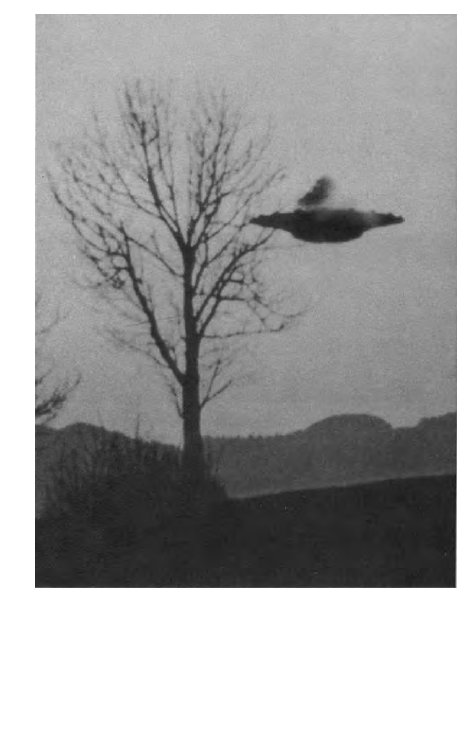
Called “the sunlight scene”, this photograph, taken March 29, 1976, at
Hasenbol, was the last in a sequence of nine that Meier took as the
beamship approached from the west. The Hasenbol site, with its rad-
ical weather and steep drop behind the tree, impressed the investi-
gators more than any other.
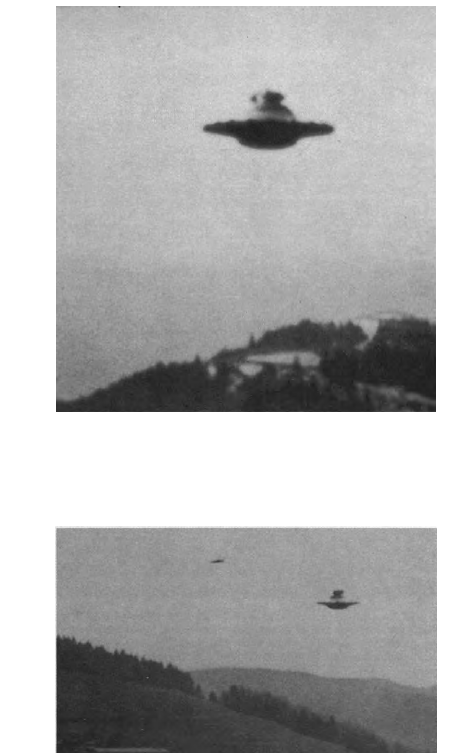
Mount Auruti stands in the background to the south of Hasenbol. In
Meier’s 8mm film of this same scene a Japanese production crew no-
ticed the sudden brightening of a red light on the ship’s flange just
above the two red lights that appear here on the bottom of the ship.
A jet fighter on maneuvers with the Swiss Air Force flew into the scene
as Meier took this photograph near Schmarduel April 14, 1976.
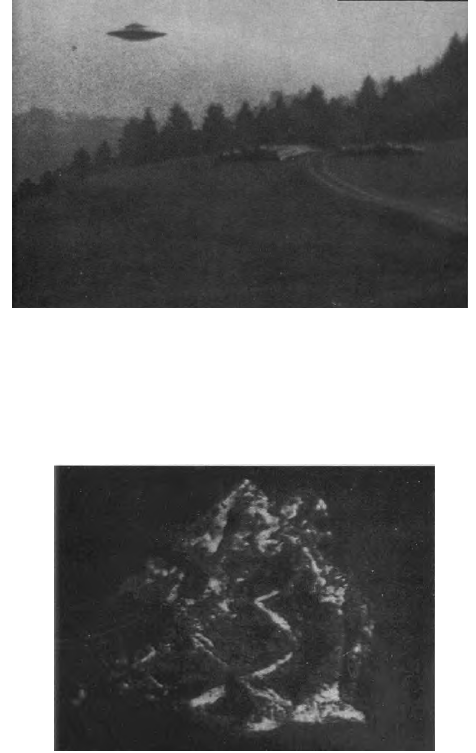
Physicist Neil Davis of Design Technology in Poway, California,
examined this photograph taken August 3, 1975. Three years later, just
beyond the stacks of debarked pine, Meier recorded the beamship
sounds analyzed by Los Angeles sound engineers Nils Rognerud and
Steve Ambrose.
The metal fragment, which represented one of the final stages in the
manufacture of the material for the beamship hull, glistens under
Marcel Vogel’s electron microscope at IBM. The unique sample disap-
peared while in Vogel’s lab.
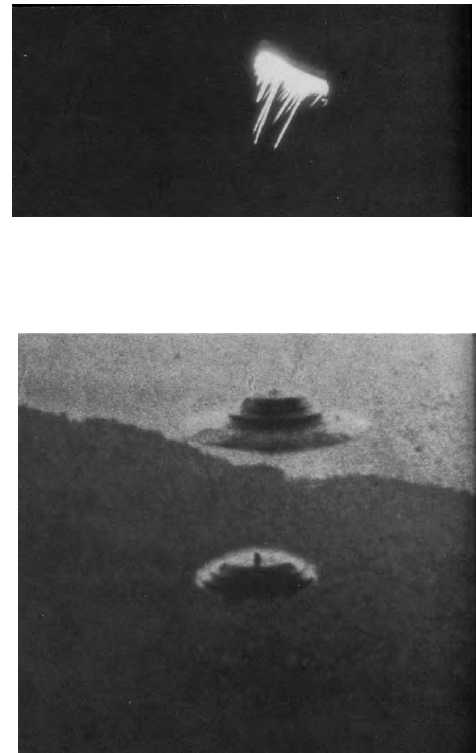
The photograph taken by Austrian schoolteacher Guido Moosbrugger
one night while on a contact with Meier June 13, 1976.
Taken March 3, 1975, this is the first in a sequence of photographs of a
beamship and an accompanying remote-controlled craft; one of the
photos in this series appeared on the cover of Europe’s newsweekly
Der Spiegel November 17, 1978.

L I G H T Y E A R S
“Colonel Stevens once told me that sometimes when
you came back you were out of breath”. said Lee. “Is that
true?”
“It’s because of the atmosphere we have here”, ex-
plained Meier, “and the atmosphere they have there. They
have thirty-two percent oxygen. It is better and lighter
breathing”.
“The air on board the ship?”
“Yes. Just imagine you are somewhere out in the
countryside and then you have to go to the city. And this is
very fast, practically a split second from one place to the
other”.
“Is there anything you’ve been told not to discuss?”
asked Lee.
“Mainly things that concern the future”, said Meier.
“Also not to talk too much about the teachings, because
man has to think for himself to find out the truth”.
* * *
“A lot of what he said had to be taken with a grain of
salt”, Elders said later. “It was hard to conceive of. But yet
everything made such logical sense. I think what I focused
on was the delivery of what he was saying. Was he emo-
tional? Was he blase? He was just sitting there as if he were
talking about going down to the corner to get a loaf of
bread—which made it all appear real; made it very believ-
able.
“Basically he made you stop and think, Why shouldn’t
they be like us? Why should they be any different as far as
family life or education? And if they’re two or three thou-
sand years more technologically advanced than us, then
sure it would make sense that they carried little devices on
their belts that could translate languages instantly. I had
to go back to that one phrase he kept saying. ‘They’re no
different than we are’.”
Meier talked on about civilizations that lived in har-
107

G A R Y K I N D E R
mony in the universe and traveled faster than light, about
life on Erra and the androids and the spiritual leaders
there, about his childhood experiences with Sfath. People
came from all over Europe to hear him speak of these
things. Lee Elders listened closely to everything Meier
said, searching for inconsistency. Not once did Meier con-
tradict himself, nor did he preach or try to sell them
merchandise. Though they offered nothing in the way of
objective proof, Meier’s answers to their questions came
patiently and logically.
Unobtrusively, in their comings and goings, in their
conversations with witnesses, the Elders and Stevens ex-
plored the farm, the main house and barn, the outbuild-
ings, and the nearby woods, searching for a darkroom, a
machine shop, or unusual rigging or equipment. Every-
thing about the farm seemed old and crude, a cover per-
haps, but basic necessities for pulling off such a sophisti-
cated show would require at least electricity, and other
than the thin wire lighting a few bulbs in the kitchen and
living areas, no power lines came to the house or anywhere
else on the farm. But Lee Elders kept looking, finally
narrowing his search to four closed rooms.
“One was under the old carriage house where Jakobus
slept; there’s a room down there. That intrigued me. An-
other was a storage place to the side of the carriage house.
The third area that intrigued me was the basement to the
house itself. And the fourth area was Meier’s office. I kept
wondering, What’s in there?”
One afternoon, under the pretense of an urgent need to
speak with Jakobus, Elders engineered a stunt Stevens
would never have tried on his own. He dragged Stevens
down the steps leading to Jakobus’ room beneath the
carriage house. “We knocked on the door and sort of invited
ourselves in”, recalled Elders. Immediately, before Jakobus
could rise, they combed the room and started babbling in
English about farming and the weather and whatever else
came to their minds, none of which Jakobus understood.
Before he could respond, they had satisfied themselves that
108

L I G H T Y E A R S
Jakobus and his room were clean. Then they started
laughing and shook his hand.
“Danke, danke schön
!”
“Very Spartan conditions”, said Elders, “nothing ab-
normal.
“The second area I got into was the equipment room.
This was the side of the carriage house facing the farm-
house, and there was nothing in there except saws and hoes
and grass cutters and things like this, a lot of equipment
they used around the farm.
“And then finally we got into the basement under the
house itself. We just went down one day. It was very easy;
you come out the back stairs there, down the concrete steps,
and turn to your right and come down the other steps. The
door was unlocked. We didn’t make it obvious that we were
skulking or anything like that; we just walked to the door
and opened it. ‘Ah, wonder what’s in here, let’s see how they
store their food’, or whatever, walked in, and checked it out.
They used it for storing their cabbage and carrots and
things like that. There was nothing down there. So except
for his office we had totally explored everything that we
could see which might be a hiding place for something”.
Brit found herself in the office and the room adjacent
when Elsi Moser, an English-speaking schoolteacher, took
her back to show her some contact notes and 11 × 14 blow-
ups of the photographs. But there was little to see—a few
books, an old typewriter, an old desk with no drawers, two
lamps, and a small cactus garden. “Nothing odd”, wrote
Brit in her diary. She even had the Meier children show her
parts of the farm, including their rooms.
“We’ve seen nothing strange”, Brit recorded after a few
days at the farm. “Lee is in a quandary. It’s hard not to like
Billy and the others. We must remain objective. After all
the evidence that’s been presented—not analyzed, pre-
sented—Lee still questions all. Steve has no objectivity left,
just wants more and more and more. I’m on overload”.
Stevens and Elders also got into Meier’s office after
Stevens asked Meier about the sound made by the beam-
ships. Stevens had overheard someone at the farm talking
109

G A R Y K I N D E R
about the sounds, but neither he nor Elders knew a tape
existed. Meier surprised them by offering to take them back
to his study and play the recording for them. Elders turned
on his own tape recorder to capture the eerie, warbling, at
times piercing sound that, as far as he knew, could have
been produced with a synthesizer. But the tape was nothing
they could have analyzed back in the States.
“We were in one of those little crannies there next to
his office”, said Elders, “and there were chickens all
through the damned place, and he was playing the sound
and we were recording chickens clucking, roosters squawk-
ing, and the beamship purring. And it was a total disaster.
When we got back it sounded like we were in a henhouse.
So we had to retape them later”.
After a few days of circulating around the farm and
finding nothing suspicious, the only discovery that shocked
Lee Elders was how Meier had his evidence organized.
“He kept everything in the closet and stuffed under
drawers, in between mattresses. It was unbelievable. And
that first year at the farm there were no doors to close off,
just a little curtain between the living area and the area
they slept in. People walked through there all the time. He
used to keep these beautiful photographs in shoe boxes
under his bed!” Several hundred photographs had disap-
peared.
* * *
Among the witnesses with whom the Elders spoke was
Herbert Runkel, who told them of the first time he went on
a contact with Meier, not the night of the dense fog, but an
earlier night. Jakobus drove that night too. When Meier
disappeared into the woods, it had been raining, there were
puddles on the road, and the trees swayed in the wind. An
hour passed as the two men sat in the car at the edge of the
forest and talked, or walked back and forth to keep warm.
They never saw any lights.
“Nothing”, Herbert said to the Elders. “No animal, no
110

L I G H T Y E A R S
light, no car, nothing. No sounds, no house, no nothing.
Only the wind blowing”.
After an hour and twenty minutes, Meier had re-
turned.
“I remember when Billy came back”, said Herbert. “I
put my hand on his shoulder, ‘Hello, you are back’, and I
saw his clothes were completely dry. I shook his hand. He
was warm”.
Lee Elders was certain this was merely a trick of some
sort. He questioned Herbert. Could Meier have had a
shelter in the woods, a small fire going, turned his coat
inside out?
“No”, said Herbert, “that’s impossible because we were
always looking around. We looked up at the sky and lis-
tened carefully because we wanted to see something or hear
something, maybe when the ship rose up”.
One thing that struck the Elders about Herbert was
the confusion on his face when he recounted his experiences
with Meier. The man obviously was intelligent and well
read, yet he seemed totally perplexed by what he had seen.
Often he would end a story by saying, “I am not crazy. I saw
that with my own eyes”.
Elsi Moser taught school in a nearby canton. A warm
and intelligent woman of fifty who had lived for two years
in England and spoke excellent English, Elsi told the
Elders, “If Billy really had contact every time he said he
did, I don’t know. But he has had contact with extraterres-
trials. I am certain of this”.
One of the little things that had convinced Elsi that the
contacts were taking place was a film Meier had shot with
his movie camera on a tripod. In the clip, what appears to
be a beamship hovers at some distance. Meier himself
suddenly comes into the film from the right, the left sleeve
of his old green sweater dangling as he walks away from
the camera down a path. Then he stops and, with his right
hand, beckons the ship to come closer. But the ship remains
in the distance. Meier squats on his haunches, waiting for a
111

G A R Y K I N D E R
minute or two watching the sky. Once, he looks at the
camera and points to the ship, which still moves no closer.
Finally, he shrugs, and with a look of disappointment
walks back toward the tripod, as the ship still hovers high
in the distance. Elsi told the Elders they would have to
know German and the Swiss-German people to understand
this, because the disappointment on Meier’s face when the
ship does not come closer is genuine.
Many witnesses had seen strange lights in the sky,
perfectly silent lights, sometimes white, sometimes red and
yellow and orange, often in twos, and flying crazy patterns.
Even more of the witnesses had seen Meier himself do
unexplainable things. Harold Proch told the Elders about
New Year’s Eve 1977, a night when Meier and about ten
other people had been sitting around the kitchen table
talking. Harold had asked Meier a question about parapsy-
chology, but Meier did not answer directly.
“He asked if I had a two-franc piece”, recalled Harold.
“I didn’t have one, so Elsi gave one to me. Billy took it and
told me to hold his hand. I sat on the opposite side from
him”.
Meier wrapped his fingers around the two-franc piece,
a coin the size of an American half-dollar. Harold cupped
his hands around Meier’s fist. Meier looked at the fist and
suddenly his whole body began to tremble. The table shook,
as did Meier’s chair. Several people found themselves sud-
denly fearing the power that had been unleashed. Harold
held on to the shaking fist, but when he looked up at
Meier’s eyes, what he saw there startled him.
“This is hard to describe”, he said later. “It was as if you
were looking into space through his eyes”.
For fifteen seconds Meier shook violently as though the
coin in his fist controlled him. His eyes grew larger and
larger, deeper and deeper, his face now contorted and
drained of all blood.
“Then he collapsed at the table”, said Harold, “his hand
opened and the coin fell out. It was black. All the people
stood up, Billy was gasping, as if he were dead. It
was
112

L I G H T Y E A R S
phenomenal. And I sat face-to-face with him. I could see the
reaction on his face. I have never seen anything like it. You
can’t describe this with words”.
The hot coin had singed the palm of Meier’s hand,
causing a blister. When Harold had the coin analyzed, a
metallurgist told him that to scorch such metal would
require a heat of 1,500 degrees.
* * *
Another evening the Elders and Stevens sat again in
the kitchen listening to similar stories from people who had
seen Meier do things no one could explain. Meier had done
so many things no one could explain that the stories had
begun to sound the same to the Elders. Some people had
seen him hold a twenty-centime piece between his thumb
and index finger, and etch his fingerprints into the metal.
Elsi had once seen him take a nail two to three inches long,
stand it on its head on the kitchen table, then cup his hand
on the table about eight inches away. In a moment, as
though drawn by some irresistible force, the nail had
started to dance across the table and vibrated upright all
the way into Meier’s motionless hand.
“When did you realize you had this power?” Brit asked
Meier.
“When I was a small boy”, said Meier. “I started to
learn new thinking”.
“For this power of the mind”, suggested Lee, “could you
use the word ‘magic’?”
“You see”, said Meier, “magic is a word that means only
‘
using
the power’. Nothing else. Only ‘power using’.”
“And when did you discover you had magic in your
life?” Lee repeated Brit’s question.
“When I was a small boy”.
“What did you do?”
“I was taught by Sfath”, said Meier. “He told me how to
use everything, how to study to learn”.
“Could you make things move”, asked Lee, “or put out a
candle by thinking about it?”
113

G A R Y K I N D E R
“I was never testing”, answered Meier. “I don’t know”.
And then he told them a brief story. When he was six
years old and weighed only fifty-five pounds, his father was
constructing a small addition to their house and had asked
the young boy to wheel a cart filled with dirt out of a deep
hole he had dug under a portion of the house. The cart
weighed two or three times as much as Meier at that young
age. But by “using the power”, he told the Elders, he was
able to lift the cart with his thoughts and transport it out of
the hole.
Among the favorite stories told by witnesses who had
seen Meier do unexplainable things was the time during a
discussion he had melted a thick metal spoon in his bare
hand. Meier had been stirring his coffee when, to empha-
size a point, he raised the spoon out of the coffee and shook
it. The raised spoon suddenly had turned to a silver liquid
in his hand and dripped onto the table. Several people had
seen this.
As he listened to this story, Stevens said, “Man, why
didn’t you save the liquid?” Nobody had thought to do that.
With the liquid in small puddles on the table, someone had
simply wiped it up with a damp cloth. But the story got
Stevens thinking out loud. “God”, he said, “what we could
do with a piece of metal”.
When Stevens said that, Meier stood up from the table
and said, “Just a minute”.
He walked out of the kitchen and they heard his
footsteps heading out to the barn.
“He came back with this dilapidated, dirty, filthy card-
board box”, remembered Lee. “And he put it on the kitchen
table. Inside he had brown wrapping paper, and he started
opening it. All of us were just hanging over his shoulder”.
“I asked them to give me a piece of the beamship”, said
Meier, “but all they brought me were some metal samples”.
Lee Elders stood quickly and took two pictures, one of
Brit helping Meier open the box, and another of Brit and
Stevens peering into the box. Inside lay several small
packages of brown wrapping paper, and in each package,
114

L I G H T Y E A R S
carefully wrapped, was a sample that Meier claimed had
been given to him by the Pleiadians.
“We were in the kitchen there”, remembered Elders,
“and Meier had just shown us the metal. Bashenko was
running amuck, slamming things against the wall, yelling,
trying to get attention. On top of that, a chimney sweep was
there cleaning the chimney. But we had the microphone
close to Meier, you can hear what he’s saying, and it was
real interesting because he said one thing and that was
that this metal is used to make the ship”.
Meier started to unwrap the little packages, and one
after another out came a small rock specimen, or a crystal,
or a shiny fragment of metal.
“They told me that the metal is in four states”, said
Meier. “Here are the notes I made”.
In each cubicle, brown and somewhat faded, lay small
pieces of paper, Meier’s handwritten notes on each of the
specimens, describing briefly what each was and from
where it came. According to the notes, one of the samples he
unwrapped represented the next-to-the-final stage in a
seven-step process the Pleiadians used to make the metal
substance that comprised the hull of the beamships. On the
table glistened a half-inch triangle appearing to be an alloy
containing silver and gold.
Stevens had always told the Elders that pictures could
be faked, but one thing that could never be faked was a
piece of metal exhibiting unusual, possibly unearthly prop-
erties. However, this solid kind of evidence rarely accompa-
nied UFO cases. In all of Stevens’ experience such an
intriguing piece of evidence had arisen perhaps twice. Yet
Meier had been sitting on these specimens for over three
years, and he had made no attempt whatsoever to use them
to sell his story to Stevens, to “prove” he was telling the
truth. Stevens had to ask about them specifically. And this
was his second trip to see Meier. Again, Stevens learned
that with Meier he had to ask the question or he would
never get an answer.
Meier gave several metal and crystal samples to
115

G A R Y K I N D E R
Stevens and the Elders to have them analyzed back in the
United States if they desired. Now nearing the end of their
five days in Switzerland, they had many signed witness
statements and several items that could be tested in a
laboratory by a scientist—photographs, metal samples,
sound recordings, and movie footage.
“It’s overkill for us by this time”, remembered Elders.
“We’ve just heard sounds, we’ve heard all these stories, now
he’s showing us metal. It’s just flat overkill. Steve had been
there the year before and he had no idea . . . none of us had
any idea . . . that Meier had metal specimens, or sounds, or
the numerous photographs he had”.
At the conclusion of their stay, Stevens seemed even
more overwhelmed than he had upon completing his first
trip to the farm.
“It just got to the point where one man couldn’t have
done so much so well to fool so many people for so long”, he
said. “Just too much for one person to accomplish. Having
tried to do a number of these things myself I realized what
was involved in faking a simple picture of a suspended
object in the sky. To fake all of the types and kinds of
pictures successfully and not be caught, with no confeder-
ates, no resources, no equipment, no money, no lab, and a
broken camera and one arm, makes it a little bit difficult to
believe that the whole thing is a fabrication and a fraud
perpetrated by somebody for some reason when there
wasn’t even an apparent reason”.
Because of his obvious intelligence and sincerity, the
great deal of time he had spent observing Meier, and the
resulting confusion in his mind, perhaps the most convinc-
ing witness had been Herbert Runkel. Herbert warned the
Elders and Stevens that people who had seen only a few of
Meier’s pictures and then concluded that the object had to
be a model and that the case therefore had to be a hoax, just
did not understand the reality of the setting in which the
story was taking place.
“These thoughts always come from people who know
nothing about the case”, said Herbert. “They hear about the
116

L I G H T Y E A R S
case, or they see only one or two pictures. They never go to
the place where the pictures were taken. Because people
who have seen the places always say, That is not possible’.”
Though a shallow crust of snow remained in large
patches on the ground, the Elders finally walked one of the
sites, the high green bluff at Hasenbol. As he stood on top of
the bluff Lee Elders thought about what Herbert had said.
“My moment of truth did not come until I walked that site”,
he said later. “I went up to that hilltop where he shot, I’d
say, thirty percent of the best photographs of his collection
plus that film, and I knew right then and there something
was going on—because of the distance involved, because of
the terrain, everything about it. We marked fifty-two yards
from where Meier stood to the tree the ship was hovering
behind. That’s a long distance. You’re not going to use small
models on that”.
“And there’s a drop right behind that tree”, added Brit.
“It just goes straight down”.
“And it’s always cold there”, continued Lee, “wind’s
always blowing, cold and miserable. Yet he got movie
footage on that site and photographs on that site. So that’s
when I started thinking, Okay, so he didn’t take them with
models, and they are not pasteups. So what are they?”
117

PART
II
THE INVESTIGATION

S E V E N
On the clear blue afternoon of June 24, 1947, along the
high, snow-covered ridges of Mount Rainier, Washington, a
bolt of bright light hit a small mountain plane flown by
Kenneth Arnold so suddenly that Arnold thought he was
about to collide with another plane. Instead, he spied a
formation of nine luminescent objects, bright enough to be
seen a hundred miles away, skimming the mountaintops at
extraordinary speed. Arnold thought he was watching a
test flight of new and secret jet planes, but as they came
closer he could see no tails on any of the craft.
The strange objects closed at right angles to Arnold’s
plane, flying like nothing he had ever seen: The echelon
formed a pinnacle with the lead craft at the top, the others
trailing behind and below, the reverse of military air for-
mations. And their flight was erratic. As Arnold wrote later
in his book,
The Coming of the Saucers
, “It was like speed
boats on rough water or similar to the tail of a Chinese kite
that I once saw blowing in the wind”. The craft fascinated
him with the way they “fluttered and sailed, tipping their
121

G A R Y K I N D E R
wings alternately and emitting those very bright blue-
white flashes from their surfaces”.*
When Arnold landed in Pendleton, Oregon, he at-
tempted to locate a representative of the Federal Bureau of
Investigation, but was unsuccessful. Instead, he talked to
other pilots at the airport about what he had seen; then
local reporters heard of the sighting, and within two days
Arnold’s story had hit 150 newspapers; He told the press
the craft flew “like a saucer would if you skipped it across
the water”, prompting one reporter to coin the term “flying
saucer”.
In the midst of a cold war with the Soviet Union,
intelligence analysts in the United States suspected the
Communists of conceiving ingenious and extravagant plots
to spread their propaganda, even among the American
populace. When the story of Arnold’s sighting appeared in
print, his politics, finances, business, and reputation in the
community were investigated by Military Intelligence, the
FBI, the Central Intelligence Agency, and the Internal
Revenue Service, each hoping to discover that Arnold was
unstable, publicity-conscious, given to exaggeration, or
linked to the Communist Party. But not only was Arnold
considered an excellent mountain pilot with a cool head,
calm hand, and 20/15 vision, his general reputation in the
community and as a family man was impeccable.
Then other reputable citizens, many of them pilots,
reported strange aircraft penetrating hundreds of miles
inland from the West Coast, aircraft that appeared super-
* Arnold timed the lead craft from the southern edge of Mount
Rainier all the way to Mount Adams, a distance of 39.8 miles, which the
disk flew in one minute and forty-two seconds. In the summer of 1947,
the fastest experimental aircraft on earth was thought to be the U.S.
Army’s X-1, developed by Bell Aircraft Corporation. A bullet-shaped
fuselage with a rocket engine, the X-1 was powered to exceed the speed
of sound, 760 miles an hour, but no pilot had yet been able to fly it that
fast. Chuck Yeager would not break the sound barrier in the X-l for
another four months. Yet Arnold’s figures, trimmed conservatively, had
the shiny metallic disks traveling almost Mach 2, or twice the speed of
sound.
122

L I G H T Y E A R S
sonic, sophisticated, and unconventionally designed. News-
papers reported each of the new sightings, and the public
wanted to know what they were.
Hallucination, said the Air Force. There was no need
for an investigation into the presence of these flying sau-
cers because all of the sightings were due to hallucination.
Secretly, they wondered if perhaps Communist sympa-
thizers, attempting to frighten the American public, had
reported bogus sightings to increase cold war jitters. Or
was the intention to get the Air Force so soft on responding
to myriad reports of lights in the night sky that waves of
Soviet bombers could penetrate our air defenses unchal-
lenged?
But then their own pilots, navigators, generals, and
advanced radar detectors began reporting strange flying
craft that could stop on a dime, hover, ascend and descend
in a straight line, turn at right angles, make no noise, and
then take off at speeds into the thousands of miles an hour.
If it was the Soviets, why had no bombs been dropped, no
missiles been deployed, or overt strategic action taken by
these craft? They would simply appear at all times of the
day and night, in all parts of the country, dazzle their
onlookers with their incredible speed and maneuverability,
and then disappear. No one considered what later came to
be known as the extraterrestrial hypothesis, the possibility
that such technology might originate on worlds trillions of
miles into our galaxy or even beyond.
* * *
During World War II, American and British pilots had
reported seeing strange objects that flew at fantastic speeds
and glowed from orange to red and white, and back to
orange again. They named them “foo fighters”. One pilot
saw fifteen of them during the day, describing them as five-
foot golden spheres that shone with a metallic glitter. Near
Truk Lagoon in Japan, B-29 bomber crews reported the
balls came up from below their cockpits, hovered over their
tails, winked their lights from red to orange, then back to
123

G A R Y K I N D E R
red, then to white. One pilot said they glowed with an eerie
red phosphorescence and had no wings, fins, or fuselage.
Allied fighter pilots thought they were secret German
experimental devices designed to cause fear and confusion.
Intelligence officers figured they were radio-controlled ob-
jects launched to baffle radar. The Germans and Japanese
thought they were secret weapons launched by the Allies.
Scientists in New York surmised everyone had been seeing
“Saint Elmo’s lights”, small balls of luminescence often
connected with metal during electrical storms. The Army
Air Forces dismissed the whole episode as a result of “war
nerves” and “mass hallucination”.
The summer before Arnold’s sighting, hundreds of
people in Scandinavia had watched flights of “ghost rock-
ets” in the night sky, speeding balls of light that resembled
meteors but behaved in what was described as “unmeteor-
like fashion”. American intelligence suspected the source
might be Russian experiments at the captured German
missile center at Peenemünde, but no evidence existed, and
eventually the ghost rockets ceased flying without offering
a clue as to what they were or from where they came.
But in 1947, Arnold’s sighting captured the world’s
imagination. Only three months later, such sightings had
become so frequent that General Nathan Twining, head of
Air Materiel Command, wrote a letter to the commanding
general of the Air Force that concluded: “The phenomenon
reported is something real and not visionary or fictitious.
. . . The reported operating characteristics such as extreme
rates of climb, maneuverability (particularly in roll), and
action which must be considered evasive when sighted or
contacted by friendly aircraft and radar, lend belief to the
possibility that some of the objects are controlled either
manually, automatically or remotely”.
Quickly and quietly, the Air Force established Project
Sign, which began officially two weeks after an F-51 fighter
pilot, Thomas Mantell, died chasing a UFO near Louisville,
Kentucky. Mantell’s last words were: “It’s metallic and it’s
tremendous in size. Now it’s starting to climb”. A few
124

L I G H T Y E A R S
seconds later: “It’s above me and I’m gaining on it. I’m
going to 20,000 feet”. It was not yet three o’clock in the
afternoon. Mantell was not heard from again; an hour later
the tower lost sight of the UFO and learned that Mantell’s
F-51 had crashed.
Before the wreckage had cooled, the Air Force offered a
solution that seemed to satisfy press and public alike—
Venus. For thirty minutes, Mantell had chased the planet,
even climbing without oxygen beyond the point of blackout,
to get a better look at Venus. He had died in pursuit of a
planet millions of miles away. Though Venus indeed would
become the solution to many of the sightings, on that day,
at three o’clock in the afternoon over the state of Kentucky,
Venus was a pinpoint of light so faint it could not be seen by
the human eye. Even the secret report filed by Project Sign
investigators concluded: “The mysterious object which the
flyer chased to his death was first identified as the Planet
Venus. However, further probing showed the elevation and
azimuth readings of Venus and that object at specified time
intervals did not coincide. It is still considered ‘Unidenti-
fied’.”
Project Sign drew only high-level intelligence special-
ists, and period correspondence reveals that amid a great
deal of confusion bordering on panic, they developed two
categories of theory: earthly and non-earthly. In the
earthly category, the Russians outdistanced our own Navy,
which earlier had been conducting secret experiments with
the XF-5-U-1, a circular craft nicknamed the Flying Flap-
jack. In the non-earthly, “space animals” placed second
behind interplanetary craft.
Since the second theory was impossible to test, intelli-
gence analysts sought initially to determine if captured
German rocket and missile testing centers, now in Soviet
hands, had produced these sophisticated aircraft. German
aeronautical engineers had been developing several radical
designs, and an intelligence rumor held that the Russians
were continuing the experiments. Intelligence analysts
studied every intelligence report dealing with German
125

G A R Y K I N D E R
aeronautical research and computed the maximum per-
formance that could be expected from the German designs.
They even contacted the German engineers themselves.
“Could the Russians develop a flying saucer from these
designs?” they asked. The answer was that no aircraft could
perform the reported maneuvers of the flying saucers. Such
maneuvers and fantastic speeds would either tear apart or
melt all aerodynamic materials known on earth. Even if
such an aircraft could be built, the human body would not
survive at the controls.
One strange sighting after another continued to baffle
the Air Force. From 1948 into 1951 “green fireballs” flew
over the supersensitive Atomic Energy Commission instal-
lation at Los Alamos, traveling an estimated maximum
speed of 27,000 miles an hour. Dozens of scientists, Air
Force special agents, airline pilots, military pilots, and Los
Alamos security inspectors submitted over two hundred
reports of seeing the objects—huge half moons, circles, and
disks flying at extreme velocities and emitting a green light
so bright it caused the contours of surrounding mountains
to glow momentarily at night. Some of the witnesses re-
ported watching flat, disk-shaped objects traveling at
equally high speeds and varying in color from brilliant
white to amber, red, and green.
A private pilot flying one night north of Santa Fe
encountered one of the fireballs and described it this way:
“Take a softball and paint it with some kind of fluorescent
paint that will glow a bright green in the dark. Then have
someone take the ball out about a hundred feet in front of
you and about ten feet above you. Have him throw the ball
right at your face, as hard as he can throw it. That’s what a
green fireball looks like”.
The Air Force hired Dr. Lincoln LaPaz, an expert on
meteors, to solve the mystery, but LaPaz concluded the
phenomena were not of meteoric origin. He thought the
fireballs were guided missiles being secretly tested nearby.
But the military and the FBI knew that no such secret
experiments were under way in this country, and they had
126

L I G H T Y E A R S
now been assured that the Russians were also incapable of
conducting such experiments.
In January 1949 a cable sent from the San Antonio
field office to FBI Director J. Edgar Hoover noted that at
weekly conferences involving military intelligence the
main topic was “the matter of ‘Unidentified Aircraft’ or
‘Unidentified Aerial Phenomena, ’ otherwise known as ‘Fly-
ing Discs’, ‘Flying Saucers’, and ‘Balls of Fire’.
This matter
is considered top secret by Intelligence Officers of both the
Army and the Air Forces
[emphasis in original]”.
Publicly, the Air Force maintained that flying saucers
were nothing more than the sun reflecting off low-hanging
clouds, or crystals from shattered meteors glinting in the
sun’s rays, or gigantic hailstones gliding through the atmo-
sphere. But their intelligence analysts began to focus seri-
ously on the possibility of extraterrestrial origin.
In 1951 several reputable scientists speculated that the
green fireballs over Los Alamos were unmanned test vehi-
cles projected into our atmosphere from a “spaceship” sev-
eral hundred miles above earth. About this time, three
White Sands scientists with a telescope, stopwatch, and
clipboard tracked a flat, oval-shaped object a hundred feet
in length and whitish silver in color flying at an altitude of
296,000 feet and a speed of 25,200 miles an hour. One of the
scientists, a naval commander, later wrote in an article
cleared by the Navy, “I am convinced that it was a flying
saucer, and further, that these disks are spaceships from
another planet, operated by animate, intelligent beings”.
When an airline captain and his co-pilot sighted “a
deep blue glow” along the underside of what looked like a
wingless B-29 fuselage that came within 700 feet of their
DC-3, intelligence analysts at Project Sign decided it was
time to write an “Estimate of the Situation”. The top-secret
“Estimate” concluded that from all evidence collected, the
presence of the mysterious flying objects could best be
explained by visitations from advanced extraterrestrial
societies. And this hypothesis might have formed the basis
for all future UFO research if Air Force Chief of Staff
127

G A R Y K I N D E R
General Hoyt S. Vandenberg hadn’t adamantly refused to
accept it. Instead, he fired the document back to Air Intelli-
gence, where it was quickly declassified and burned, en-
couraging Sign personnel still bucking for promotion to
drop their original hypothesis for an official new one: UFOs
don’t exist.
* * *
Performing most of their security work late at night
when corporate offices lay deserted, the Elders and Welch
had become night people who functioned best in the early
hours of the morning; Stevens could go either way, as long
as he had a breakfast of sausage, eggs, and pancakes after
midnight. When the Elders returned from Switzerland, the
four of them spent hours in all-night coffee shops, eating
breakfast or pie, drinking coffee or iced tea, and collectively
scratching their heads over Meier. At 1 or 2 a.m. they
might drive to Good’s on Camelback Road or Carrow’s on
Thomas, tell the waitress, “We’ll have iced tea, and leave us
alone”, then retire to a corner booth in the back of the
restaurant to argue over Meier for the next two hours. “We
became connoisseurs of iced tea”, said Welch.
Between bites of breakfast and sips of coffee, Stevens
would shake his head. Sometimes he would even jump up
and pace excitedly back and forth next to the booth, admit-
ting openly he had lost all objectivity in the case. “I don’t
understand a lot of things about this”, he would tell the
others. “But I am convinced that something strange hap-
pened, and I am convinced that Meier could not fake the
pictures, and I don’t think there’s anybody around him that
could”.
After one of the late-night sessions, Brit wrote in her
diary, “Steve excited about stuff from Billy. Thinks we’ve
got a ‘real one’. Lee still skeptical, calling in favors, hopes to
find good qualified people for analysis. Initial budget
$10,000 set aside. Plan trip to L.A., try to dig into universi-
ties there, maybe turn in interesting stone”.
128

L I G H T Y E A R S
Later Brit admitted she pushed Lee hard to get in-
volved in the Meier investigation. “He was reluctant. Deep
down inside he liked Meier, they hit it off. But with Inter-
cep and everything that was happening, it was hard to let
go and start off in a new direction. But Lee’s a very curious
person, and this had too much to offer. He sat down and
said, ‘How did he create this hoax?’ Steve was already
committed, Lee was the balance”.
Stevens’ only concern was that Meier might have
almost too much evidence. And the number of contacts
Meier claimed, like the clarity of his photographs, made his
story seem even more suspect.
“The conventional idea of a contact is a quick happen-
stance, a onetime experience that passes, doesn’t come
back”, Stevens explained to the others. “When the second
contact occurs it reduces in the minds of UFO buffs the
credibility factor. It’s kind of a ‘lightning doesn’t strike
twice in the same place’ syndrome. When it happens a third
time, credibility is reduced even further. This happened
over a hundred times”.
Lee Elders retained his skepticism, challenging
Stevens again and again, for no matter what the witnesses
had said, he had difficulty understanding certain things,
like Meier’s sudden disappearances and just as sudden
reappearances. He thought the man had somehow merely
persuaded the others to imagine he had vanished: “I can’t
buy that somebody can be standing in his office and have all
his molecules broken down into a beam of light or whatever
and transferred two miles away to another locale. I just
cannot conceive of this”.
Then he would argue with himself in front of the
others, as if he were alone. “But we have so much support-
ive evidence documenting other things that we can’t say,
‘Well, if they say this crazy thing is happening, then the
whole thing has to be a hoax’.
“But, my God”, he would argue again, “if this thing
is
legitimate, how do we logically explain Meier being dema-
terialized?”
129

G A R Y K I N D E R
Then they would spend two and a half hours trying to
comprehend how he disappeared.
“Did he really disappear?” they wondered.
“Our comfort level”, said Elders, “was dealing with
solid, tangible evidence. But there’s another level here that
just taxes the imagination. You can’t say that the case is a
hoax because it contains this level, any more than you can
leave it out and say the case is real. But it’s unexplainable”.
The arguments over Meier got longer and became more
frequent, involved more restaurants, more sausage, eggs,
and hot pie, more coffee and iced tea. As Stevens had
predicted, Meier and his story had gone right to the core of
the Elders’ curiosity, challenging their considerable inves-
tigative skills. Once recalling the many late-night conver-
sations, Lee Elders said, “It wasn’t so much, ‘Do you think
Meier is telling the truth?’ We were way beyond that. It was
the mystery that was driving us crazy, these little things
that didn’t make sense”.
The brief side trip they had taken to Switzerland
reluctantly, and only as a favor to a friend, had piqued their
interest and at the same time failed to yield an explanation
for the bizarre story. But in addition to their own impres-
sions, they now held several items of hard evidence. They
could argue forever over imponderables, but proper analy-
sis of the evidence would give them answers.
“So we went directly for the hard stuff”, remembered
Brit. “We worked with the photographs, the metals, the
sounds, everything like that. We went in looking for how he
did it, because we didn’t believe it was real”.
* * *
At the Elders’ apartment in Phoenix and on Stevens’
dining room table in Tucson sat several stacks of paper,
film, and other evidence waiting to be examined—rough
notes taken at a few of the sites, the interviews and signed
statements of many witnesses, hundreds of translated
pages of the contact notes, taped interviews with Meier,
over two hundred photographs, pictures of landing tracks,
130

L I G H T Y E A R S
metal and crystal samples, and seven 8mm films. The
Elders and Stevens labeled every piece, catalogued it, then
combed through it all, searching for clues and inconsisten-
cies. In thirty-two years of studying UFOs, there was little
about them Stevens did not know, and he had never heard
of a case with so much evidence.
“It’s a lot of work”, said Welch. “You have to sit down
and analyze it. Not study, not read—analyze. Do we have
any correlations here? Find them all and list them, poten-
tial or otherwise. Do we have any contradictions? Find
them all and list them. Everything. We had to develop an
attack plan. So on a daily basis we were jamming on our
notes, getting together on the things that Lee and Brit had
learned from their first trip, and that Steve had brought
back, correlating data, and planning our next trip in July,
which was to be my first trip there”.
With computer theft occurring more and more fre-
quently, and the reputation of Intercep growing apace, the
Phoenix-based security firm continued to expand. But the
Elders and Welch also spent more and more time on the
Meier case. Between conducting communications sweeps
for various corporate clients, they met frequently with
Stevens to analyze the data they had collected and to plot a
course on how to proceed. At the beginning they had
initiated a rapidly expanding list of questions to be an-
swered; the next step was to pin down a precise, acceptable
method for determining the authenticity of photographs.
“The photographs in a sense were too real”, remem-
bered Welch. “They were so clear and so stark, it was as if a
craft was in the air over your driveway and you walked
outside and took a picture of it. They were that vivid”.
Stevens already had examined the photographs
closely, looking for missing or misplaced shadows. The only
additional test they could think to perform was to blow up a
photo into the largest format possible, then search it care-
fully with a microscope for inconsistencies in the grain.
Such inconsistencies would indicate that Meier had placed
the craft in a scene either by exposing the same piece of film
131

G A R Y K I N D E R
twice or by superimposing two separate pieces of film to
create a single picture. Either way the grain would appear
thickened around the craft. But when they blew up the film
and examined the grain, they found nothing.
Stevens continued his work, begun a year earlier, of
cataloguing the photographs according to site. In the proc-
ess he discovered that, as with the Hasenbol series, nearly
every picture Meier had taken was part of a
sequence,
with
the flight path uniform from picture to picture as the object
moved low over the hills or flew directly at the camera. On
his first trip to Switzerland Stevens had noted that the
numbers at the edge of each slide in Meier’s collection were
in proper order with no interruptions. Stevens also discov-
ered that Meier’s camera had a “signature”, a tiny speck of
dirt or lint just to the right of center near the top of each
slide. The signature itself remained constant in every pic-
ture.
In Switzerland, Stevens had taken about twelve of
what he thought were original Meier slides to a photo shop
in the city of Winterthur. At his instruction the shop had
made clean internegatives of each slide, first-generation
copies that Stevens brought back to the States to have
tested. But so much of the evidence in Switzerland had been
through so many hands that he could not be certain of the
generation of the slides he had taken to Winterthur. As he
would discover later, many of the people who had come to
Meier in the early days of the contacts had been permitted
to borrow Meier’s negatives to make copies of the photo-
graphs. They had returned the copies to Meier and kept the
originals.
* * *
For several weeks the Elders, Welch, and Stevens had
been sifting through the data and designing procedures for
testing the evidence when an acquaintance heard about
their efforts and contacted a friend of his, documentary
filmmaker John Stefanelli. As an independent producer,
the thirty-six-year-old Stefanelli had made two theatrical
132

L I G H T Y E A R S
features, five documentaries, and many educational films.
Before that he had worked at Disney for seven years,
including two years in production budgeting on such films
as
The Love Bug
and
The Jungle Book.
He knew how
special effects experts transferred images on to film and
how much it cost to stage such special effects.
“If this Meier thing was a fraud”, he said, “it was done
with some sort of special effects technique. And a lot of
those techniques were used by Disney Studios and I was
very familiar with them because of my experience there. I
knew what it cost”.
Stefanelli’s friend had told him the Elders were inves-
tigating a rare UFO case, one that for the first time pre-
sented a significant amount of evidence for scientists to
study; the thought of documenting on film the testing of
that evidence intrigued him. But Lee Elders hesitated to
show the evidence to anyone. Not until the acquaintance
assured him that Stefanelli was a knowledgeable producer
with a good track record did Elders confirm the investiga-
tion and offer to show some of the evidence to Stefanelli.
They agreed to meet at B. B. Singer’s, a mid-Phoenix
cocktail lounge.
When Stefanelli arrived there he found Lee Elders and
Tom Welch sitting in a corner half-circle booth. Elders had
nothing with him but a thin manila folder lying in front of
him on the table. After introducing themselves the three
men talked for a while, about Stefanelli’s background and
experience in film, including his years with Disney, and
about the Elders’ trip to see Meier and what they had
brought back with them. Once he felt satisfied that not only
was Stefanelli legitimate, but he also wanted to produce a
credible film, Elders opened the folder and spread before
the filmmaker a dozen high-gloss 8 × 10 photographs. Ste-
fanelli nearly came out of his seat.
“The pictures just knocked my socks off”, he said. “I was
very impressed. My first reaction was, ‘Wow!’ My second
reaction was, ‘Oh, come on, this is really hard to believe’.”
“You could tell he was having problems with a lot of it”,
133

G A R Y K I N D E R
Elders said later. “We must have had the same look on our
faces when Meier was telling us about the Pleiadians
coming to Earth in seven hours, and how they have gardens
back on Erra”.
Stefanelli sat there in a quandary. In his mind the
crazy things Elders told him about Meier could not possibly
coexist with the reality of the pictures. So either the crazy
story was, in fact, true or the beautiful photographs had
somehow been faked. And he couldn’t believe they had been
faked.
“If someone was doing this fraudulently”, he said, “they
were doing a hell of a job. I was fascinated by it. And the
more I got into it, the more I found it really intriguing”.
Stefanelli met often with the Intercep group and
Stevens in his own office and Lee Elders’ apartment,
monitoring the progress of their investigation, and on his
own, arranging for some preliminary testing of the evi-
dence. He put together a prospectus, persuaded two screen-
writers to pen a treatment, and began talking to investors.
His idea was to follow the Elders’ investigation, document
all of the testing, even arrange a science outlay in the film
budget for assuring quality scientific analysis, and then
produce a two-hour docudrama.
“It’s an absolutely fascinating story”, he said later.
“Whether it’s a fraud or whether it’s true, it’s incredible.
And my approach was not to try to prove it or disprove it; it
was just to go after all the evidence and analyze it to its
fullest extent”.
But finding scientists willing even to look at the photo-
graphs, examine the metal, or listen to the sounds proved to
be far more difficult than Stefanelli had anticipated. He
knew the public still laughed at people who saw flying
saucers, but with hard evidence in his hands he expected
scientists to be at least intrigued. When he took a sample of
the metal to UCLA for preliminary analysis, he returned
with the sample and the discovery that the stigma of UFOs
still existed.
“When I went in”, he recalled, “I expected to be greeted
134

L I G H T Y E A R S
with open arms, and I wasn’t at all. I was just another kook
coming in off the street. I explained the project, I told them
what evidence there was and what the story was, and they
just didn’t want to be bothered. They finally turned me over
to a graduate student who had some interest in it. He did
some testing, kept the sample for a couple of days, and came
back and said the testing had been inconclusive. He did say
it was unusual, it could be from another planet, but it was
certainly possible that you could find it on this planet”.
* * *
With General Vandenberg’s refusal to accept the extra-
terrestrial hypothesis, Project Sign became Project Grudge
in early 1949. Grudge personnel evaluated reports on the
premise that UFOs
couldn’t
exist. They explained every
sighting as a weather balloon, a meteor, or the planet
Venus. What came to be known as the Grudge Report
concluded that unidentified flying objects were no direct
threat to national security, and that reports of such objects
resulted from a mild form of mass hysteria or the misidenti-
fication of conventional objects, or were hoaxes fabricated
by psychopaths and publicity seekers. But Dr. Allen Hy-
nek, Ohio State University astronomer and consultant to
Projects Sign and Grudge, had studied 237 of the best
sightings and attributed only 32 percent of them to various
astronomical bodies. Another 12 percent had been dis-
carded as being weather balloons; and hoaxes, incomplete
reports, and airplanes made up exactly one-third. No one
could explain the remaining 23 percent, not Hynek, not the
Air Force Weather Service, and not even the subcontracted
Rand Corporation. The Grudge Report dismissed them with
this sentence: “There are sufficient psychological explana-
tions for the reports of unidentified flying objects to provide
plausible explanations for reports not otherwise explain-
able”. From the beginning of 1950 to the middle of 1951,
Grudge remained a project in name only.
Not until 3:04 on the afternoon of September 12, 1951,
did Air Force Intelligence have reason to
resuscitate Proj-
135

G A R Y K I N D E R
ect Grudge. On that day the teletype at Air Technical
Intelligence Command spit out three feet of tiny print on a
sighting at Fort Monmouth, New Jersey, that had occurred
two days earlier. At eleven o’clock in the morning, a techni-
cian at the Monmouth radar school had been demonstrat-
ing the latest tracking equipment to a group of military
VIPs. Capable of automatically “painting” a target, the new
device could track the fastest jets. But when it locked on a
low-flying object two and a half miles east of the radar
station, the set immediately kicked back into manual oper-
ation. The operator again switched the set to automatic,
and again the set kicked back to manual. For three minutes
the target remained in range as the radar operator franti-
cally tried to force the set to track it automatically and the
set refused to respond. Finally, the embarrassed technician
turned to the VIPs gathered around the scope and said, “It’s
going too fast for the set”.
In the vicinity less than a half hour later, the pilot of a
T-33 jet trainer, with an Air Force major on board, saw
flying below him a disk thirty to fifty feet in diameter and
silver in color. As he rolled the T-33 and dived toward the
disk, the silvery object stopped, hovered for a few moments,
then accelerated heading south, and without slowing made
a 120-degree turn and disappeared out over the ocean.
Immediately, the Director of Air Force Intelligence
ordered a new UFO project and assigned Captain Edward
Ruppelt as its head. Later in his book,
The Report on
Unidentified Flying Objects
, Ruppelt wrote that when he
arrived at Air Technical Intelligence Command he was told,
“The powers that be are anti-flying saucer, and to stay in
favor, it behooves one to follow suit”, a carryover from the
mind-set of Grudge personnel. Ruppelt described them as
“schizophrenic”, officially laughing at the UFO reports com-
ing in, and individually, in private, defending the phenom-
enon. Grudge became Project Blue Book in early 1952, and
the reports trickling in each month increased to about
twenty. In April they jumped to ninety-nine. The following
month, the Secretary of the Air Force said in a press
136

L I G H T Y E A R S
statement, “No concrete evidence has yet reached us either
to prove or disprove the existence of the so-called flying
saucers. There remain, however, a number of sightings that
the Air Force investigators have been unable to explain”.
Then at 11:40 on the night of July 19, 1952, seven objects
suddenly appeared on the radar screen at Washington
National Airport, three miles south of the nation’s capital.
* * *
The seven green blips cruised through forbidden air
corridors, moving slowly across the radar screen at 100 to
130 miles an hour. Suddenly, two of the objects accelerated
to tremendous speed and almost instantaneously flew be-
yond the range of the radar, a distance of 100 miles. Four
radar controllers agreed that nothing like an airplane could
cause the blips on the scope. Then two other radar centers,
one at nearby Andrews Air Force Base, called in. Painted
on their scopes, they had the same targets performing the
same speed bursts; and now the targets had moved into
every quadrant on the scope and were flying in prohibited
airways over the White House and the Capitol. One of the
targets had been clocked at 7,000 miles an hour.
As airline pilots in the vicinity radioed that they were
being followed by unknown aircraft, or that the aircraft
suddenly seemed to be leaving, the luminescent blips on
ground radar would appear or trail away. In the early hours
after midnight, the most powerful of the radar installa-
tions, located at Washington National Airport, radioed the
operators at Andrews that one target appeared to be hover-
ing directly above them. When the operators rushed out
and looked up they saw “a huge fiery-orange sphere”. And
then all of the objects disappeared.
One week later the same radar controllers locked again
on the mysterious objects. This time the objects formed a
wide arc around Washington, and the controllers called in
two F-94 interceptors, which arrived just after midnight.
But when the jets appeared on the radar screens, the
targets suddenly disappeared. The jets returned to base. As
137

G A R Y K I N D E R
soon as the jets departed, the targets appeared once again.
In the interim, Langley Air Force Base in Virginia had
received calls of bright lights in the sky, “rotating and
giving off alternating colors”. The Air Force scrambled
another F-94 from Langley and the pilot made visual con-
tact with one of the lights, but as he closed on it, it suddenly
disappeared, “like somebody turning off a light bulb”. The
radar operator in the F-94 made contact three more times,
but each time contact was broken as the strange object
apparently accelerated out of range within seconds.
A few minutes after the object broke radar contact for
the last time, the green blips appeared again en masse on
the radar screens at Washington National Airport. The Air
Force scrambled two more jets and this time the targets
remained stationary, so the radar controllers could monitor
both their movements and those of the jets as they came on
to the screen. But when the pilots themselves closed in for
visual contact, the objects sped away. Finally, one of the
pilots saw a light hovering in exactly the position radioed
in by one of the radar controllers. He flew closer and the
light remained motionless. Then he cut in the after-burner
and rapidly closed, but moments before he would have
overtaken the light, the light suddenly blinked off, and the
pilot found himself traveling at Mach 1 speed into a black
sky.
Three days later the Air Force held a press conference
at the Pentagon, the largest and the longest since World
War II. Before taking questions from the press, Major
General John A. Samford, director of intelligence, pointed
out that of the one to two thousand reports investigated by
the Air Force to date, the bulk could be attributed to “either
friendly aircraft erroneously recognized or reported,
hoaxes, quite a few of those, electronic and meteorological
phenomena of one sort or another, light aberrations, and
many other things.
“However”, he continued, “there have remained a per-
centage of this total, in the order of twenty percent of the
reports, that have come from credible observers of rela-
138

L I G H T Y E A R S
tively incredible things. We keep on being concerned about
them”.
One of the press corps asked how the radar controllers
on the previous two Saturday nights had interpreted the
blips on the radar screen.
Samford replied, “They said they saw ‘good returns’.”
But, he pointed out, this did not necessarily mean the
objects had to be solid body aircraft. Birds could give off
good returns. Radar could even bounce off invisible temper-
ature inversions, hit a ground target, and show up as a blip
on the screen. But Samford’s aide, an expert on radar, was
not sure how that theory accounted for the sudden disap-
pearances and reappearances of the targets, or the incredi-
ble speeds at which they seemed to travel. Nor did it
explain the visual corroboration of several airline pilots in
the air at the time.
When another reporter asked Samford his opinion of
the “temperature inversion” theory, he responded, “My own
mind is satisfied with that explanation”. But he also felt
they should continue their research, that the objects were
probably some sort of phenomenon that science would
someday be able to explain. Personally, because of their
apparent ability to change direction and speed instanta-
neously, Samford felt the objects were not “material”.
Late in the press conference a reporter asked Samford
if he could state unequivocally that none of the strange
flying craft observed during the previous five years had
actually been ultra-secret military weapons. Samford re-
plied it was always possible that an observer had mistaken
a jet fighter for a flying saucer.
“What I was aiming at”, said the reporter, “was this
popular feeling. . . ”.
“Of mystery?” interjected Samford.
“Of mystery”, said the reporter. “Of something. That
it’s some very highly secret new weapon that we’re working
on that’s causing all this”.
Samford chortled. “We have nothing that has no mass
and unlimited power!”
139

G A R Y K I N D E R
And everyone laughed.
By the end of 1952, 1,501, or nearly twice as many
sightings as each of the previous five years combined, had
been reported, and over three hundred of these remained
unexplained.
* * *
While exploring every angle of the Meier case they
could think to explore, the Elders and Welch began a search
through campus libraries at the University of Arizona and
Arizona State for information on the star cluster Meier
claimed to be the home of his extraterrestrial visitors—the
Pleiades.
“In an investigation like this”, said Welch, “nine out of
ten times you’re presupposing it’s a hoax because that’s the
way you’re testing, that’s the way you’re interrogating. But
let’s suppose for a moment that it’s real. Then we ask, ‘If
this is true, were there other Billy Meiers in the past?’ We
began at that point, and what popped up in a couple of
weeks is what I call the Pleiadian Connection”.
With the help of Lee Elders’ sister and several friends
in California and the East, they searched through libraries
and secondhand bookstores for hundreds of books, maga-
zine articles, trade journals, and doctoral theses at various
universities.
“What was startling was a consistency”, said Welch.
“From an astronomical point of view you’re talking about
an extremely young, extremely insignificant system of
stars. Yet at different parts of the globe, many times simul-
taneously, many times a thousand years apart, history and
mythology mention the Pleiades and their importance.
They’re noted as being the source of knowledge in the rice
culture in Asia, and in the potato culture in Europe and
South America. These societies attributed their knowledge
to a series of events in mythological form involving messen-
gers from the Pleiades. Why in so many times, in so many
parts of the world, are the references similar? Why all this
energy toward the Pleiades? They’re revered, they’re
140

L I G H T Y E A R S
looked at as the center of heaven, and they’re looked at as a
source of ancestry and wisdom and guidance”.
Though other stars and star groups are mentioned in
history, to the surprise of Welch and the Elders, the fre-
quency of reference to the Pleiades seemed to exceed that of
its closest rival, Orion, by nearly ten times. When they had
collected every mention of the seven stars they could find,
Welch and the Elders had scores of references to the
Pleiades and their importance in cultures all over the world
and from all periods of history, including three from the
Bible. The Book of Job spoke of their “sweet influences”.
But Welch wondered if perhaps Meier himself had
conducted the same research in Swiss and German li-
braries.
“My first thought was, What are the odds of him doing
that very thing? But a lot of these connections were not
readily available; you had to be looking for them. So if you
picked a star system and said, ‘Let me see if I can find
something on that’, you’re talking about quite a bit of
research before you come across the Pleiades.
“At one point, I remember us all sitting down kind of
tired, Wendelle was up from Tucson at the time, it was late
at night, and we were talking about some of the connections
that each of us had separately discovered. And we’re sitting
there with, oh, it must have been about seven or eight
legal-sized pages front and back of noted connections we’d
come across. And somebody said, ‘God, we’ve spent over a
thousand hours on this already and it seems like we’ve just
begun’.”
* * *
A tight cluster of several thousand stars, the Pleiades
lie in the constellation Taurus, nearly five hundred light
years from earth. The principal stars shine bluish-white
and radiate intensely, illuminating surrounding clouds of
gas. The Pleiades are young, too young for intelligent life to
have evolved. But Meier had repeated specifically that the
Pleiadians had not originated there, only that they had
141

G A R Y K I N D E R
migrated to the Pleiades after engineering a planet to their
liking.
Early civilizations recorded that the seven brightest
stars were once visible to the naked eye, though today only
six can be seen. Aligned with nearby Orion’s Belt, the
Pleiades are often mistaken for the Little Dipper, but their
configuration is far more compact and appears to be en-
shrouded in a gossamer haze, one that inspired Tennyson to
describe them as looking “like a swarm of fire-flies tangled
in a silver braid”. Of all the stars in this beautiful swarm,
Alcyone is the brightest, shining with a brilliance one
thousand times greater than our sun.
In
Star Lore of All Ages,
published in 1911, William
Olcott wrote:
No group of stars known to astronomy has excited such
universal attention as the little cluster of faint stars we
know as ‘the Pleiades’. In all ages of the world’s history they
have been admired and critically observed. Great temples
have been reared in their honour. Mighty nations have
worshipped them, and people far removed from each other
have been guided in their agricultural and commercial af-
fairs by the rising and setting of these six close-set stars. . . .
This little group, twinkling so timidly in the nights of
autumn in the eastern heavens, links the races of mankind
in closer relationship than any bond save nature’s. No won-
der that they have inspired universal awe and admiration,
that within this group of suns man has sought to find the
very centre of the universe.
Legends from pre-Inca peoples living in Peru speak of
inhabited stars and “gods” who visited them from the
Pleiades. The astronomical writings of China mention the
Pleiades as early as 2357
b
.
c
., worshipped by young women
as the Seven Sisters of Industry. The Greeks aligned tem-
ples with their rising and setting. In Egypt, on the first day
of spring, the south passageway of the Great Pyramid
perfectly framed the Pleiades; some scholars even main-
tained that the seven chambers of this enormous monu-
142

L I G H T Y E A R S
ment were inspired by the cluster’s seven visible stars. May
Day and the Japanese Feast of Lanterns are remnants of
ancient rites in honor of the Pleiades. The Hopi call the star
cluster Choo-ho-kan, Home of Our Ancestors. And Navajo
legend holds that men arrived on earth from the stars,
particularly the Pleiades, and that we continue to be vis-
ited by our celestial relatives.
Attempting to explain the seeming coincidences be-
tween customs of ancient cultures and those of more mod-
ern societies, R. G. Haliburton wrote in
Nature Magazine
in
1881 of the universal reverence for the Pleiades. He noted
that the Samoans of the South Pacific called their sacred
bird the Bird of the Pleiades, and that the Berbers of
Morocco claimed that paradise lay in the heavens circum-
scribed by the cluster. Haliburton concluded his article,
“Even if the theory of prehistoric astronomers and of some
modern men of science, that the Pleiades are the center of
the universe, should prove to be unfounded, I am persuaded
that the day is coming when the learned will admit that
those stars are the ‘central sun’ of the religions, calendars,
myths, traditions, and symbolism of early ages”.
Agnes Clerke, in
The System of the Stars
, written in
1907, called the Pleiades “the meeting place in the skies
of mythology and science. The vivid and picturesque as-
pect of these stars riveted, from the earliest ages, the
attention of mankind; a peculiar sacredness attached to
them, and their concern with human destinies was believed
to be intimate and direct”.
Though the Pleiades form little more than a speck in
the visible night sky, no other star group has been men-
tioned as frequently in the literature and mythology of
world cultures for the past two and a half millennia. And in
every instance, the tiny cluster of seven was portrayed as
female: the sisters, the virgins, the maidens, the goddesses.
* * *
Puzzled over how to analyze the Meier evidence and
how to capture the scientists and their work on film, John
143

G A R Y K I N D E R
Stefanelli had looked for a consultant. In Phoenix he lo-
cated a sound and light technician, Jim Dilettoso. Short,
gaunt, and mercurial, the twenty-eight-year-old Dilettoso
was involved in myriad projects in the entertainment in-
dustry staging sound and light shows with lasers, compu-
ters, and sound digitizers. A friend had recommended him
because the young technician had been a part-time consult-
ant for a documentary film on the testing of the Shroud of
Turin, the 2,000-year-old funeral sheet that purportedly
had covered the body of the crucified Christ; Stefanelli
wanted to subject the Meier photos to the same computer-
ized image analysis as that performed on the shroud.
At their first meeting, Stefanelli showed Dilettoso six
of the photographs of extraterrestrial spacecraft allegedly
taken by Meier.
“Good special effects”, thought Dilettoso. “I was trying
to figure out how I would make them. Couldn’t be models
because of the properties of the edges and the reflective
surface. No, I’d build a rigid structure out of aluminum or
titanium, shaped like a flying saucer, actual size twenty
feet, and fill it with helium like a Goodyear Blimp. That
was just my initial reaction. Later I came to find out that
the cost is tremendous, or it doesn’t look real.
“But the first thing Stefanelli wanted to know was,
‘Well, can we test these pictures?’ and, ‘What labs can we
get into?’ I’m looking at the guy, thinking, Does he have
any idea what he’s asking? That’s not equipment you go out
and rent by the hour”.
Using contacts from his film days in Hollywood, Ste-
fanelli already had begun his search for scientists; at the
same time he had launched his campaign to attract inves-
tors. He later estimated he traveled to Los Angeles between
thirty and forty times, trying to interest someone in back-
ing the film, someone who at least could finance the cost of
properly analyzing the evidence.
“There were a lot of things we wanted to do”, he said.
“And I had a fair amount of success at finding people to tell
144

L I G H T Y E A R S
me what sort of tests should be performed. The problem
was getting the people who would do them without having
to spend a small fortune. Everyone I did uncover wanted a
lot of dollars—we’re talking maybe tens of thousands—to
do testing. But I didn’t have the money to do that”.
Stefanelli found himself in a catch-22: Without suffi-
cient testing having already been completed yielding posi-
tive results, it was nearly impossible to interest anyone in
funding the project; and without funding he could not hope
to have the evidence tested by qualified scientists.
“Once I found out that there were substantial costs
involved”, Stefanelli admitted, “I really didn’t push it so
hard”.
The Elders, Welch, and Stevens saw less and less of
Stefanelli, but at the same time they began seeing more
and more of Jim Dilettoso. With Stefanelli’s project on the
wane, Dilettoso, now thoroughly intrigued with the Meier
story, offered to help direct Intercep’s efforts in the scien-
tific areas to interest scientists in government and univer-
sity laboratories without having to pay enormous fees. To
the group, Dilettoso looked and spoke like a former child
prodigy who simply had become bored with school. He had
attended several universities but never earned a degree,
though he seemed to understand computers and had a
knack for ferreting out information. Despite his Einstein
hairdo and dizzy ways, they liked him; he could talk faster
and better, and seemed to know more about a variety of
subjects than anyone they had ever known.
“My first impression of Jim”, said Welch, “was that he
seemed to have an extremely detailed mind. He was in-
volved in creating the support behind entertainment-ori-
ented events, the science behind it, computers, electronics,
sound systems. I could tell by the way he spoke that he was
very familiar with certain kinds of technical equipment,
particularly in the computer field. And he was unique in
one sense: He could sit down and carry on an intelligent
conversation with people having different areas of exper-
145

G A R Y K I N D E R
tise and hold his own in each one technically. So I thought
he might be what we needed to further the investigation”.
* * *
After the wave of sightings around Washington, D.C.,
in 1952, the National Security Council ordered the Central
Intelligence Agency to determine if the existence of UFOs
created a danger to national security. One CIA memoran-
dum, written August 1, stated that “so long as a series of
reports remains ‘unexplainable’ (interplanetary aspects
and alien origin not being thoroughly excluded from consid-
eration), caution requires that intelligence continue cover-
age of the subject. . . . It is strongly urged, however, that no
indication of CIA interest or concern reach the press or
public, in view of their probable alarmist tendencies”.
With influential people in Washington wanting an-
swers, the CIA appointed a team of five eminent scientists
to study the UFO problem: Dr. H. P. Robertson, from the
Office of the Secretary of Defense; Dr. Luis Alvarez, a
physicist who fifteen years later would receive the Nobel
Prize for physics; Dr. Samuel Goudsmit, an associate of
Einstein from the Brookhaven National Laboratories; Dr.
Thornton Page, deputy director of the Johns Hopkins Oper-
ations Research Office; and Dr. Lloyd Berkner, also of
Brookhaven. Dr. Allen Hynek, the Ohio State astronomer
and special consultant to Blue Book, attended selected
meetings as an associate member, but was not asked to sign
the final report.
The group, known as the Robertson Panel, secretly
convened on January 14, 1953. The first morning they
watched two color films, one taken at Tremonton, Utah, the
other at Great Falls, Montana. The films represented what
Air Force Blue Book personnel considered the best evidence
of extraterrestrial visitation.
The Navy Photograph Interpretation Laboratory had
analyzed the Tremonton film for a thousand hours and
concluded that the twelve objects flying in loose formation
could not be birds, balloons, aircraft, or reflections; and
146

L I G H T Y E A R S
whatever they were, they were “self-luminous”. But despite
the Navy’s findings, the panel
assumed
that the cinematog-
rapher, a naval commander, was probably mistaken in his
estimate of how far away the objects were, that they proba-
bly were considerably closer, and that therefore the forma-
tion of flying objects was probably nothing more than sea
gulls or some other kind of bird “reflecting the strong desert
sunlight but being just too far and too luminous to see their
shape”. Similarly, they dismissed the two objects in the
Great Falls film as probably jet airplanes that had been
seen in the area a short while before, though the man who
took the footage testified he knew the difference between
jets and the two objects he filmed.
After reviewing only six cases in detail, and fifteen
cases generally, the panel concluded that nothing they had
seen or heard offered scientific data of any value. The
reports, while great in number, were poor in quality, and
any attempt to “solve” them would be a tremendous waste
of resources. They stated that most sightings could be
reasonably explained, and that “by deduction and scientific
method” they probably could explain all other cases as well.
An aeronautical engineer, who for fifteen months had
served as the Air Force project officer for UFOs in Washing-
ton, reviewed several of the better sightings from Blue
Book files for the panel and concluded that he saw only one
explanation for the presence of the unusual flying objects—
extraterrestrial visitation. But the panel would accept none
of the cases cited by the engineer because they were “raw,
unevaluated reports”.
After a total review of approximately twelve hours, the
panel concluded: “We firmly believe that there is no resid-
uum of cases which indicates phenomena which are attrib-
utable to foreign artifacts capable of hostile acts”. However,
“the continued emphasis on the reporting of these phenom-
ena does, in these parlous times, result in a threat to the
orderly functioning of the protective organs of the body
politic”. The panel was concerned that if the reports contin-
ued, the American population might be vulnerable to “pos-
147

G A R Y K I N D E R
sible enemy psychological warfare” through “the cultiva-
tion of a morbid national psychology in which skillful
hostile propaganda could induce hysterical behavior and
harmful distrust of duly constituted authority”.
Among other things, the panel recommended that the
two major UFO research groups—Aerial Phenomena Re-
search Organization (APRO) in Sturgeon Bay, Wisconsin,
and Civilian Saucer Intelligence (CSI) in New York—“be
watched because of their potentially great influence on
mass thinking if widespread sightings should occur. The
apparent irresponsibility and the possible use of such
groups for subversive purposes should be kept in mind”.
The panel also recommended that national security agen-
cies “take immediate steps to strip the Unidentified Flying
Objects of the special status they have been given and the
aura of mystery they have unfortunately acquired”.
Last, the panel outlined a program to educate the
public to identify known objects in the sky, and to “debunk”
the phenomenon and therefore reduce interest. The pro-
gram would consult psychologists versed in mass psychol-
ogy, utilize an army training film company and Walt Dis-
ney Productions, and employ famous personalities selected
for their believability. The panel specifically suggested
Arthur Godfrey.
Twelve years after he sat on the panel, Goudsmit wrote
in a letter (to David Michael Jacobs, author of the definitive
treatise,
The Controversy Over Unidentified Flying Objects
in America: 1896–1973
) that the subject was “a complete
waste of time and should be investigated by psychiatrists
rather than physicists”. To Goudsmit the extraterrestrial
theory was “almost as dangerous to the general welfare of
our unstable society as drug addiction and some other
mental disorders”.
Dr. Hynek, the Air Force special advisor to Blue Book
who in time would evolve from a skeptic to the recognized
dean of UFO study, disagreed with the panel’s conclusions.
They had rendered judgment in just four days on a phenom-
enon he had been studying for four years and still could not
148

L I G H T Y E A R S
explain. And the more he studied, the more perplexed he
became.
* * *
Before Dilettoso had joined their group, Stevens lo-
cated a physicist in San Diego, Neil Davis, who was part
owner of Design Technology, a photo optics laboratory un-
der contract with General Dynamics and the U.S. Navy.
Though Davis could not perform the ultra-sophisticated
computer image processing possible at some of the govern-
ment-sponsored labs, he could quickly eliminate several
possibilities of hoaxing technique or tell Stevens he was
wasting his time with the photographs.
Davis consented to test one color print, three by four
and a half inches. His conclusions, he told Stevens, would
have to be preliminary because a complete and proper
scientific analysis could only be conducted on an original
negative; Stevens could not be sure the internegative he
gave to Davis was even first generation.
The photograph Stevens selected to be analyzed by
Davis was of a silvery beamship hovering approximately
150 feet off the ground near two long piles of cut and
debarked pine. Emerald grass and a dark green tree line, a
bluish sky, and smoky hills in the distance filled the rest of
the picture.
Davis first examined the print under a microscope to
compare the sharpness of the object with the sharpness of
the scene. “There is no discernible difference in image
sharpness”, he wrote in his report. Next he magnified the
photograph ten times, made color separation black-and-
white negatives, and scanned them with a microdensitome-
ter for uniform density. “Examination did not reveal any
details which would cast doubt upon the authenticity of the
photograph”.
Then Davis carefully examined the print and his
freshly made negatives for evidence of double exposure,
superimposure, photo pasteup, or a model at short range
suspended on a string. He wrote, “Nothing was
found to
149

G A R Y K I N D E R
indicate a hoax”. Furthermore, “Examination of the loca-
tion of the shadows and highlights in the photograph veri-
fies that the object and the scene were apparently taken
under the same conditions of illumination”.
After conducting all tests on the photo, Davis con-
cluded, “Nothing was found in the examination of the print
which could cause me to believe that the object in the photo
is anything other than a large object photographed a dis-
tance from the camera”.
Davis’ findings encouraged Stevens, but Elders, still
cynical, punched holes in his enthusiasm. The results gave
them a green light on the photographs for now, he admit-
ted, but much more sophisticated analysis would have to be
performed. And Elders reminded Stevens that a metal-
lurgist at the University of Arizona had already examined
one of Meier’s metal specimens and labeled it “potmetal”, a
low-grade casting alloy used to make such things as tin
soldiers.
“These were the initial steps in the analysis”, recalled
Welch. “Compared to what ultimately occurred, they were
very, very, very basic”.
Welch suggested that before they ran more tests on any
of the evidence, they needed additional information from
Switzerland. No one yet had stood on the sites with the
Meier photos in hand, determined where Meier had stood,
and then measured distances to objects in the pictures.
Such comparisons might give them clues as to how Meier
could have staged the scenes. Welch, too, wanted to roam
about the farm with both eyes open. As the son of an ex-FBI
agent, he knew he might see things the others had missed.
150

E I G H T
As a boy Tom Welch remembered watching his father circle
tough FBI cases, some of them involving attempted Com-
munist infiltration of unions in Chicago and Tucson. His
father had probed and thought, gathered his information,
and assessed it. Welch’s fascination with his father’s work
influenced his own curiosity about how things are, as
opposed to how they seem to be. “My interests have always
run along the lines of investigation”, said Welch, “of dig-
ging behind mysteries. Even when I was young I remember
distinctly a number of cases of my dad’s where things so
elaborately obvious turned out to be so different in reality.
And how that was dug up just fascinated me”.
Ten years younger than Lee Elders, Welch was six feet
tall and thin, with a narrow brown beard and mustache
outlining his jaw and upper lip. A Roman Catholic, Welch
had been educated by priests of the Jesuit Order, which
perhaps explained his demeanor. Whereas Elders visibly
simmered, quick to exude charm or release a formidable
temper, the soft-spoken and articulate Welch remained
detached, composed, and analytical. The two men greatly
complemented one another.
Welch was the only one in the group who had yet to
visit the Meier farm, to speak with Meier and the wit-
151

G A R Y K I N D E R
nesses, to observe at least the countryside where Meier had
taken his photographs and shot his movie footage. Welch
knew Lee Elders well, and through him had spent time
with Wendelle Stevens. He respected their opinions, but
until he experienced for himself the feel of the place, the
demeanor of the people, and had the opportunity to test
some of his own hypotheses, he reserved judgment on the
case.
The Honeywell Symposium in Phoenix had been an
international conference attended by representatives of
government agencies, the banking industry, and the mili-
tary of various countries; and Honeywell had presented
Tom Welch as an expert in electronics communications
protection. Already, another international client had called
from outside London, requesting the services of Intercep.
Elders and Welch continued to sweep corporate offices and
search for leaks in corporate telecommunications systems.
But their curiosity over Meier and his story was growing,
and as it did, Intercep slowly received less and less atten-
tion. Welch ceased making his frequent speeches at service
club luncheons, and the firm no longer solicited business
through private contacts.
“We were still doing a lot of work for Intercep”, said
Elders. “Steve was working on Meier. But we reached a
point where we finally had to just put Intercep on the shelf
because we didn’t have time for it”.
At the end of July, a large financial institution eighty
miles outside London contacted Intercept through the Ho-
neywell Corporation. Fearing that a competitor had tapped
into their telephone system, the directors of the company
wanted an immediate sweep of the entire office building.
Elders and Welch blocked out a full two weeks on their
slowly shrinking Intercep schedule and told Stevens to
meet them in Switzerland after they had concluded their
work in London. Now warm and dry in the hills southeast
of Zurich, they finally could walk and measure the sites
where Meier had taken his photographs.
Elders and Welch flew to London and after several long
152

L I G H T Y E A R S
days of work solved their client’s problem. Then they
boarded the train for Zurich, where Stevens was to pick
them up in a rental car and drive them to the farm. With
better than a week to investigate Meier, the people, and the
sites, and to pursue the theories they had formulated back
in Phoenix, Welch figured they would leave Switzerland
with answers. But by now Elders had seen and heard much
with his own eyes and ears, and he was beginning to sense
the difficulty of Meier’s having fabricated the entire story
and all of the evidence. No education, no accomplices, no
resources. It was becoming easier to believe that perhaps
part of Meier’s story was true.
Still, some things seemed not to fit, others simply were
too outlandish to believe, and nothing definitive had yet
been done with the photographs. It even appeared that the
metal sample was anything but extraordinary. Though
Elders admitted confusion, Meier’s evidence had to pass
several more tests before he would concede there might be
some degree of truth in what the man claimed.
As planned, Stevens met them at the train station in
Zurich and drove through Winterthur to the small village
of Dussnang, over the hills and about fifteen minutes by car
east of the farm. They checked in at the Gasthaus Brücken-
waage, where the Elders had stayed the previous spring, a
three-story guesthouse with green shutters bordering
many windows, each sill now bursting with bright red
geraniums.
Though they had had little sleep on the night train to
Zurich, it was a sunny morning in Switzerland, and Elders
and Welch wanted to get to the farm as soon as possible.
After they had unloaded the car and carried their things up
to the room, the three of them drove over the hills, through
the farms and pear orchards, to Schmidruti. Welch sat in
the backseat, observing the countryside and thinking
about the information he wanted to collect at the sites, from the
configuration of the forests surrounding the landing track
sites to the distances between objects in the photos. But he
kept reminding himself not to overlook the less obvious.
153

G A R Y K I N D E R
“I wanted to get a feeling as much as I wanted to get
facts”, he said. “I wanted to get an insight into the people
there as much as I wanted to get measurements and other
things that we had scheduled out”.
As when Stevens had arrived at the farm late the
previous fall, and again when the Elders had been there in
early spring, young people from all over Europe had come
on motorcycles and by foot to Hinterschmidruti, and
pitched their tents in various places around the farm, some
in the large grassy field below the duck pond. As it was
midsummer, the weather had turned mild and warm, and
the number of those camped there had greatly increased.
Others, many of them older, had driven there, and of these
many slept in the tiny, simple rooms at the Freihof along
the cobblestone row in Schmidruti. Verena Furrer, the
Freihof’s cherub-faced proprietress, said that in summer
the people who came to see Meier accounted for 25 percent
of her business. “A few French”, she explained, “but most
are German, some are Austrian, Americans, a lot of
Swedes, some Dutch”.
Meier was waiting for them in front of the farmhouse
when they arrived. He now had a full beard, reddish in
spots and beginning to curl. As they shook hands, Welch
looked into his eyes as Elders had done before, but he saw
and felt nothing familiar, no magnetism, no déjà vu. Welch
saw only an “earthy man wishing for a simpler life”.
“He looked to be in the middle of something not under
his control”, said Welch, “something he was learning from”.
Welch noted immediately that Meier was not an “ea-
ger” man. Although he acted cordially toward Welch, he
seemed at the same time almost indifferent to his presence.
Welch soon discovered this indifference pervaded the farm.
“I expected either to have a story laid on me—in other
words, people making an effort to explain things out of
enthusiasm or some ulterior motive—or the reverse, people
trying to hide something. Instead, it was as though we
weren’t even there. They would answer any questions that
154

L I G H T Y E A R S
we had, and they related to us one to one, but they had no
reaction one way or the other to what we were doing”.
Though Welch had many questions for Meier, he had
already decided that little of substance could be learned
from the man himself; the story lay in the eyes of the
witnesses and the terrain of the contact sites. Meier served
only as a focus for the story; not someone to question, but
someone to question others about. Welch was more inter-
ested in walking the sites and talking to the Swiss weather
bureau than in chatting with Meier.
The procedure they had devised for assessing the con-
tact sites was to take each 3 × 5 print in the series photo-
graphed at the site, locate the exact point from which the
photographs had to be taken, and begin measuring.
“Measure distances, measure heights, measure the width of
trees, even the height of blades of grass”, said Welch.
“Looking for that kind of detail is the way we walked onto
each site”.
Beginning that afternoon and continuing for the next
several days, they visited four of the alleged contact sites,
accompanied by Meier. Just driving to the sites, Welch
perceived problems with the theories they had formulated
back in Phoenix: some of the sites were up steep grades,
passable in summer, but a strain for the car to climb. Yet
Meier had taken many of his photos on these sites in late
winter or very early spring, when snow covered the paths
or melted and turned them to mud.
Welch remembered, “That’s where the theories started
disappearing”.
They had been at the first site only briefly when Welch
noticed another similar problem, one of many experiences
he soon labeled “gross consistencies”. A gross consistency
was usually a simple observation that in some small way
corroborated Meier’s story. Singly each added little weight;
collectively they made a curious story seem even more
mysterious.
What Welch noted at the first site and every one
155

G A R Y K I N D E R
thereafter was that from the time they got out of the car,
looked over the site, and began taking measurements, no
more than twenty minutes would pass before someone came
up and asked them who they were, or what they were doing,
or why they were there. Or they would simply stand and
watch. Once, Welch walked onto a site, expecting it to be
secluded, only to find a farmhouse not more than a hundred
yards from where Meier had taken his photographs.
Driving to the site near that farmhouse along a side
road, Elders, Welch, and Stevens had encountered another
car traveling in the opposite direction. Moments later,
when Meier directed Stevens to pull off onto a narrow path
leading to the site, the other car had turned around, fol-
lowed them, and parked. Then the occupants had watched
them walk around the area measuring trees and distances
for most of the time they were on the site.
“Essentially we thought we were dealing with remote
sites”, Welch said later, “where you could fairly well do
anything you wanted unseen and uninterrupted for a
lengthy period of time. And that you could get to that site
without being observed. This was another factor just blown
out the window”.
Welch obtained weather reports, thinking he could use
them to confirm or invalidate the background of the pic-
tures taken at each site. For example, he offered, August 8,
1975. Was that actually a cloudy day? “Wouldn’t it be
funny”, he said, “to learn that the shot here with the deep
ruffled clouds in the background, storm clouds, could not
have been shot in 1975 in August”. Although he found no
inconsistencies, Welch discovered that often the weather
reports themselves could be misleading. The sites lay
mostly in the foothills where the weather could change in
minutes. And having experienced these radical changes at
the sites, Welch could then listen to the nearest weather
source reporting mild temperatures and consistent skies
during that same period.
“The weather impressed me to no end”, said Welch.
“Particularly Hasenbol. You can stand there
for an hour,
15
6

L I G H T Y E A R S
and in some cases nothing will happen; it’ll be a beautiful
sunny day. At other times you’ll go from beautiful sunny to
deep clouds and a little mist and rain and fog to what seems
like it’s definitely going to snow and get cool and then hefty
breezes pop up all of a sudden. It was like standing in one
place and going to three or four different climates, and not
moving an inch. And that presented another angle we
hadn’t thought about—the further difficulty of faking any-
thing on those sites because of the weather. And you can’t
just visit those sites for five minutes to learn this; you have
to spend some time at them”.
One thing Welch had starred in his notes was to view
the drop behind the tree in the Hasenbol photos. He had
formulated various theories on how Meier could have
rigged these photos of a beamship that appears to be almost
in the branches of the tall leafless tree. Late on a sunny
afternoon they climbed the steep, rutted path to the site,
where Welch found a grassy bluff facing into the setting sun
and in the distance a succession of jagged peaks as far as he
could see. When he walked to the tree at the edge of the
bluff and saw the land drop sharply away, roll down and
down across a wide valley, his theories simply “dissipated
in the wind”.
The tree was fifty-two yards from where Meier had
taken the picture. By measuring the trunk of the tree as it
stood, and as it appeared in the photo, basic triangulation
gave him the size of the beamship.
“That’s often a simple mistake people make when
they’re hoaxing”, explained Welch. “The ship they film just
couldn’t be the size they say it is when compared to the
other known objects in the photograph”.
According to their measurements, the beamship at the
edge of the tree over Hasenbol had to be approximately
twenty-one feet in diameter, as Meier had always said.
“We had developed some possible theories by that time
that we wanted to apply to the circumstances”, said Welch,
“taking a real strong look at the sites and doing some
measuring. But you go to one of those sites, and you
157

G A R Y K I N D E R
compare the photographs right there, and you see the
perspective for yourself. Just eyeballing it you know you’re
not dealing with something that is easily rigged by ama-
teurs, because of the nature of the terrain, the topography,
the wind, and even the laws and regulations of Switzerland.
The country is so small and jets run down those valleys
sometimes no higher than two, three hundred feet, and
you’ll see them doing barrel rolls, loops, and dogfights at
that height. So there were a lot of little technical things
that kind of blew out the perception of this being an easily
explained circumstance.
“Now . . . here’s the conditions under which these
photographs were taken at Hasenbol. You have severe cold,
you have high winds, you have a good amount of snow on
the ground. We were there in summer and you could barely
get up the hill because it was too muddy and slippery. What
we’re talking about here is passing that farmer’s house on a
very wintry late afternoon. Anybody out in that kind of
weather is a little unusual and the people there are nosy as
hell. Now here comes a man on a moped, all right, and he’s
going to go up through this farmer’s land, up this bluff, in
this weather . . . and it’s not snowplowed up there . . . he’s
going to go up there in the wind and the weather, and he’s
going to deal with all the technical factors in the midst of
all that”.
Always present, yet far more subtle than the difficult
terrain or the curiosity of strangers, one thing that would
have made the hoaxing of the photographs virtually impos-
sible occurred to Welch only slowly as he stood at site after
site. Finally, he focused on what he had been feeling in the
air—moisture—heavy, constantly changing, and invisible,
except to a camera lens. For all its beauty, perhaps largely
responsible for that beauty, Switzerland is a damp country.
A large object posing independently could be photographed
several times in a matter of seconds and the atmosphere
would remain constant throughout the series. A model of
any size would require setting up and repositioning, a
158

L I G H T Y E A R S
procedure that could consume an hour or more. In that time
the background might change.
“You have weather so inconsistent”, remembered
Welch, “that in fifteen minutes you can go from literally zip,
clear sharp air to very thick air, actual mist. That alone
would drive a technician crazy trying to fake photos. It
would cause too much bluing.
“Also”, said Welch, “you need time. Because if it’s a
model, you’ve got to throw it five times before you get your
shot, or hang it and run it and play with it a bit. This would
drive you crazy with the wind, the moisture, there are
probably a dozen factors. If you’re going to fake this you
need time. The one thing you can see that Meier did not
have a lot of at any of these sites, whether he’s faking them
or taking them, is time”.
* * *
By the mid-1950s, a coterie of men claimed not only to
have seen remarkable spacecraft, but to have flown in them
and to have talked at length with the occupants. They were
known as contactees, and their stories so captured the
public imagination that they completely thwarted Air
Force efforts to downplay flying saucers. They also under-
mined the work of private UFO organizations searching
seriously for answers.
The contactees, most notably George Adamski, Tru-
man Bethurum, Orfeo Angelucci, Daniel Fry, and Howard
Menger, each claimed to have been contacted by “space
brothers” who gave him a “mission” to save the world from
greed, corruption, and the atomic bomb. The space brothers
took them aboard a Venusian, Saturnian, Jupiterian, or
Martian spaceship, where they saw beautiful women and
received further instruction from Orthon, Aura, A-lan, or
Neptune, and heard of idyllic conditions on their home
planets, a situation to which the people of Earth could
aspire. National interest in the contactees was so great that
over a hundred fifty flying
saucer clubs sprang up dedicated
159

G A R Y K I N D E R
just to them. In 1954 contactee George Van Tassel spon-
sored the first Giant Rock Convention in Yucca Valley,
California, a carnival affair with contactees giving lectures
on their experiences and selling souvenirs from booths.
Over five thousand people came.
In the fall of 1956 the thirty-four-year-old Menger, a
pipe-smoking sign painter with black wavy hair and a long
thin neck, appeared with his story on the
Tonight
show
with Steve Allen. Journalist Jules B. St. Germain de-
scribed the scene in the November 1957
Argosy
: “The
audience’s original reaction, which ranged from snickering
to outright laughter when it learned that Menger claimed
to have ridden on a ‘flying saucer’, changed to a mood of
perplexed wonderment and keen interest shortly after he
started speaking. Amusement soon became interested si-
lence”. Menger told the audience that earlier that year the
space beings had taught him to communicate through tele-
pathy, and had flown him to Venus where he saw “beautiful
domed buildings”.
“I rode through space in a Venusian scout ship”, he
said. “It is a difficult feeling to describe, a feeling of no
motion, of suspension in space. I was shown, through some
means of tele-projection, a view of life in a city on Venus. It
was not too different from ours. More orderly, quiet, much
more beautiful”.
He also had traveled to the Moon, where he could
breathe the air with little difficulty.
“Most of the people who have contacted me”, he said,
“have been from the planet Venus, although I have seen
others from Mars and Saturn. Some live on our Earth
among us”.
After Menger’s radio and television appearances, so
many thousands of people came to his home in Highgate,
New Jersey, that at one point the police had to be called in
to unravel a traffic jam in front of the house. St. Germain,
visiting in late fall 1956, found three hundred people there
on a single afternoon.
The public demanded little proof, seemingly content
160

L I G H T Y E A R S
with a contactee’s “sincerity”. As evidence of his contacts,
the father of contacteeism, Adamski, showed skeptics eigh-
teen photographs, some of spots and shadows, and some of a
murky, bell-shaped object with what appeared to be wheels
on the bottom. He also had one Venusian footprint cast in
plaster of paris and containing a coded message. Other
contactees had less to show. Bethurum offered a note writ-
ten in French. A contactee named Buck Nelson sold $5
packets of hair from a Venusian St. Bernard he said
weighed 385 pounds. Angelucci and Fry had only their
word.
Like Adamski, Menger had photographs, five of them,
one of a black mummy shape standing before a glaring
rounded object—a Venusian in front of his scout ship, said
Menger. Menger also cut a commercial record called “The
Song From Saturn”, “actual music that came from another
planet”. He once wrote to one of the UFO organizations,
“We are tired of mysteries, hearsay, and ugly rumors circu-
lating about saucer researchers and contactees. Inciden-
tally”, he added, “we have a scientist who is working on the
qualitative analysis of the vegetables brought back from
the Moon”.
* * *
In January 1957, Major Donald Keyhoe, a graduate of
Annapolis, retired Marine Corps pilot, and former aide to
Charles Lindbergh, became head of a privately organized
group called the National Investigations Committee on
Aerial Phenomena. Formed only several months earlier,
NICAP eventually boasted a membership of 12,000, includ-
ing many politicians, scientists, and high-ranking military
officers. Keyhoe established NICAP headquarters in Wash-
ington, D.C., and appointed prominent people to its board of
governors, one of whom was Vice Admiral Roscoe Hil-
lenkoetter, a Naval Academy classmate of Keyhoe’s and the
first director of the CIA in 1947. Intent on pushing UFOs
into the political arena, Keyhoe and other NICAP members
appeared on television and radio nine hundred times from
1957 to 1966.
161

G A R Y K I N D E R
Because of close and reliable contacts within the mili-
tary, Keyhoe had been privy to much of the early (and
secret) information concerning the Air Force’s confusion
over flying saucers. He knew that many sightings had been
made by impeccable witnesses who had reported fantastic
things, and that lacking feasible alternatives many intelli-
gence analysts had leaned toward “interplanetary” as an
explanation. Based on this information, Keyhoe had writ-
ten many of the early articles and books on the subject. In
1950 he had concluded that the Air Force knew the origin of
these splendid and mysterious craft, and that official state-
ments, “contradictory as they appear”, were simply “part of
an intricate program to prepare America—and the world—
for the secret of the disks”. Seven years later, if the Air
Force had a secret, they still were keeping it.
As head of NICAP, Keyhoe opened war on two fronts:
one with the Air Force for keeping UFOs classified, and the
other with the “lunatic fringe” for tainting the study of
UFOs by legitimate investigators. Too many people con-
stantly confused NICAP with the crazies who had flown to
Venus and eaten “space potatoes”. Though he was con-
vinced UFOs were of extraterrestrial origin, he refused
membership to anyone who claimed contact with the occu-
pants.
One of many letters he wrote to contactees went to
Howard Menger. “We have been informed”, he said, “that
during your lectures and upon other occasions you have
stated that this Committee endorses your claims and views,
including your claims to have met and talked with space
people and to have visited the moon. This is to inform you
that this Committee does not in any way endorse such
claims by you or anyone else”.
While battling to avoid the stigma of the contactees,
Keyhoe also fought the military on Capitol Hill by pushing
for congressional hearings on UFOs. He wrote letters, made
speeches, and provided current information to congress-
men, impressing many with the quality and quantity of the
162

L I G H T Y E A R S
facts he presented. But each time his lobbying efforts
persuaded a House or Senate subcommittee to consider an
open hearing on UFOs, the Air Force would somehow
convince one or two of the members that the whole matter
of UFOs perpetuated itself only because the public had an
insatiable appetite for the fantastic. Congressional hear-
ings, they said, “would merely give dignity to the subject
out of all proportion to which it is entitled”. Whatever they
were, said the Air Force, UFOs were harmless, at the most
perhaps curious. The country was safe.
Keyhoe, however, felt he had abundant proof that
something indeed was happening, and that the Air Force
not only had been inept in its efforts to solve the problem,
but had made “contradictory, misleading and untrue state-
ments” to congressmen and the public. So strongly did
Keyhoe believe the Air Force
was
concealing what his
editor had called “the biggest story since the birth of
Christ”, that he proposed a showdown: Before the House
Subcommittee on Space Problems and Life Sciences,
NICAP and the Air Force would present evidence on the
existence of “superior” craft piloted or otherwise controlled
by extraterrestrial beings. Then NICAP would answer Air
Force questions, and the Air Force would answer NICAP
questions. If the subcommittee agreed with NICAP, Keyhoe
wanted an end to the secrecy. If Keyhoe’s proof failed to
convince the subcommittee, he would dismantle the entire
NICAP organization.
But before the scheduled pre-hearing, one member of
the subcommittee spoke with Blue Book personnel pri-
vately and concluded there was no need even to consider
the hearings. The head of the subcommittee then attacked
Keyhoe for his “malicious intent toward a great branch of
the military”. He called Keyhoe’s proposal “a cheap scheme
to discredit the Air Force”.
But the Air Force’s own special advisor to Project Blue
Book, Dr. Allen Hynek, had secretly and consistently sug-
gested that the Air Force delve deeper into the UFO phe-
163

G A R Y K I N D E R
nomenon. Although he could explain most of the 15,000
sightings that had come to his attention, he wrote in
The
Saturday Evening Post
in 1966 that “several hundred are
puzzling, and some of the puzzling incidents, perhaps one in
25, are bewildering”.
As Keyhoe waged his war in the halls of Congress
during the late fifties and early sixties, the public sighted
fewer and fewer mysterious objects flying in the sky. Con-
stituents lessened the pressure on congressmen for an-
swers, and reports coming into Blue Book decreased so
markedly that Hynek himself thought the phenomenon
might go away. Then one night in March 1966 eighty-seven
coeds at Hillsdale College in Michigan watched a glow of
red, yellow, and green lights rise from a swamp only a few
hundred yards from their dormitory.
Roughly “football-shaped”, the glow seemed suddenly
to fly at the dormitory. Then it stopped. Then it flew back to
the swamp where it hovered. The county civil defense
director watched the glowing object through binoculars for
three hours. The following night, sixty-three miles away, a
dozen people in Dexter, Michigan, several of them police
officers, watched another glowing object rise from a marshy
area on a farm. At about a thousand feet the object stopped,
hovered for a few minutes, and then flew away. A farmer
and his son had approached to within five hundred yards of
the object and heard it take off with the sound of a ricochet-
ing bullet.
The two sightings sent reporters into a frenzy, and the
Air Force dispatched Hynek to investigate. But when he
arrived at the Hillsdale campus, he could hardly get to the
witnesses. Journalists looking for answers had swarmed
the campus and the farm, and emotions ran so high that
even the police now saw flying saucers everywhere. The
head of Blue Book called Hynek in Michigan and told him
to stand up before a crowd of reporters in this near hysteri-
cal community and issue a statement on the cause of the
sightings. But Hynek had nothing to say. He had no idea
what could have caused the lights.
164

L I G H T Y E A R S
“Searching for a justifiable explanation of the sight-
ings”, he wrote in the 1966
Saturday Evening Post
article,
“I remembered a phone call from a botanist at the Univer-
sity of Michigan, who called to my attention the phenome-
non of burning ‘swamp gas’.”
Three days after he began his investigation, in the
midst of being pulled in one direction by TV cameramen
and in another by news reporters at the largest press
conference in the history of the Detroit Press Club, Hynek
uttered the words “swamp gas”. He had only meant to say
that this rare gas, known to burst into tiny flames that
sometimes floated above the ground, was a “possible” cause
of the sightings; but no sooner had the words slipped out of
his mouth than the press conference erupted in a clamor of
reporters rushing to the phone.
The Air Force and Hynek both looked foolish. Not one
of the hundred-plus people who had witnessed the lights
accepted the explanation. The civil defense director said
that the pulsating lights he had watched through binocu-
lars for three hours that night unquestionably came “from
some kind of vehicle”.
House minority leader Gerald R. Ford castigated the
Air Force for their “flippant answer” to the Michigan sight-
ings and called for a “full-blown” congressional investiga-
tion into UFOs. Two and a half weeks later, for the first
time in the nineteen-year history of the phenomenon, the
House Armed Services Committee held open hearings on
UFOs.
“At that point”, said Hynek in an
OMNI
magazine
interview in 1985, “I had to ask myself when I would
become scientifically honest and say that I just didn’t know
what the sightings were and that they deserved further
investigation”.
* * *
During the congressional hearings of April 5, 1966,
Secretary of the Air Force Harold D. Brown revealed that
165

G A R Y K I N D E R
an ad hoc group of scientists called the O’Brien Panel had
secretly convened only six months earlier to review the
UFO problem. The panel had concluded that UFO sightings
had potential scientific value and recommended that the
Air Force supplement Blue Book with science teams from
selected universities who could mobilize quickly, gather
data while fresh, and evaluate that data thoroughly. But
with few sightings being reported and public interest on
the wane, the Air Force had felt no pressure to implement
the panel’s recommendations, so it had done nothing. Now,
with press coverage of the recent Michigan sightings firing
public interest, and Congress pressuring the Air Force to
find answers, Secretary Brown told the House Armed Ser-
vices Committee that the Air Force would immediately
begin a search outside the military for teams of scientists to
study the UFO problem. The subject embodied so much
misunderstanding and sensation, however, that several
universities, including Harvard, MIT, University of North
Carolina, and University of California, refused to partici-
pate. After months of searching, the Air Force Office of
Scientific Research finally offered a $313,000 grant to Dr.
Edward Uhler Condon at the University of Colorado to
conduct the entire study with the help of special consult-
ants and a staff of twelve, half of whom were scientists or
psychologists. What became known as the Condon Commit-
tee remains the most controversial episode in forty years of
UFO history.
Condon, sixty-four, a noted physicist and former presi-
dent of the American Association for the Advancement of
Science, had once served as deputy director of the highly
secret Manhattan Project at Los Alamos, where he provided
several pieces to the A-bomb puzzle. He also had been
instrumental in the development of radar. His stature as a
scientist satisfied both the Air Force and the science com-
munity, and his reputation for bucking governmental au-
thority (he was one of the few to checkmate young Richard
Nixon and the House Un-American Activities Committee)
seemed to assure that UFOs would receive a fair hearing.
166

L I G H T Y E A R S
But in September 1966, two weeks prior to the first
meeting of the committee, Hynek had dinner with Condon.
Later, in the
OMNI
interview, Hynek recalled that the
renowned scientist was “quite clearly negative” toward the
subject of UFOs. When Hynek then visited the project
offices, he found the project coordinator, Bob Low, already
writing on a blackboard the chapter headings and
conclu-
sions
for a report that as yet had not been researched and
would not be complete for another two years. Hynek’s early
experiences with the two men running the project would
prove prophetic.
Though the Air Force at the behest of Congress had
established the Condon Committee to settle the UFO con-
troversy, within months the committee itself was adding to
the confusion. In January 1967, Condon addressed an hon-
orary scientific fraternity, telling them, “It is my inclina-
tion right now to recommend that the Government get out
of this business. My attitude right now is that there’s
nothing to it”. Then, according to the
Star-Gazette
in
Elmira, New York, he smiled and added, “But I’m not
supposed to reach a conclusion for another year”.
A mesmerizing storyteller, Condon loved to spin a good
yarn and kept many audiences in near hysterics with
material provided him by the lunatic fringe with which he
came in contact during his tenure as head of the committee.
For instance, a well-dressed gentleman in his fifties arrived
at committee headquarters one day in a chauffeured Cadil-
lac, announced himself as “Sir Salvador”, agent of the Third
Universe (the Second Universe was populated by bears),
and demanded three billion dollars to build a spaceport to
accommodate ships from the Third Universe trying to land
on earth. According to
UFOs? YES!
, a book published in
1969 by Condon Committee psychologist Dr. David Saun-
ders, Condon actually researched the “case” and found that
Sir Salvador had recently been released from a mental
institution. Nevertheless, Condon soberly reported his find-
ings to Washington. When an Ontario, California, man
gave a specific date and time for an imminent landing on
167

G A R Y K I N D E R
the Bonneville Salt Flats, Condon notified the Governor of
Utah and dispatched an investigator who waited for two
hours in vain next to members of the Utah Highway Patrol
and a brass band. In September 1967, the
Rocky Mountain
News
in Denver quoted Condon as saying, “The 21st cen-
tury may die laughing when it looks back on many things
we have done. This [the UFO study] may be one”.
Condon himself investigated few if any of the truly
perplexing cases and rarely discussed the progress of seri-
ous research with his staff. In fact, his staff saw little of
him. And Low, who ran the project in Condon’s absence,
refused to investigate potentially important cases sug-
gested by the staff; at the same time he occupied himself
with what other members considered irrelevant research.
On one trip to Europe, ostensibly to research UFOs, Low
spent much of his time in Scotland studying the mystery of
the Loch Ness Monster. According to Saunders’ book, Low
“explained later that this was relevant to UFOs because
neither one exists and it was important to see how they
were studying something that does not exist”.
Because of his own experiences as a scientist, Hynek
anticipated that the committee would find UFOs “of impor-
tance to the national interest”, and that the committee
would recommend that Congress establish a commission for
studying “the many truly scientifically challenging cases”.
In a letter to Condon in January 1967, he wrote, “There are
so many scientists who have now expressed a ‘subterra-
nean’ interest in UFO’s that I am moved to organize as
loosely as possible, an ‘Invisible College of Interested Scien-
tists’.”
But as months passed, Hynek and others who ad-
dressed the committee noticed both Condon’s and Low’s
disturbing preoccupation with the obviously explainable
reports. Condon continued to make jokes in public about
contactees, giving the impression that such stories formed
the bulk of UFO facts. And Low was too quick to point out
how easily most cases proved to be some sort of astronomi-
cal phenomena or a misidentification of a known object.
168

L I G H T Y E A R S
UFO researchers had known this for years; they wanted an
explanation for the difficult cases.
Then in the summer of 1967, one of the scientists on
the staff discovered a memorandum written by Low in
August 1966, just before the university signed the contract
with the Air Force. Low had titled the memo “Some
Thoughts on the UFO Project”, and addressed it to univer-
sity officials. In the memo he noted that several of the
scientists at the university wanted to avoid the project
because the study would have to be objective, and that
meant admitting the possibility that UFOs exist. Low cap-
sulized their feelings by saying, “It is not respectable to
give serious consideration to such a possibility”. But Low
had an answer. He wrote, “The trick would be, I think, to
describe the project so that, to the public, it would appear a
totally objective study but, to the scientific community,
would present the image of a group of nonbelievers trying
their best to be objective, but having an almost zero expec-
tation of finding a saucer”. One way to achieve this, he
suggested, would be to stress the investigation of the psy-
chological makeup of people who claimed to see UFOs, and
to downplay the physical evidence.
Low’s memo so offended Saunders and Dr. Norman
Levine, an electrical engineer on the staff, that they sent it
to Donald Keyhoe, who turned it over to a prominent
scientist outside the committee. Condon countered by firing
Saunders and Levine for “incompetence”. Two weeks later,
February 15, 1968, Mary Louise Armstrong, Low’s admin-
istrative assistant, resigned, stating in her letter of resig-
nation that there was “an almost unanimous lack of confi-
dence” in Low, and that Low “had indicated little interest
in talking to those who carried out the investigations or in
reading their reports”. She could not understand how most
of the scientists had “arrived at such radically different
conclusions” from Low’s and noted there was “a fairly good
consensus among the team members that there is enough
data in the UFO question to warrant further study. . . .
“To say in our final report”, she continued, “as I believe
169

G A R Y K I N D E R
Bob would like to, that although we can’t prove ‘ETI’ does
not exist, we can say that there isn’t much evidence to
suggest it does, would not be correct. I do not understand
how he can make such a statement when those who have
done the work of digging into the sighting information do
not think this is true. . . . I do not think it is an unfair
conclusion on our part to say that Bob is misrepresenting
us”.
Other staff members quit, too, and an article in
Look
,
May 14, 1968, publicly exposed the problems within the
Condon Committee, promoting a new congressional investi-
gation. On July 29, 1968, as the Condon Committee began
winding down its operation and writing its final report,
Hynek, Dr. Carl Sagan, and four other scientists, including
Dr. James McDonald, testified before the House Committee
on Space and Astronautics.
In only a few years, Jim McDonald had become the
most articulate proponent of UFO study. Tall, lean, dy-
namic, with a photographic memory, he was far more vocal
than Hynek. David Michael Jacobs, in
The Controversy over
Unidentified Flying Objects in America,
reported that at
the first meeting between McDonald and Hynek in 1967
McDonald had walked into Hynek’s office, pounded on his
desk, and exclaimed, “How could you sit on this informa-
tion for so many years without alerting the scientific com-
munity!”
Holder of a master’s degree from MIT and a doctor of
philosophy from Iowa State University, McDonald headed
the Institute of Atmospheric Sciences at the University of
Arizona. Highly respected, he had done extensive research
on cloud seeding, hurricane reduction, and ozone problems
caused by SST emissions. Though he had discovered UFOs
much later than Hynek, he called the study of UFOs “the
most important scientific problem of our time”, adding that
“we do not know what they are because we have laughed
them out of court”.
“My own present opinion,
based on two years of careful
170

L I G H T Y E A R S
study”, he told the House Committee on Space and Aero-
nautics, “is that UFOs are probably extraterrestrial devices
engaged in something that might be very tentatively
termed ‘surveillance’. Indeed”, he added, “I have to state,
for the record, that I believe no other problem within your
jurisdiction is of comparable scientific and national impor-
tance. These are strong words, and I intend them to be”.
Hynek told the committee that only two things kept
scientists away from UFOs: One was lack of hard data (the
Air Force, interested only in national security, had failed to
collect sufficient scientific data); the other was the sensa-
tionalizing of UFOs by contactees and pulp magazines.
Between the two, said Hynek, the science community’s
misconception of UFO information was “powerful and all-
encompassing”.
Each of the experts to testify before the committee
recommended the subject be given further scientific study.
Then the committee adjourned and everyone awaited the
Condon Committee’s final report.
On November 15, 1968, the Condon Committee re-
leased a document 1,485 pages long. The committee had
examined ninety-one cases, each listed in one of five catego-
ries: astronaut sightings, optical and radar sightings, old
cases, new cases, and photographic evidence.
Astronomer and professor of astrogeophysics Dr.
Franklin Roach wrote the chapter entitled “Visual Obser-
vations Made by U.S. Astronauts”. A consultant to NASA,
Roach had briefed and debriefed the astronauts on their
experiences in space aboard Mercury and Gemini flights.
After examining ten of the more intriguing sightings,
Roach could explain only seven of them. He wrote that,
“The three unexplained sightings which have been gleaned
from a great mass of reports are a challenge to the analyst.
Especially puzzling is the first one of the list, the daytime
sighting of an object showing details such as arms (anten-
nas?) protruding from a body having a noticeable angular
extension. If the NORAD listing of objects near the GT-4
171

G A R Y K I N D E R
spacecraft at the time of the sighting is complete as it
presumably is, we shall have to find a rational explanation,
or alternatively, keep it on our list of unidentifieds”.
Physicist Gordon Thayer wrote the chapter “Optical
and Radar Sightings” and concluded that one case, which
occurred in Lakenheath, England, in August 1965, was
“the most puzzling and unusual case in the radar-visual
files. The apparently rational, intelligent behavior of the
UFO suggests a mechanical device of unknown origin as
the most probable explanation of this sighting”.
One of the photographic cases examined by astronomer
and photoanalyst Dr. William K. Hartmann involved two
photographs taken by a farmer in McMinnville, Oregon, in
1950. Hartmann and his staff not only analyzed the origi-
nal negatives, but found and interviewed the farmer. Hart-
mann concluded: “This is one of the few UFO reports in
which all factors investigated . . . appear to be consistent
with the assertion that an extraordinary flying object,
silvery, metallic, disk-shaped, tens of meters in diameter,
and evidently artificial, flew within sight of two witnesses.
“It cannot be said that the evidence positively rules out
a fabrication”, he added, “although there are some physical
factors such as the accuracy of certain photometric
measures of the original negatives which argue against a
fabrication”.
Hartmann noted that about two percent of cases in-
volving photographic evidence “appear to represent well
recorded but unidentified or unidentifiable objects that are
airborne—i.e. UFOs”. This, wrote Hartmann, “is not incon-
sistent with the hypothesis that unknown and extraordi-
nary aircraft have penetrated the airspace of the United
States”.
Many of the case reports contained conclusions like
this: “If the report is accurate [it was made by six Air Force
officers and confirmed by ground and airborne radar] it
describes an unusual, intriguing, and puzzling phenome-
non, which, in the absence of additional information, must
be listed as unidentified”. And this: “Taking into consider-
172

L I G H T Y E A R S
ation the high credibility of information and the cohesive-
ness and continuity of accounts, combined with a high
degree of ‘strangeness’, it is also certainly one of the most
disturbing UFO incidents known today”. Or: “In conclusion,
although conventional or natural explanations certainly
cannot be ruled out, the probability of such seems low in
this case and the probability that at least one genuine UFO
was involved appears to be fairly high”.
Condon, who investigated few if any of the cases and
talked rarely with his staff about their research, wrote the
conclusion for the report.
“No direct evidence whatever of a convincing nature
now exists for the claim that any UFOs represent space-
craft visiting Earth from another civilization”, he claimed.
Furthermore, “nothing has come from the study of UFOs in
the last twenty years that has added to scientific knowl-
edge”. And finally, “Careful consideration of the record as it
is available to us leads us to conclude that further exten-
sive study of UFOs probably cannot be justified in the
expectation that science will be advanced thereby”.
In the
OMNI
interview eighteen years later, Hynek
said, “It almost seemed to me as if Dr. Condon had not read
his own report. The report itself presented real mysteries”.
An eleven-member panel from the National Academy
of Sciences reviewed the Condon Report and approved its
conclusions. “On the basis of present knowledge”, noted the
panel, “the least likely explanation of UFOs is the hypothe-
sis of extraterrestrial visitations by intelligent beings”.
They agreed with Condon: UFOs did not warrant further
scientific study.
In a press conference, January 11, 1969, Keyhoe com-
plained that the committee had examined only fifty cases
from 1947 to 1967, and those were hardly typical of the
“reliable, unexplained” reports. NICAP had ten to fifteen
thousand such cases in its files.
Hynek wrote in his review that he would never have
wasted his time on nearly two-thirds of the cases studied by
the committee. The Air Force consultant also noted that
173

G A R Y K I N D E R
members of the committee sometimes stretched so far to
explain a sighting they came up with solutions like this:
“This unusual sighting should therefore be assigned to the
category of some almost certainly natural phenomenon
which is so rare that it apparently has never been reported
before or since”.
Dr. Peter Sturrock, professor of astrophysics and space
science at Stanford, wrote a lengthy evaluation of the
Condon Report for the Institute of Plasma Research. Stur-
rock concluded, “It is my opinion that the substance of the
Condon Report presents a persuasive case for the view that
there is some phenomenological fire hidden behind the
smoke of UFO reports, and that the Report therefore
sup-
ports
the proposition that further scientific study of UFOs
is in order”.
On May 16, 1969, Roach, who had been responsible for
the section on astronaut sightings, wrote to Hynek that he
had attended a recent Condon lecture entitled “UFOs I
Have Loved and Lost”. “He was amusing, hilarious at
times, but did not touch on the serious part of the investiga-
tion”, said Roach. “The listeners must have gone away with
the erroneous impression that his encounters with psycho-
paths or retards represented the essence of the investi-
gation rather than a peripheral aspect of the matter”.
Roach referred to “all the errors and comedies of the inves-
tigation”, and ended with, “The fallibility of scientists has
been revealed which is important and the public may now
enter a new era of confusion”.
Two years after the Condon Report, in November of
1970, a subcommittee on UFOs sponsored by the American
Institute of Aeronautics and Astronautics found that many
of Condon’s conclusions were his own, not based on research
in the report. Nor was there “a basis in the report for his
prediction that nothing of scientific value will come of
further studies”. The subcommittee recommended in-
creased study, finding it “difficult to ignore the small resi-
due of well-documented but unexplainable cases which
form the hard core of the UFO controversy”.
174

L I G H T Y E A R S
“Nevertheless”, Hynek recalled, “when the Condon Re-
port came out in 1968, it was the kiss of death”.
* * *
The Condon Report recommended that the Air Force’s
efforts at Project Blue Book be discontinued. One year
later, December 17, 1969, the Secretary of the Air Force
announced that the Air Force’s twenty-two-year study of
UFOs would be terminated. The Air Force “got out of the
UFO business”, folded Project Blue Book, and declassified
all files: forty-two cubic feet of paper, over 80,000 pages. In
twenty-two years the Air Force had investigated 12,618
reported sightings, only 701 of which remained unsolved.
The rest the Air Force attributed to balloons, satellites,
aircraft, lightning, reflections, stars, planets, the sun, the
moon, weather conditions, or outright fabrications. Using
the figures provided by the Air Force, once every eleven
days for twenty-two years someone in the United States
sighted a flying object that no one could explain.
But many people in the field had felt for some time that
the Air Force and its Project Blue Book served only as a
publicity front, that in fact the real investigation had been
conducted by another agency or agencies. Bill Spaulding of
Ground Saucer Watch examined the newly declassified Air
Force files in the early seventies and came away feeling
something was missing.
“It’s always been our contention”, said Spaulding, “that
there was another agency or entity involved. In other
words, the Air Force is not the bad guy. If you look at it
logically you’ll see that the Air Force projects consisted of
about five people, including some secretaries, very minis-
cule, who did nothing. The Air Force went around and
gathered information. But after reviewing all the Project
Blue Book files, we came across none of the cases that
people had given to us. Where were they? What we found
out was that another agency was involved, so we said, ‘To
heck with this. Let’s go after the CIA’.”
* * *
175

G A R Y K I N D E R
In 1975, under the newly revised Freedom of Informa-
tion Act, Ground Saucer Watch filed a request with the CIA
for one copy of the 1953 Robertson Panel Report. Respond-
ing to the request, the CIA declassified the controversial
report, but stated that the CIA’s
only
involvement with
UFOs was the Robertson Panel.
“At no time prior to the formation of the Robertson
Panel and subsequent to the issuance of the panel’s report”,
read the reply, “has the CIA engaged in the study of the
UFO phenomenon. The Robertson Panel Report is summa-
tion of the Agency’s interest and involvement in this mat-
ter”.
Three and a half years later, after extended litigation,
the CIA was forced to admit to Ground Saucer Watch that it
not only investigated the phenomenon before and long after
the convening of the Robertson Panel, but that it possessed
412 UFO-related documents that had originated within the
CIA, and another 199 documents that had originated with
other government agencies. The CIA relinquished 900
pages of UFO sightings and internal policy on UFOs.
While the litigation between GSW and the CIA pro-
gressed through the legal system, an independent UFO
researcher filed another Freedom of Information request,
this one with the super-secret National Security Agency.
He received this reply: “Regarding your inquiry about
UFOs, please be advised that NSA does not have
any
interest in UFOs in
any
manner [emphasis in original]”.
But during its suit against the CIA, GSW learned that
some of the CIA documents they sought had originated
with NSA. After a new and again protracted legal battle
NSA released only two of its admitted 239 documents
relating to UFOs, a decision upheld by the courts for
reasons of national security.
During the late 1970s and early 1980s, UFO groups
and independent researchers utilizing the Freedom of In-
formation Act prompted the release of 3,000 pages of previ-
ously classified material concerning UFOs—reports, corre-
176

L I G H T Y E A R S
spondence, minutes, and memoranda—all pieces of a
historical puzzle that when put together revealed over
thirty years of interest in UFOs by the State Department,
Army, Navy, Air Force, FBI, CIA, NSA, and Defense Intel-
ligence Agency.
Among the thousands of pages of UFO-related docu-
ments researchers found many old and revealing me-
moranda such as this one concealed in CIA files since 1950.
On November 21 of that year, an engineer named Wilbert
B. Smith in the Canadian Department of Transport wrote a
proposal for a study of the earth’s magnetic field as a
possible energy source. In the secret memo, he stated, “I
made discreet enquiries through the Canadian Embassy
staff in Washington who were able to obtain for me the
following information:
a. The matter is the most highly classified subject in
the United States Government, rating higher even
than the H-bomb.
b. Flying saucers exist.
c. Their modus operandi is unknown but concentrated
effort is being made by a small group headed by
Doctor Vannevar Bush.
d. The entire matter is considered by the United
States authorities to be of tremendous significance”.
* * *
Since no one had ever uncovered a photo lab or dark-
room where Eduard Meier might have developed and possi-
bly fabricated his photographs, Elders and Welch wanted to
know who processed his film. Perhaps that person could
offer clues or even answers, making the testing of the
photographs unnecessary. They discovered that Meier had
all of his film developed at a small photography and video
shop in Wetzikon called Bar Photo, part of a downtown
shopping strip about thirty or forty minutes from the farm.
Bar Photo was owned by a couple in their mid-thirties,
Beatrice and Willy Bar, each of whom during the interview
177

G A R Y K I N D E R
appeared to be bright and well traveled, far more cosmopol-
itan than most of the people they had met at the farm. Each
spoke English well.
When Meier had first brought in rolls of black-and-
white film to be developed, Bar himself had done much of
the processing.
“I never saw anything suspicious in the black-and-
white film I developed”, said Bar, “nor was I ever told to
manipulate anything. A lot of people have suspected I did
that, but no. When someone brings you pictures like this
your first reaction automatically is, ‘This is a lot of crap’.
But he aroused my curiosity”.
Meier had even invited Bar several times to accom-
pany him on a contact to photograph the beamships if he
desired, but Bar had declined. At the time he did not
believe strongly in Meier’s story, nor did he have time to
drive and walk with Meier through the Swiss countryside
late at night. He had been curious, but not curious enough.
When Meier had first brought his exposed film to Bar,
the shop owner had studied the photographs closely with a
magnifying glass. He was certain he would be able to
recognize a double exposure because the portion exposed
twice always appears “stronger”. But he never saw any
evidence that Meier had tinkered with the photographs.
Bar said, “My personal opinion was always, ‘I don’t
know about UFOs, but the pictures are real’. You could
drag me before a court of law and I would say the same
thing I have told you”.
During the interview Bar said he had always sold
Meier equipment he could handle with one hand. That was
the major selling point. Meier would come into the store
and experiment for hours with every model until he found
one that would be the easiest for him to use. Bar had once
sold Meier an old 8mm camera made by Alcom that had
been sitting around his shop for years; nobody wanted to
buy it, but it was by far the easiest movie camera to use
with one hand.
“If he had an accomplice”, Bar pointed out, “he would
178

L I G H T Y E A R S
not have to try out all the models to see what could be used
with one hand”.
Beatrice Bar also knew Meier and often had spoken
with him in the shop. Unknown to Meier she, too, had
studied his photos.
“I don’t believe in the same thing he does”, she said.
“But I always wondered just how he could do that, because
the pictures looked real, they didn’t look faked. As a rule, if
you have a double exposure or any reproduction, you can
see the outline, but with his pictures you could see noth-
ing.
She and her husband often had talked about Meier, but
neither understood how the man could create such authen-
tic-looking photography. Beatrice herself had decided that
Meier fabricated everything, but she couldn’t see how he
was doing it. Nor could she understand, with so many
people traveling to the farm to visit Meier, and now so
many actually living with the Meiers, how some of them
could not know or even be involved in the hoax. She
wondered how Meier could keep all of them quiet, espe-
cially the children.
“Children always talk”, she said.
Both Willy and Beatrice Bar had learned nearly every-
thing they knew about photography and developing from a
younger man who several years before had been employed
at the shop when it had a different owner, and who had
encouraged the Bars to buy the shop when it came up for
sale in 1970. Fritz Kindliman, who recently turned thirty-
one, had now worked there for ten years. He knew Meier
better than anyone in the store, had handled and inspected
hundreds of his photographs, and often had talked with him
since Meier began bringing his film to Bar for processing in
1973.
Kindliman had been taking pictures since he was a
small boy. When he turned sixteen and under the Swiss
educational system had to select a profession for study and
apprenticeship, he chose video and television. Whenever
new equipment came out on the market he bought it so he
179

G A R Y K I N D E R
could study how it worked. He now owned and could dis-
mantle and reassemble many cameras, video, and 35mm.
Quiet, somewhat disheveled, with hair sticking up in
the back, and appearing almost lost when out of the lab or
not behind a camera, Kindliman met one morning with
Elders and Welch in a small pastry shop a few doors down
from Bar Photo. At first the conversation was of congenial
things—Kindliman’s interest in cameras, his years of expe-
rience at the Bar shop. Then, speaking through an inter-
preter, Elders asked Kindliman, “Did Mr. Meier ever ask
you about darkroom techniques or film developing?”
Kindliman shook his head.
“Never?” said Elders.
Kindliman turned to the interpreter and said that
Meier never asked
any
questions about such things. “Of
course I must admit”, he added, “in the beginning I was
very critical when he came in with these pictures. But he
kept bringing them in. Today I am convinced this is the real
thing”.
The photographer seemed equally positive that Meier
had no color photo lab of his own hidden away somewhere.
The processing and equipment were far too expensive and
complex to be owned and operated by a single individual.
Bar Photo itself had no such sophisticated laboratory.
Every roll of film Meier brought to the shop, and often there
were as many as four or five a week, Bar sent to one of three
places: slides to Lausanne Kodak, Ektachrome to Studio 13
in Zurich, prints to Wädenswil Labor Pro-Cine.
Since Meier used both print and slide film, his nega-
tives had to be sent to all three Swiss laboratories. Kindli-
man’s job included scanning random pictures when they
came back from the developing labs, checking through the
packets to ensure the quality of the photos and slides they
returned to their customers. He had examined many of
Meier’s photographs before Meier himself had seen them.
And he was certain there had never been any of what he
called “manipulation” of the photos.
Welch asked him why. “
Warum?
”
180

L I G H T Y E A R S
On the table in front of them lay a picture of Meier’s
they had brought to the interview, two beamships close up,
one below the crest of a hill and one just above. Kindliman
picked it up and immediately began to talk.
“If you wanted to superimpose those two UFOs on the
landscape you would have to practice for a long time to get
the upper one without any shadows on it. You must under-
stand when you bring in a whole strip of film there are
many pictures on that strip. If this shot had been manipu-
lated you would assume that on that strip of film you would
have several shots of the same scene but of different qual-
ity, because he’s experimenting with that scene.
“Now if Herr Meier had come into the store just to
order one picture and on the strip to the left and to the right
there were the same scene with different lighting tech-
niques, then I would have immediately noticed these pic-
tures had been manipulated. But I never had the slightest
suspicion the pictures had been manipulated. I exclude
such a possibility. Whenever he brought in negatives to
have prints made, the negatives were always in strips, not
cut up”.
Welch asked Kindliman if there was any way Meier
could have manipulated some of these pictures without his
being able to detect it. Kindliman became indignant.
“I can’t imagine that”, he said. “Absolutely not!”
Kindliman also said they had told Meier again and
again to take better care of his negatives, because he would
bring them in scratched and smudged.
Elders and Welch had surmised that when they got to
Bar Photo they would discover that Meier frequently had
been in asking about darkroom techniques. But according
to the man in the shop who had spent the greatest amount
of time with him, he never asked such questions. Kindli-
man told them that most of Meier’s film was in slides and
that if Meier had wanted to fake pictures of that size he
would have needed specialized macro equipment, but Meier
didn’t have any.
“Had he ever asked me questions about macro tech-
181

G A R Y K I N D E R
nique or how to light macro shots, then I would have
become suspicious”, said Kindliman. “Had he asked me
pointed questions, I might have studied those photos more
carefully, but he never gave me reason to disbelieve him”.
Perhaps the single thing that impressed Kindliman
was Meier’s 8mm films of the beamships—Meier’s footage
of the beamship that appears to cut in front of a tall pine
causing it to sway, of the ship coming to a stop over
Hasenbol, and of the craft that begins to dematerialize
above a hillside and seems to be reappearing down below in
the same frame.
Video and movie film had become Kindliman’s spe-
cialty. He told Elders and Welch, “When I saw these shots
they looked real to me”.
* * *
Even on warm summer evenings, the large Meier
kitchen with its many chairs continued to be the place for
everyone to gather. After a dinner of boiled potatoes from
the garden, with perhaps some cheese and a loaf of bread
out of the oven, most everyone simply remained at the
table, especially if there were guests. Chairs got rear-
ranged, people tilted back or leaned on the table, and the
conversation went on until the evening light showing
through the kitchen windows first had softened to gray,
then finally turned black.
“We had many such evenings”, recalled Welch. “On one
that I’ll always remember we talked about the Pleiadians,
what Meier had been told, their knowledge of their past,
tracing it from Lyra, how they for the first time came in
contact with Earth. I think we sat there spellbound for
about two hours. And the way it came out of him was more
than interesting.
He
found it interesting, and so he would
highlight points that were interesting to him or somehow
had surprised him, as a couple of things had.
“1 looked at all of it in a dual sense: The question
whether it was too far out to believe I felt we’d find the
answer to later, so that wasn’t important to me. At that
182

L I G H T Y E A R S
time I was more interested in experiencing, watching, and
hearing all of it, and I enjoyed the experience. And what
was impressing me to no end was that a lot of what was
coming out of Meier . . . was not Meier. It was alien to the
man, and to his style of describing things. He was explain-
ing something he’d been told by somebody else. Whoever
was the source of all this description was very, very intelli-
gent, very, very good at communicating a fact or an event.
And very philosophical at times in an alien way, or highly
technically accurate in a way that Meier didn’t even seem
to be aware of”.
“We
are
the Pleiadians”, Meier was explaining to the
people at the table. “We came from a cross between the
Pleiadians and the human beings from the earth”.
“Why don’t we live as long as they do?” asked Welch.
“We have to build up our age”, said Meier, “like they
had to do on their planets some millions or billion years
ago. The age of a living form, especially of a human being,
will evolve very slowly, like his wisdom and knowledge,
and his technology. You can see here in Europe some
twenty-five years ago we had an average age for the Euro-
pean people of seventy-two years. And now it’s up to sev-
enty-five years”.
“What does Erra look like?” asked Elders.
Meier said he had never traveled there. “But it looks
nearly like earth”, he explained. “It’s a little bit smaller
than earth, and the buildings there are round. The vehicles
have no wheels, they hover, and the work is done by robots
and androids. The androids are half mechanical and half
organic, and they are able to think by themselves, but
humans oversee everything that’s done. Each family is not
more than five persons, the parents and a maximum of
three children”.
Meier told them that about three thousand ships from
other star systems in the galaxy visit the earth each year.
“There’s eight different human races that have stations
here on earth”, he claimed. “They are here exploring, they
are here studying, they are here watching”.
183

G A R Y K I N D E R
“Are any of them here to try to destroy us?” asked
Elders.
“No”, said Meier. “If a human race can cross a very,
very great distance, maybe light years of space, they will
not be coming here to make trouble or start a war. The
earth human is a fighting creature—his whole life is based
on fighting—so he thinks if there is a human race on
another planet those creatures will be exactly the same as
he is. But that isn’t true”.
If they so desired, the Pleiadians could destroy the
earth in a matter of minutes, said Meier; they could have
enslaved all earthlings thousands of years ago. Meier ad-
mitted that some of the other ships had picked up humans
against their will, but he compared the situation to earth
scientists and anthropologists who, upon discovering a
primitive people still on earth, dispatch teams to study
them and return them to the lab.
“Humans are humans”, said Meier.
If the Pleiadians or other entities abducted earth hu-
mans, it served only to satisfy their legitimate curiosity.
Occasionally a mistake might be made and an abducted
human would die, much as earth doctors made mistakes
causing people to die. But human life was never taken
purposely.
Meier was certain that World War III would take place.
“That will be for sure”, he said.
“When will it happen?” asked Welch.
“That’s a good question”, said Meier.
“Very soon?”
“It’s not so far”, replied Meier. “They know the exact
dates, but it’s not so good to know them”.
“Won’t the Pleiadians try to stop it?” asked Welch.
“It is impossible”, said Meier. He told the people at the
table that the Pleiadians are not allowed to interfere with
the development of earth. “It is absolutely impossible to
stop all these things. Some two thousand years ago, World
War III was called by several prophets. Nobody heard them
for two thousand years. And now it’s really too late”.
184

L I G H T Y E A R S
Such a holocaust could be prevented only by change,
and change could be effected in only two ways: One was by
teaching, by showing earth humans how to advance spiri-
tually from within, which the Pleiadians desired to do; the
other was to use force, which the Pleiadians forbid. They
would not step in to prevent war unless our earth war
threatened civilizations elsewhere. Though they possessed
the power to stop the ultimate conflagration, they would
stand idly by and watch us destroy ourselves if we chose to
do so, even if a crazy man reached for the button. The
Pleiadians attempted only to effect small changes in people
of clear head and heart, by teaching and allowing the
person to grow from the inside.
“If you travel into space”, said Meier, “you will find
humans wherever you go. And when they start to think,
they need a teacher. If they have never seen a flower before,
never heard anything about a flower, the one who knows
the flower can teach them. And this is the way over the
whole universe. The photographs are only to make people
think, to show them something; people shall come for these
pictures, but they shall study the teachings, and they shall
come to know”.
* * *
Meier told Welch of many things that had been ex-
plained to him by the Pleiadians, one of the most intriguing
and controversial being perhaps the most fundamental to
the Pleiadian presence on Earth.
With the Pleiades nearly five hundred light years from
Earth, conventional Earth physics dictated that traveling
at the greatest speed conceivable, the speed of light, a trip
from the Pleiades to Earth and back again would require
one thousand years. Yet Meier maintained that the Pleia-
dian propulsion system was capable of speeds many mil-
lions of times faster than light, and that Semjase frequently
traveled back and forth between her home planet Erra and
Earth. The Pleiadians, said Meier, made the trip in seven
hours.
185

G A R Y K I N D E R
During the fourth contact and again in the eighth
Semjase had explained to Meier aspects of the propulsion
system that enabled the Pleiadian beamships to transcend
distance and the passage of time.
“For traveling through cosmic space”, she said, “a drive
is necessary which surpasses the speed of light many times
over. But this propulsion can come into action only when
the speed of light is already attained. This means then that
a beamship needs at least two drives—a normal drive
which provides acceleration up to the speed of light, and a
second hyper-drive, as you would call it. With this we are
able to paralyze time and space simultaneously”, explained
Semjase. “They collapse into null time and null space. And
only when time and space have ceased to exist are we
capable of traveling through distances of light years in a
tiny particle of a second. This is done so quickly that living
forms are not aware of it.
“The reason we need seven hours to reach Earth is
because first we must fly far into space before we can
convert to hyper-speed. We then comes back out of the
hyper-space condition far outside of your solar system, and
fly to here once more in normal drive.
“I am not allowed to give you any further details. But I
can tell you that your advanced scientific circles are al-
ready working on systems known as light-emitting drives
and ‘tachyon’ drives. The elemental principles are already
known to them. The light-emitting drive serves as the
normal propulsion system to move the ships to the limits of
space and time. Once there, the tachyon drive is brought
into action. This is the hyper-propulsion system, which is
able to force space and time into hyper-space. We use other
names, but the principles are exactly the same”.
Before Stevens’ first trip to Switzerland in 1977, Lou
Zinsstag had sent him the contact notes pertaining to the
Pleiadian propulsion system. But Stevens had never heard
the term “tachyon”. Nor had the Elders or Welch.
After Welch had read in the contact notes Semjase’s
explanation of Pleiadian propulsion to Meier, he questioned
186

L I G H T Y E A R S
the man often about the concept. Welch came away think-
ing that Meier knew more than he should, both for his
station in life and for the dearth of information on the
subject in all but the most sophisticated scientific circles.
“He wrote down in the notes what he had been told”,
said Welch, “and then he elaborated on what he understood
of the concept as a method of space travel. I saw those notes
in ’78. We did learn later that for some period of time
specialists either connected with NASA or with companies
like General Dynamics had been quietly working on that as
a propulsion concept. What’s interesting is that the man
who wrote the notes has a formal education equivalent to
the fifth or sixth grade. He does not live near major li-
braries, he does not live near major scientific centers, he
doesn’t have immediate contacts in those fields. At the
time, we didn’t know what ‘tachyon’ meant. Most
physicists
didn’t know what a tachyon was. And to apply the concept
of theoretical tachyon to space propulsion is a huge step to
make. There was no evidence that we could dig up that he
had collaborated with anybody on this.
“But the thing that was startling to me was that as
soon as we started to dig into that, all of a sudden some-
thing else would pop up, in the notes or through Billy, that
was equally sophisticated, unique, and advanced in a differ-
ent field. In the notes there were conversations about the
universe and celestial mechanics, about healing methods
and advanced medical equipment that just did not make
sense coming from a man out in the remote countryside of
Switzerland. Most of it, though, I noticed in the way he
carried himself in conversations—the way he dealt with
knowledge. It all seemed out of context with his personal-
ity. It seemed as if the man had a tutor in various fields who
was one incredible tutor”.
* * *
“After my first trip in the summer of ’78”, said Welch,
“we got together and decided there was a tremendous
amount of information here, a tremendous number of unan-
187

G A R Y K I N D E R
swered questions. We were intrigued, we were hooked at
this point. Witnesses we had met seemed quite sincere as
well as changed. That was the thing. They seemed changed.
There was a sense of change in the area all around the
Meier farmhouse, something that you couldn’t put your
finger on, just something you sensed. I can give you an
analogy. Some of the people we met reflected the same kind
of change you would detect in someone who’s been on an
operating table and has been termed technically dead for
two or three minutes and then comes back. I had talked to
two people like that, so I knew the difference. They have a
light airiness about them, a sense of harmony about their
lives that envelops you when you talk to them. I sensed that
in some of the witnesses.
“When I left after that trip, I had the feeling, ‘I don’t
know what it is, but something is going on. Something here
is going on’. And I wouldn’t have been satisfied if Meier
himself all of a sudden had stood up in front of everybody
and shocked them by saying, ‘I faked everything!’ I
wouldn’t have believed that, because he couldn’t have
known how”.
188

N I N E
Although little known in the United States before 1979, the
case of Eduard Meier would emerge as one of the most
controversial in the history of UFO phenomena. No case
had ever offered so much evidence; in fact, Meier seemed to
possess more evidence than nearly all previous UFO cases
combined. But that evidence would be seen by few and
studied by even fewer, because Meier’s preposterous and
sometimes misunderstood stories of traveling back in time
to see Jesus and photographing the Eye of God would be
laughed at and dismissed as nonsense—the same as Lee
Elders had reacted before he had seen with his own eyes the
conditions in which Meier lived, talked with the witnesses,
and walked the sites. Meier’s stories couldn’t be true, but
neither could the witnesses and the evidence be dismissed
easily. Instead of space potatoes from the Moon and piano
music from Saturn, Meier offered scientists what they had
asked for for thirty-two years—something they could place
under a microscope or enter into a computer and examine.
And Lee Elders held all of it in his hands.
But in the late 1970s in the United States at least a
dozen private groups vied for such evidence. The Aerial
Phenomena Research Organization (APRO), headquar-
tered in Hicson, and the Mutual UFO Network (MUFON),
189

G A R Y K I N D E R
in Sequin, Texas, were the largest now that NICAP was
defunct. Both organizations boasted several scientists and
experts in various fields who lent prestige to the groups’
activities and publications. But the research, the gathering
of facts, the interviewing of the rancher who had observed
the strange light in the night sky, often was conducted by
volunteers whose only qualification was the dues they paid
to be members of the organization.
“Hobbyists”, Stevens called them. “Often their investi-
gations are no more than meeting the witness in his living
room and discussing his experience over tea or coffee”.
Usually short-lived and poorly financed, most investi-
gations generated one or two pieces of paper to be mailed to
the organization’s headquarters, which most often was the
home of the director.
Though united in a common cause, this small commu-
nity churned with dissension. Because each organization
remained viable only through the energy, dues, and contri-
butions of its members, keeping their interest high was
important, and this often led to intense competition for the
more compelling stories. Should one group discover an
intriguing case with claims or photographs to captivate its
membership, it would often conceal such discovery as long
as possible. Debate over old cases raged for years. Newslet-
ters and bulletins mailed to memberships of a few hundred
or a few thousand became forums for attacking not only
cases, but other ufologists. Emotions ran high and accusa-
tions were sometimes vicious.
When Stevens returned from Switzerland after meet-
ing Eduard Meier in the fall of 1977, he felt the case was so
big, complex, and potentially sensational that if he took it
to one of these groups it would become embroiled in the
politics of the UFO community. He wanted to avoid this.
(Stevens had his own critics: One prominent ufologist,
Stanton Friedman, had labeled him a case “collector, not
investigator”). Stevens also knew that most ufologists still
automatically dismissed contact cases, especially claims of
repeated contact. But he felt that the Meier case had hard
190

L I G H T Y E A R S
evidence and that this evidence needed more than the
typical short-term, poorly financed investigation by one of
the UFO groups. Instead, he had approached the Elders and
Welch, who were experienced in investigation and the
preservation of evidence, and, most important, had no
connection with any UFO organization. Immediately, El-
ders had capped the case with a tight lid of security.
“I guess I was overly protective with this case in the
beginning”, he said later. “And rightfully so. I still wasn’t
totally convinced it was for real, but I’d be damned if I
would let anybody get near the evidence. We’re talking
about hard evidence. I made a lot of enemies that way. Our
problems really began right after that with the UFO com-
munity”.
* * *
In the summer of 1978, Jim Dilettoso set out to explore,
experiment, and talk to people about how the Meier evi-
dence might be legitimately tested. If he was to organize
the testing, he needed to know the latest equipment, the
qualified scientists, and the proper procedures. He searched
first for the experts. Then he spent a year writing and
phoning them, sometimes interviewing them in person,
before he understood what tests should be performed and
what equipment should be used, and which scientists were
not only knowledgeable, but also open-minded enough to
analyze evidence associated with UFOs. After he felt he
understood the procedures, he tried to locate and use the
equipment at various labs and universities before he ap-
proached one of the scientists with the actual evidence in
his hand.
“At times I cringed about it”, said Welch. “It would
have been much nicer to have somebody with a Ph.D. who’d
spent five years in research at Harvard to be there carrying
on that conversation for us. Also, I cringed many times
because we couldn’t be sitting there with a $20,000 check in
our hand when approaching someone to ask to use their
equipment or to do the work”.
191

G A R Y K I N D E R
Once he understood what needed to be done, Dilettoso
then had to convince the scientists themselves to perform
the actual procedures on the metal, sound recording, and
photographs, and that proved difficult. A scientist’s reputa-
tion remains only as good as his credibility, and many if not
most scientists felt their credibility would be seriously
threatened if it were known they were studying UFOs. But
after many tries, Dilettoso discovered an Achilles’ heel he
suspected might exist—the natural curiosity of the scien-
tist.
* * *
Marcel Vogel was a research chemist, one of less than a
dozen senior scientists at the IBM facility in San Jose that
employed 9,000 people. The holder of thirty-two patents, he
had worked for IBM for twenty-two years, inventing for the
huge computer company the magnetic disk coating memory
system still used in IBM disk memories throughout the
world. Research begun in 1960 by Vogel also had intro-
duced the use of liquid crystals for optical display. Now a
specialist in the conversion of energy inside crystals, Vogel
probed the interior of crystalline structures with the most
complete optical microscopic equipment available in the
world—a system of scanning electron microscopes costing
$250,000.
In his forty years as a scientist, Vogel had received
many unusual requests for his expertise, but the strangest
came in mid-April 1979, in a phone call from Jim Dilettoso.
Searching for scientists to examine the Meier evidence,
Dilettoso had discovered Vogel at IBM and felt he repre-
sented the perfect blend of expertise and curiosity: Eminent
in his field, he had a reputation for being open to new ideas,
even those on the fringe of science. When Dilettoso con-
tacted Vogel, the scientist seemed amused with the story,
but intrigued as well. Stevens followed with a letter cata-
loguing the samples in his possession—various crystals
that Meier had labeled as coming from certain planets in
192

L I G H T Y E A R S
other star systems, and four states of metal used in forming
the hull of the Pleiadian beamships.
“These specimens are available for any kind of non-
destructive analysis”, wrote Stevens.
Both men explained to Vogel that the samples had
been entrusted to Stevens by a Swiss farmer named Eduard
Meier, who claimed since 1975 to have met face-to-face over
one hundred times with beings from the star cluster known
as the Pleiades. “I am personally convinced that the contact
is actually taking place”, wrote Stevens, “and is still to this
date proceeding on an irregular basis”.
Skeptical but curious, Vogel agreed to conduct an anal-
ysis. Later he admitted, “I’ve had a rather negative feeling
toward UFOs because, I said, ‘Unless I have something
physical that I can get my hands on, just reported sightings
and things like that have no interest to me’.”
One Saturday morning, not long after he had agreed to
examine the Meier evidence, Vogel found lying on his
doorstep a small padded mailer addressed to him. Upon
opening the package he was surprised to find a note from
Stevens and four smaller packages, one enclosing a laven-
der crystal, two filled with darkened metal specimens, and
the last containing a half-inch triangle appearing to be an
alloy of silver and gold.
Vogel studied the samples in his hand and conducted
elementary testing in his IBM laboratory. Except for its
clarity and the beauty of its soft violet tinge, the amethyst
crystal revealed no unusual properties. And the two metal
specimens darkened by oxidation contained only small and
impure quantities of aluminum and sulphur, with some
silver, copper, and lead. But they held at least one surprise
for him.
“When I touched the oxide with a stainless steel probe”,
Vogel later remembered, “red streaks appeared and the
oxide coating disappeared. I just touched the metal like
that, and it started to deoxidize and become a pure metal.
I’ve never seen a phenomenon like that before. It’s just
something that was unusual”.
193

G A R Y K I N D E R
Though the two darkened samples exhibited this unu-
sual property, Vogel considered them no better than stan-
dard silver solder. “You could have gone to a jeweler and
gotten a specimen of that”, he said. “The other fragment
that I had, the triangle, was different”.
In the separate packages, Vogel had found handwritten
notes with information about each specimen. The note
enclosed with the triangle said that when the Pleiadians
gave it to Meier in 1975, Meier recorded in the contact
notes that they had warned: Earth scientists would easily
be able to analyze the components of the alloy, which
included the basic building blocks of the universe. But the
alloy was bonded in a unique way involving seven separate
development stages that by twentieth-century earth tech-
nology would be impossible to duplicate.
“This information”, one of them told Meier, “can be
only a suggestion to the earth scientists for the still distant
future”.
One evening, several days later, Vogel remained late at
IBM to begin analyzing the burnished triangle. Placing the
metal in the electron microscope, he turned on a video tape
to record his analysis and peered through the lens. Though
he had expected to encounter nothing new in the specimen,
to his surprise he was looking at the most peculiar maze of
elements he had ever seen.
* * *
Since arriving in Tucson in 1966, Stevens had investi-
gated cases for the Aerial Phenomena Research Organiza-
tion, sometimes piloting a private plane to the sites.
Though he was friends with Jim and Coral Lorenzen, who
had founded APRO in 1952, he told them nothing of the
Meier case for over a year. “I didn’t want them meddling in
it yet”, he said, “because I didn’t know where it was going”.
But after visiting the farm and talking to Meier in April
1978, he and Elders had discussed bringing APRO in on the
case: The UFO organization had connections in the science
194

L I G H T Y E A R S
community that might prove useful in having the evidence
analyzed.
“So we decided to invite APRO to come into the case
with us”, said Elders. “I really respected at that time the
work they were doing, and so did Steve. They were the
oldest and largest UFO group in the world, and they had a
great reputation, they were dedicated, they had pioneered
in a lot of areas. I liked Jim Lorenzen. And Jim was
interested in the case, he seemed sincere”.
Lorenzen said later he had “serious doubts” about the
case. But he would reserve judgment until the evidence had
been examined by “outside experts”. For the present, he
said, he considered Meier’s photos to be “art”. “They were
exciting and interesting”, he added, “but we didn’t consider
them proof of anything”.
The alliance with APRO began with a basic misunder-
standing. Lorenzen saw the gesture as an invitation to him
to supervise the investigation so that the APRO stamp
would make the efforts of Stevens and Intercep “beyond
question”.
“I got involved in this with the idea it was to be an
objective investigation and that I was to have control of the
investigation”, said Lorenzen. “I would decide what tests
would be done and what scientists and labs to use”.
“Mostly”, said Stevens, “he asked questions about
where I was on the investigation. Had I tested this? Had I
looked at it this way or that way? Did I ask this or that
question? The only inclination he gave me that he was
sympathetic to it was that he said several times, ‘There
seems to be an awful lot here for one party to fake. Either
it’s a big group with a big scam, or something is going on’”,
For a while Lorenzen met frequently with the investi-
gators. He talked at length with the producer John Ste-
fanelli and traveled to San Francisco to speak with Marcel
Vogel, the scientist Dilettoso had discovered at IBM; he met
with representatives of a computer company that manufac-
tured image processing equipment for analyzing photo-
195

G A R Y K I N D E R
graphs. But as time went on, Stevens held back on much of
the evidence and information coming from the case. He did
not want to lose control to Lorenzen. Furthermore, Dilet-
toso was now digging into the science for them, and he had
begun to establish his own contacts; they no longer needed
APRO’s connections in the science community.
At the same time, Lorenzen had been speaking with
other ufologists who had European contacts, and one of
them passed on a rumor that the whole case was a big joke,
that each time the Americans left Switzerland to return
home, the Meier group laughed behind their backs at how
easily they had been fooled. Lorenzen also heard that
affidavits from alleged witnesses not only failed to support
Meier’s claims, but actually refuted them.
“I think he used models”, Lorenzen said later, “and he
threw away those pictures that didn’t turn out. See, they
never checked out his avenues of developing and printing to
see if they stood up. They never checked anything like that,
which is one of the first things I would have checked”.
Lorenzen said that as far as he knew, no scientist ever
analyzed the photographs.
Then, over a year into the investigation, Lorenzen and
Elders had a disagreement.
“Lorenzen asked if we would cover his expenses to
Europe”, said Elders. “At that time, we were using our own
money, Intercep money, to cover our segment of the investi-
gation. Wendelle was using his retirement pay from the Air
Force. So we were operating on the ‘ten dollars a day
through Europe’ program to save money to try to conduct
the investigation. We told APRO no, we couldn’t do it.
APRO said, ‘Okay then, fine, we want all the evidence
turned over to the APRO organization’. Hell, who needs
someone to help you under those conditions? So we said,
‘Thanks, but no thanks’. Made them mad”.
“We all finally agreed”, Stevens admitted later, “that
we wouldn’t discuss the facts in the case anymore with
anybody outside our group, and if anybody pressed for
196

L I G H T Y E A R S
answers, try to get out of it, and if we couldn’t get out of it,
to drag a hare across the trail and throw them off. It was
probably not the best thing to do, but we were trying to
keep people from stirring our pot at that time. We already
were inside government laboratories, and we didn’t need
anybody else trying to help us get in there”.
* * *
Before 1978 scientists had used image processing ex-
clusively to extract data from a photograph everyone knew
was legitimate: A satellite had beamed it back from the
Moon or Mars; it was real. The challenge with the Meier
photos was to detect possible fabrication. Dilettoso discov-
ered a UFO group in Phoenix, Ground Saucer Watch, that
claimed to have a reliable computer method for authenti-
cating UFO photographs. Since 1974 they had received five
hundred photographs from around the world, subjected
them to their new process, and pronounced a large majority
hoaxes. A few, less than 5 percent, they proclaimed to be
genuine.
Unknown to Dilettoso, a West German researcher had
sent ten Meier photos to GSW for analysis two years
earlier. After analyzing the photos, GSW had reported: “All
of the pictures are hoaxes and they should not be considered
evidence of an extraordinary flying craft”. Nearly every
method of photo fakery possible had allegedly been em-
ployed by the one-armed Meier—a suspended model, the
double exposure technique, the double print method. The
West German UFO group had immediately ceased their
investigation of the Meier case.
Later, Ground Saucer Watch had received a photo-
graph of a disk-shaped craft taken by a man in Calgary,
Canada. They analyzed the photograph and found it to be
“genuine”, which they announced publicly. Sometime later,
through an intermediary, the man from Calgary sent a
second photograph he had taken of the same disk on the
same roll of film. GSW concluded that the photo “depicts
197

G A R Y K I N D E R
the crudest attempt at a hoax that we have ever seen”.
Since that blatant contradiction was publicized, few people
had given weight to the findings of the organization.
In his research of equipment and procedures, Dilettoso
learned that GSW performed none of the alleged computer
work. They sent all photographs to a firm in California,
where technicians entered them into a computer by taking
another picture with an inexpensive video camera, and
applied basic software programs to enhance the photo-
graphs with bright colors. Then they took another picture
off the computer screen and sent these pictures back to
GSW to be studied with the naked eye. By then, the
information in the original photograph had been greatly
distorted.
“This frustrated Jim”, said Welch, “it frustrated Steve
and me. Because there was no structured approach. They
could have been looking at stuff that came from a dirty
lens”.
“Or”, said Dilettoso, “the angle of the light on the photo
could be wrong and create surface reflection from the gloss
on the picture. There’s a hundred things that could happen.
I spent a lot of time talking to GSW and found I wasn’t
going to get anything out of them. They really were playing
with toys”.
After GSW, it took Dilettoso little time to discover the
father of image processing, Dr. Robert Nathan at NASA’s
Jet Propulsion Laboratory in Pasadena. Dr. Nathan had
conceived image processing in the 1960s and developed it
for nearly twenty years. Although other government labs
now had comparable equipment, as well as scientists com-
petent in image processing, JPL was considered first in the
field. After several calls form Dilettoso and Stevens over a
period of months, Nathan finally agreed to look at the
photos, but he would not commit himself to examining
them: The procedure was costly and time consuming, and
though Nathan’s job was to detect and analyze objects in
space, whatever their nature, he had no time to waste. Still,
he kept an open mind.
198

L I G H T Y E A R S
In his office, before even viewing the photographs,
Nathan told Stevens and Dilettoso he would look at the
photos as an individual, not as a scientist at JPL, and that
any opinion he rendered would be his own, not that of the
NASA facility. That made clear, Stevens pulled out several
11 × 14 prints he had had made of Meier photos and laid
them on Nathan’s desk. The scientist perused them, saying
nothing. Then he reached for the phone and called the
photo lab to tell them he was coming over. After looking at
the photos for a few more minutes, he escorted Stevens and
Dilettoso to the lab to have copies made of a set of transpar-
encies also in Stevens’ possession.
“We took the internegatives that I had to their process-
ing facility”, recalled Stevens. “And they made copies from
those. They wanted to keep the internegatives, but we
wouldn’t let them, because every time somebody has kept
one they end up talking with it in front of them and little
spit balls fall on it, and when you put it under super
magnification the next time you’ve got little blues in the
picture”.
Bob Post, the head of the photo lab where every JPL
photo of planets, stars, asteroids, and comets was processed
and printed, had worked there for twenty-two years. “Over
the years of looking at photographs and judging photo-
graphs”, he said, “you get to the point where you can see a
lot of things in a photograph that the average person
doesn’t see”.
About four o’clock in the afternoon, Nathan entered
the lab and showed the large prints to Post. “I’d seen
pictures of UFOs before”, said Post, “and I looked at them as
a bunch of bull. There’s no definition to anything. But these
were good. Whatever they were, they were good. You’ve got
a nice spacecraft sitting there, you’ve got some good ground
out here, you’ve got a sky with clouds in it once in a while,
and you can see some detail. The pictures look good. Under
further scrutiny you might find out, ‘Yeah, they’re fake’.
But some of his pictures I thought were gorgeous, abso-
lutely gorgeous, best stuff I’ve ever seen for UFO pictures.
199

G A R Y K I N D E R
From a photography standpoint, you couldn’t see anything
that was fake about them. That’s what struck me. They
looked like legitimate photographs. I thought, God, if this is
real, this is going to be really something”.
Nathan reserved judgment.
* * *
By the summer of 1979, the Elders, Welch, and Stevens
had spent over $30,000 traveling to Switzerland to see
Meier, traveling to San Francisco, Los Angeles, and other
locales to speak with scientists and computer companies,
and telephoning all over the United States. With Dilettoso
beginning to open doors at major laboratories, they decided
they needed more money if they were to continue investi-
gating the case properly. A few scientists had conducted
preliminary tests on some of the evidence, and so far they
were getting interesting results, but nothing conclusive as
yet. Without consulting Lorenzen further, Intercep formed
Genesis III Publishing and produced
UFO
. . .
Contact from
the Pleiades,
a large-format photo journal containing many
of the Meier photos, a sampling of quotes by Semjase, a
brief outline of Meier’s experiences since 1975, astronomi-
cal and mythological information on the Pleiades, and some
of the preliminary findings on the testing of the evidence.
“Sort of a mix of what we had done up to that point”, said
Elders.
Seventy-one pages long, the Pleiades book claimed that
a number of scientists had been consulted on the Meier
evidence and that some now were conducting “a most
exhaustive and painstakingly detailed investigation”. But
the text mentioned no names. The book displayed pictures
of various people sitting around a table in the Meier
kitchen and noted there were “a substantial number of
local witnesses who had personally observed these remark-
able events”, though it identified no one in the pictures. The
book informed that scientists were analyzing the Meier
photos more thoroughly than any UFO photos had ever
200

L I G H T Y E A R S
been analyzed, “utilizing additional, highly advanced pro-
cedures and technology drawn from sophisticated aerospace
and nuclear medicine applications”, but it included no
signed reports or statements from the scientists. Near the
end of the book was one page comprised of two short
paragraphs entitled “Metal Samples Analysis”. The first
paragraph claimed: “From the beginning, unique qualities
in the metal samples were detected”. But the text referred
to those who had performed the analysis only as “the
scientists involved”. Then it claimed that these scientists
“had never seen anything like it before”, and that “these
detailed analyses continue today”. The text failed to divulge
even one source, yet the writing abounded in hyperbole.
Elders’ earlier refusal to release any of the evidence to
the UFO community had caused considerable controversy
over the Meier case months before publication of the photo
journal. Many ufologists thought Meier’s claims of having
traveled in space and time were outlandish; they laughed
when he said that a tree in a photograph had later disap-
peared because Semjase had “erased its time”, and reports
constantly drifted back from Europe that someone had seen
small models hanging in Meier’s barn. With Intercep’s
extravagant claims now public and totally unsupported in
the text of the photo journal, accusations from the UFO
community increased and became more heated. While
pretty to look at, alleged the kinder criticism, the pictures,
and whatever other evidence the Elders and their group
claimed to have, represented no proof of anything. Harsher
critics screamed fraud.
Mutual UFO Network director Walt Andrus wrote in
1980 in the
MUFON UFO Journal
that the photo book
produced by the Intercep group “is an outright fraud perpe-
trated upon the public for financial gain”. He added: “A U.S.
investigation had identified a balloon in several of the
photographs that supports the model on a string while Billy
Meier, with one arm operating his camera, moves through
several different angles”. Andrus lamented even mention-
201

G A R Y K I N D E R
ing the photo journal in his group’s publication. “However”,
he wrote, “it is imperative that such opportunists be ex-
posed”.
A 1980 book review in
Fate
magazine concluded: “I
think this book is nonsense—handsomely packaged, to be
sure, but nonsense all the same”. The reviewer, George
Earley, later wrote in a spring 1981 edition of a UFO
newsletter called
Saucer Smear
that what Stevens offered
as proof was “cheap twaddle”.
“Stevens well knows what constitutes legal and/or sci-
entific proof here on planet Earth”, he continued, “but he
and his compatriots have consistently and persistently
failed to provide any such proof. Until they do, they deserve
every bit of criticism sent their way by the rest of us”.
In the fall of 1979, Jim Lorenzen, who had had more
exposure to the evidence than anyone outside the Intercep
group, told the audience gathered at UFO ’79, the APRO
convention in San Diego, “My present disposition is that
the Meier case is a hoax”. Then he paused and added, “It’s
not that simple though”. Some aspects of the case and some
of the evidence presented, he felt, were “very difficult to
explain”. But too often Meier’s inflated claims required
Lorenzen to suspend common sense. He accused Stevens
and the Intercep group of going to Meier “as skeptics and as
investigators” but becoming “disciples spreading the word.
. . . Part of it, I would say, is mysterious and I can’t account
for it”, he concluded, “but that doesn’t mean I have to buy
the whole package”.
In the
APRO Bulletin
of October 1979, Lorenzen’s
words were more pointed. Addressing Stevens he wrote: “I
submit, seriously, that you and your associates have rushed
to judgment on this matter because of a strong will to
believe—a predisposition toward exotic explanations. . . . So
far, each instance of evidence that Meier has offered, when
pursued to its logical limit, ends up being a zero as far as
compelling proof is concerned. Add any number of zeros and
you still have zero”.
One ufologist, Lucius Farish, a columnist for the
MU-
202

L I G H T Y E A R S
FON UFO Journal
, publicly defended Stevens and the
Intercep group. “You are free to think anything you wish
concerning the Meier case or Stevens’ investigation of it”,
he wrote to the journal’s editor. “However, the fact remains
that you have no
proof
that the case is a hoax. I’ve heard all
kinds of
accusations
,
but I have yet to see one iota of real
evidence. . . . When anyone takes thousands of dollars out of
his own pocket to investigate UFOs, I think he deserves to
be heard without a bunch of clowns harassing him because
he showed them up at their own game”.
Later, in a letter to another ufologist, Kal Korff, who
more than anyone else had repeatedly attacked the Meier
case, Farish wrote: “The opinions of persons who have
never bothered to investigate the case and who are willing
to accept negative statements concerning it without inves-
tigation are totally worthless. . . . I would say that 98% of
the criticisms of the Meier case which I have read/heard are
merely ‘sour grapes’. . . ”.
In the
MUFON UFO Journal
of December 1980, Korff
published an article entitled “The Meier Incident: The Most
Infamous Hoax in UFOlogy”, which he later expanded into
a booklet and distributed among other ufologists. Korff
concluded: “After a careful review of all of the major pur-
ported events as stated by Genesis III and those individuals
involved with the Meier case, it can be conclusively shown
that none of the events as claimed contain the slightest
shred of evidence to support their authenticity. Therefore it
must be stated that the Meier case gives every appearance
of being nothing more than a grandiose and elaborate hoax.
It is certainly the most extravagant of all of the known
contactee cases contained within the records of UFOlogy”.
“At UFO ’79 in San Diego”, remembered Lee Elders,
“the character assassination started against us. They
started attacks that were unbelievable. They sent out flyers
and brochures talking about this Meier hoax that we had
perpetrated. We went through a bloody mess for a year and
a half after that, so we quietly rallied our forces together.
We’re being attacked day and night for perpetrating ‘the
203

G A R Y K I N D E R
wildest hoax since time began’, and we can’t lay this card on
the table with IBM or any of the other labs. We don’t want
people bothering the scientists. So at that point we refused
to release any more information on the case. We took it
underground. And this haunted me for two years. I felt we
had tangible evidence as an investigator. I didn’t know if
we could prove the case to be real, but I knew we had
tangible evidence. Not one of these UFO people had ever
been to Switzerland. They hadn’t spent five minutes with
Meier. None of them has been there. So how can they say
it’s a hoax? That’s what frustrated me the most”.
“Then”, added Brit, “letters started coming in here
saying, ‘We want to see what you have. Send it to us’. We
wrote back saying, ‘No. If you want to see what we have,
you come to Phoenix and look at it. It does not leave our
possession’. So then everybody starts saying, ‘They don’t
have anything. They’re not going to let anyone see what
they have because they don’t have anything at all’. That’s
how this little merry-go-round works. I said, ‘It’s here, but
if you want to see it you come here to see it’. None of them
ever did”.
* * *
While Dilettoso conducted his campaign with the sci-
entists, Lee Elders returned from Switzerland with a new
sound tape from Meier. Eva Bieri, one of the witnesses
present when the sounds were recorded, had described to
Elders the experience of listening to the sounds as a beam-
ship, unseen, hovered overhead. An attractive Swiss
woman in her mid-twenties, Eva had stood in a meadow
only two miles from the farm, balancing her two-month-old
son on her hip. Popi, a tape recorder in her hand, stood
nearby. Near the edge of a pine forest 200 to 300 yards
away, Meier had sat on his tractor, as another tape recorder
turned in the small trailer behind it. Soon, Engelbert and
Maria Wachter and others had joined them, and then ev-
eryone had watched the sky and waited.
Eva, who had sensitive ears, disliked loud music and
204

L I G H T Y E A R S
loud people. But when the deafening sounds suddenly filled
the sky over her, she became angry not for her own discom-
fort, but because she felt it would harm the ears of her
baby.
“On tape it sounds different than it really was”, she
said. “It was like the sky was full of sound, not from one
place. The sound was everywhere, and we were thinking it
must be very loud because people came from far away to see
what had happened, and they were running, not walking”.
Shrill and unnatural, seeming to echo from within as it
rose and fell, the sound, though loud, seemed almost pleas-
ant to Eva’s ears. Her child did not cry, but only craned his
neck and blinked his eyes and listened.
For years Dilettoso had worked at creating sound using
digital sound synthesizers; whereas analyzing photos in-
volved techniques new to him, he understood the analysis
of sound. Through a former employer, Micor Corporation,
he arranged one evening to examine the recording with a
digital audio analyzer. But after taking the sounds apart he
could not figure out how to duplicate them.
“That was the point at which I was blown away”, he
said. “To the ear they don’t sound that unusual. It sounds
like what you’d expect a sci-fi flying saucer to sound like.
But upon analysis, they’re continually shifting and chang-
ing, and combinations of them are getting louder and softer
and doing things at such a rapid rate that even with a
synthesizer being able to generate that many sounds it
would be really, really complex”.
But needing independent verification, Dilettoso sent
the tape to Rob Shellman, a sound engineer with the
United States Navy sonar sound laboratory in Groton,
Connecticut. Also intrigued with their complexity, Shell-
man immediately eliminated one major possibility: Meier
could not have used any electrical AC source to create the
sounds.
“The equipment was set up to analyze for 50 or 60 hz
line frequencies, which are common electrical outlets”,
Shellman wrote to Dilettoso. “If the device that generates
205

G A R Y K I N D E R
the sound was an electric motor or machine the line fre-
quencies would be evident. No such frequencies were de-
tected”.
Seeking further verification of what seemed to be an
unusual recording, Stevens located in Los Angeles an elec-
tronics consultant and computer engineer, Nils Rognerud.
A designer with a large electronics firm, Rognerud took the
tape to a sound lab and converted the sounds to wavy lines
on a spectrum analyzer. As he watched, the various fre-
quencies vibrated up and down across the screen, converged
into a thick zigzag, then split apart and converged again.
“I was being very skeptical from a scientific viewpoint”,
Rognerud said later, “but the sounds were unusual”.
At a loss to explain them, Rognerud called in a second
consultant, Steve Ambrose, who built custom microphones
for rock stars and was the sound engineer for Stevie Won-
der. Recently, Ambrose had built a tiny wireless radio
receiver and speaker that fit inside Stevie Wonder’s ear.
The radio, called a Micro Monitor, was one of two inven-
tions Ambrose had patented. He also toured regularly with
Simon and Garfunkel, Engelbert Humperdinck, Diana
Ross, and other popular singers as a sound specialist. He
understood sound synthesizers and their capabilities.
Rognerud had asked him to listen to the Meier recording to
see if he thought Meier somehow had fabricated the sounds
with a synthesizer.
Later Ambrose said, “Nils knew that if I thought it was
a hoax I would just flatly say, ‘I’m sorry, I could do this’.
He’s like that, too”.
Over the phone Rognerud explained to Ambrose that
the alleged source of the sounds was an interstellar beam-
ship coming to earth from the Pleiades. He added that from
everything he could discern the sounds seemed to be au-
thentic. Such a strong endorsement from Rognerud piqued
Ambrose’s interest, but the recording still held surprises for
him. After listening to it awhile and watching it on the
spectrum analyzer, he told Rognerud the sounds could not
possibly have been made with a synthesizer. They were
206

L I G H T Y E A R S
analog, or natural, sounds, and he agreed with Rognerud
that they seemed authentic. “If someone is perpetrating a
hoax”, he said, “they went to some length”.
“Synthesizers use oscillators that are capable of mak-
ing things that sound real”, Ambrose explained later. “But
the frequencies that this sound generated were so random
and varied it was beyond the capabilities of an oscillator or
even a group of oscillators. You’d have to use a microphone
of some analog, natural sound like a lathe, metal cutting
metal, which has low frequencies and high frequencies, and
if you speeded it up or slowed it down you could get the
various frequencies that would resemble what this had on
it. But even then you’d have to take that and layer it
several times, mixing one sound in with another, and this
just didn’t sound like something that had been layered,
track upon track upon track. When you’ve dealt with re-
cording and electronic sound you get to be able to hear what
happens when you layer one sound on top of another. This
was a single sound source recording that had an amazing
frequency response”.
Ambrose knew many people in Hollywood involved in
creating special effects, and the sounds, he said, were
something none of them could have conceived.
“How would you duplicate that sound?” he asked. “I’m
not just talking about how it sounded to your ears, but how
do you show those various things on a spectrum analyzer
and on the ’scope that it was doing? It’s one thing to make
something that sounds like it, it’s another thing to make
something that sounds like it
and
has those consistent and
random oscillations in it.
“If it is a hoax”, he continued, “I’d like to meet the guy
who did it, because he could probably make a lot of money
in special effects”.
* * *
Since the spring of 1977, the farm had been slowly
transformed into a functional place complete with electric-
ity and hot and cold running water. Finally the mud was
207

G A R Y K I N D E R
gone; the water that had once spilled down the hillsides was
now dammed, directed, and fashioned into small pools.
Running in long, well-tended rows, a huge garden spread
from the old carriage house along the path to Schmidruti.
Pear and apple trees produced large fruit in the fall and
provided fresh juices kept on the back porch in large glass
jugs. At the entrance to the farmhouse, screen mesh cov-
ered the large aviary filled with canaries and finches, one
snow-white, fluttering back and forth between nests made
of little baskets. From the front porch came a constant
chirping and twittering.
But one thing at the farm had not changed. It contin-
ued to attract large numbers of strangers—the religious,
the scientific, the philosophical, the cynical, the merely
curious—all wanting to speak with Meier. Families came,
as well as priests, ufologists, film crews, couples on motor-
cycles, single women, reporters, and an occasional disciple
searching for the Messiah. At dinner the Meier kitchen
often filled with people they had never seen before, and
because of Semjase’s request that he educate earth humans
on the existence of other races in the universe, Meier felt
obligated to speak to them all.
In November 1978, after a dozen or more articles about
Meier had appeared in the European press,
Der Spiegel,
the
huge international magazine, had run an eleven-page
cover story on UFOs: “Apparition or Reality? The UFOs
Come”. The magazine cover was a dramatic Meier photo-
graph—a beamship accompanied by a remote-controlled
craft, the latter just below the horizon.
The people who now sought out Meier came from all
over the world. An old guest book signed by only a very few
of the visitors bore addresses from Tahiti, Japan, France,
Germany, Spain, Italy, Mexico, and Belgium. Actress Shir-
ley MacLaine flew to Switzerland to spend five days with
Meier, helping to weed the garden and trim tree branches
by day, and at night probing Meier for answers about the
universe. When MacLaine left she signed the guest book:
“To Billy and his loving fight for all. Thank you
for your
208

L I G H T Y E A R S
dedication, your patience, and your LOVE. Always shine.
Shirley”.
Popi remained disgusted with the visitors. “I was fed
up many times”, she said later, “but we didn’t have a choice.
They would come into my house and say, ‘Okay Billy, let’s
go’. Not a word to me. I got aggressive, I could not see why
people could not understand when I told them that Billy
was busy right now. They came here with their problems
and Billy had to be here no matter what. He didn’t care
about his health, and the people didn’t see that he needed
time to relax, to take care of himself, and to be my husband.
Nobody ever asked Billy, ‘So you have a problem? Can we
help you with anything?’
“I learned to accept the way it is. Von Däniken came.
He wanted information. Billy talked to him. I was glad that
I didn’t have to speak with these famous people”.
“We were there”, recalled Lee Elders, “when cars came
in from France, Holland, Denmark, from all over Europe. It
created a nightmare for him”.
“At the very beginning”, added Brit, “Billy sincerely
questioned his sanity. ‘Why me? Why here? Why now?’
Then he got to where it became fun. All of these people he’d
never met before, coming to talk to him. Then the photo-
graphs hit the magazines, and all of a sudden he was
swamped with people. They started lining up outside. Lit-
erally lining up. And that he didn’t enjoy. People would say,
‘Give me this photograph’, or ‘Let me have that photo-
graph’. Then they would disappear and he would never see
them again. Here I think all of the fun left it, because half
of everything got stolen. The kids were being harassed in
school. His wife was unhappy, and he wasn’t real happy.
Because there was a constant flow of human bodies. Al-
ways”.
Popi still would have nothing to do with any aspect of
the contacts. She refused even to discuss them with her
husband. “Popi was very jealous of the contacts anyway”,
said Brit, “not just the fact it was with a female space
traveler, but also that Billy was doing something she
209

G A R Y K I N D E R
couldn’t be a part of, and that she, deep down inside, didn’t
want to be a part of. She didn’t want anything to do with
the contacts, she didn’t want to know what was being said,
she didn’t want to see the photographs. And she didn’t want
to talk to the people who were invading her privacy. I’ve
seen her take on everybody in the kitchen, tell them to get
out, leave, leave the house, go away, she never wants to see
them again. Because they were making demands on her
husband, and in her mind that was separating her husband
from her. She finally got to the point where she didn’t care.
She didn’t care if anybody showed up, she didn’t care if her
house was a mess. She didn’t care what happened to her
kids, herself, or her husband. Everything around her was
overrun with strangers”.
* * *
Meier predictably had become a cult figure, visited by
individuals searching for something to give life meaning.
Some of those who had gravitated to him looking for an
answer even took up residence at the farm, as rooms were
completed and outbuildings renovated. They always
wanted more contacts, notes, and photographs. The new
people helped keep the farm going and assisted Meier in
printing his contact notes, but now he spent much of his
time and energy settling disputes among his “followers”.
Women frequently clashed with Popi, and men vied to
become Meier’s confidant. Even the contact notes had ac-
quired a decidedly terrestrial tone, often concerned merely
with the problems and personalities inhabiting the farm,
and attributing conflict among the members to the acts of
dark forces called the “Gizah people”. The warm and stimu-
lating, even magical atmosphere that many had experi-
enced in Meier’s presence began to erode with the arrival of
more and more people.
Finally, rules had to be drawn, work schedules en-
forced, and dues collected from those who lived at the farm,
as well as from regular visitors. Everyone remaining at the
farm longer than thirty minutes was expected to work. And
210

L I G H T Y E A R S
if anyone wanted to speak with Meier they either had to do
so in the field as they worked next to him or in the kitchen
after they had earned a piece of his time.
In the fall of 1979, with a Japanese production crew
from the Nippon Television Network Corporation waiting
in London, the Elders had traveled ahead to Schmidruti to
see if Meier would agree to being interviewed for a docu-
mentary on his experiences. But when they arrived at the
farm they found Meier locked in his office not speaking to
anyone.
“He wouldn’t come out of his office”, Lee Elders remem-
bered. “He wasn’t eating. They would take a tray of food to
the door and it would sit there. All he wanted was his cup of
coffee and his cigarettes and ‘leave me alone’.”
For three days Meier remained alone in the small room
he used for an office. When he finally broke silence it was to
send an urgent summons to Elders.
“What an experience that was. I’ll never forget it as
long as I live. I walked in, the room was dark, there was one
little lamp on, and he was sitting there in the chair. We
were about this far apart. And the light was on my side. I
couldn’t see him fully but he could see me. His hair was
wild and he had this wild look in his eyes and he would just
sit there. I mean he was just a beaten man, totally with-
drawn, staring at me.
“Somewhere along in my life I was told that the first
man that speaks under conditions like that loses. So I
thought, I’ll wait him out. I went through three cigarettes.
Nothing. Him staring at me, and me looking at him and
smoking a cigarette and waiting and waiting.
“Finally I knew he wasn’t going to say anything, and I
could have been there all day, so I said, ‘How are you,
Billy?’ And he goes, ‘Oh, Lee’. And then he poured his heart
out to me for two hours. Talked and talked and talked about
problems on the farm and how the pressure was getting to
him, and he couldn’t go on anymore and he was going to
break the contacts. He says, ‘I will break them. Break
them’. He kept talking.
211

G A R Y K I N D E R
“So I sit for two hours in this darkened room listening
to him and finally I said, ‘How about some tea?’ So I got up,
went to the kitchen, got some tea, then went back over.
“I was there six hours total with the man. I did every-
thing in my power to convince him to continue what he was
doing. I’ll never forget . . . it sounded hokey at the time, but
in a way, when I started thinking about it, it wasn’t that
hokey because it worked. I drew the analogy of Michel-
angelo. I said, ‘Look Billy, you’re familiar with Michel-
angelo, aren’t you?’ He nods. ‘Well, look at this man, look
what he created, look what he did while he was on this
planet, look at his artwork, look at the things that he
accomplished, look at what he gave to humanity. You’re
doing the same thing. Your photographs are like Michel-
angelo, they’re the best anybody’s ever seen’. I said, ‘You’re
contributing to raising the consciousness on this planet,
and that’s very important’.
“I went on and on. And he started listening, and then
he started thinking about it. His problems were minute
because he was accomplishing something great. See, by
that time we had gone through a period where people were
hounding us day and night over Volume I, letters from kids
and letters from doctors and letters from people with termi-
nal illnesses trying to get to the Pleiadians for help. We had
undergone this onslaught of individuals. There was mean-
ing behind it to them, and they weren’t UFO nuts. It was
sort of like hope during troubled times. So I knew what he
was going through, but I also knew what it meant to these
other people. Finally I said, ‘Billy, I’ve got some Japanese
waiting in London, what’ll I tell them?’ And he says, ‘Bring
them in’.”
* * *
While they waited for the film crew to arrive, Brit
continued to record everyday life at the farm in her diary.
“Popi fixed three-minute eggs, bread, sausage, cheese,
enough for an army. Last night we had potatoes and cheese.
212

L I G H T Y E A R S
They laughed at us because we ate the potato skins—they
peel theirs. I’m going to teach Popi how to fry eggs, make
omelets and sausage the U.S. way”.
One night eight people piled into a Land-Rover, and
Meier drove on back trails across meadows to a small guest-
house restaurant.
“Billy drives like a madman”. wrote Brit, “lights off,
shifts with his foot, laughs all the time, says he’s protected,
‘Don’t worry’, At the restaurant Lee had his first coffee
kirsch, we all joined in, had coffee kirsch, coffee schnapps.
Came home same way—no lights, Billy shifting with his
foot, ‘Don’t worry, we’re protected’.
“Back home after a jigger of the strongest rum anyone
could ever make, we all felt extremely ‘relaxed’. Billy asked
if we had ever seen this done before, and at that point he
threw a spoon across the table and when I picked it up it
was bent, twisted. Then he did one for Lee”.
After Meier had bent the spoons, Brit said, “Are you
the next so-called Prophet?”
“No”, said Meier. “All people are prophets, and every-
one has the power to bend spoons”.
Meier explained that he used the force from the people
around him and the force of his own mind in channeling it.
“I call them ‘foolish turnarounds’,” he said. Then he
held up one of the spoons he had bent. “This I do only for
Brit”.
“And between his thumb and index finger”, Brit wrote
in her diary, “he melted the spoon and broke it in half”.
Lee still watched Meier closely, searching for a weak
point or a clue. But Meier was so quick and so natural,
Elders had yet to see anything suspicious or revealing. “I
was fascinated with what he could do with a nail”, said
Elders, “with what he could do with a compass making it
spin around without touching it. He’d say, ‘It’s just power of
the mind’, so he didn’t equate it to his Pleiadian contacts. It
was something he had learned perhaps years ago, perhaps
in India. But this fascinated me, because at this point I was
213

G A R Y K I N D E R
pretty well convinced in my own mind that he was not
hoaxing this thing through normal means”.
* * *
Jun-Ichi Yaoi and the Japanese production crew ar-
rived in Schmidruti the latter part of September to begin
three weeks of filming. Their first night at the farm, they
sat in the living room watching and filming Meier’s 8mm
footage of the beamships off a white screen. In the first
sequence the ship darted back and forth over a farmhouse
and a tall pine tree, and then appeared to cut quickly in
front of the tree as the top branches suddenly bent as if
caught in a backwash. Talking excitedly in Japanese, the
crew had Meier run the sequence over and over as they
focused on the top branches of the tree. Then while watch-
ing another series filmed at Hasenbol, one of the crew
members noticed something unusual about a seeming re-
flection off the ship’s flange. Meier ran it back, and the
Japanese cameraman zoomed to the edge of the ship. There
on the silver rim, like the slow brightening of a lighthouse
beacon, a distinct red light flashed on and then off again.
During the day Elders and Welch accompanied the film
crew to the sites where Meier’s alleged contacts had taken
place. They both had surmised for some time that if Meier’s
story were true, each of the landing sites would have some
degree of radiation left behind by the beamship. The proper
instrument at the right sensitivity might be able to detect
that radiation. After several phone calls they located a
gamma radiation detector at Wild-Heerbrügg, a precision
instruments company in Switzerland. Similar to a Geiger
counter, the instrument measures electromagnetic radia-
tion, and Welch spoke to a physicist there who had used it
many times.
“I told him what we were trying to determine”, said
Welch, “and he indicated that this would be the equipment
to use”.
The physicist told Welch that the instrument would
214

L I G H T Y E A R S
detect any artificially caused change in the molecular
structure of grass and soil.
While the crew filmed Meier in a meadow not far from
Hinwil, where Meier claimed the first Pleiadian beamship
had landed and remained for an hour and a quarter nearly
five years earlier, Elders and Welch set up the radiation
detector. To establish a comparison, they first took readings
in the grass of the surrounding area, which measured a low
.00 to .05. Each time a stronger reading appeared on the
dial, they marked the spot on the ground. But before they
had finished taking readings in all of the areas, they
noticed that the spots marked on the ground were begin-
ning to form roughly the shape of a circle. Inside the circle
the radiation level consistently measured .2, roughly 400
percent higher than the background measurements. And
the readings inside the circle pulsated.
“It didn’t go up and hang”, remembered Welch. “It went
up like this and then down a little bit, and then went back
up, back down a little bit. We didn’t expect this”.
In diameter, the circle in which the readings pulsated
and the radiation rose so much higher measured roughly
twenty-one feet.
According to Welch’s notes taken at the time of the
measuring, “Immediately after that we went back to the
hotel and I contacted the physicist who provided the equip-
ment to determine if there was any significance at all to the
findings, or if it was a calibration of the equipment that
needed to be done. The physicist, who was somewhat re-
served in his personality and approach, was surprised”.
“Tell me again the background readings”, said the
physicist.
Welch read them over the phone.
“And the other readings?” asked the physicist.
“One point five, up to two point zero”, said Welch.
“Where did you find these readings? Specifically”.
As nearly as he could describe the area, Welch told the
physicist its location. The physicist then told Welch that he
215

G A R Y K I N D E R
and others had been using the equipment in his laboratory
and in the field for about ten years, and it had always read
accurately. No brand name appeared on the equipment,
and the physicist could not remember its manufacturer.
When Welch suggested that either the readings were
insignificant or the equipment needed calibration, the
physicist dismissed both possibilities: The equipment was
sound and the readings were indeed significant, since they
represented gamma radiation levels of between 100 and
400 percent above the highest background levels.
The physicist recommended they immediately contact
the Swiss Nuclear Safety Commission for further informa-
tion and guidance, and allow their team to investigate. He
did not know what the readings indicated, but he felt that a
specialist should take them again and analyze them.
“He did not go into further detail”, read Welch’s notes,
“except to explain what would be required to cause any
such gamma radiation detection—an unnatural source
strong enough to change the electromagnetic nature of
every molecule where the readings were obtained”. Like a
paper clip that has been magnetized, articles near a strong
electromagnetic field would acquire a “memory” of that
force.
After this experience, they took the instrument to the
Meier farm and got .00 readings in the vicinity, until they
got within four hundred yards of the house, a giant circle.
Within the circle, the needle suddenly jumped from .00 to
.15.
“But it wasn’t consistent”, said Welch. “You’d be walk-
ing and there’d be no reading, and all of a sudden you’d get
this jump. And it would hang at .15 for a second, and then it
would start to go down”.
At one alleged landing site at the edge of the forest
below the farm, Welch again got sporadic readings up to
.15. At another landing site in the gravel road leading to
the front of the house, he got lightly pulsating readings
from .05 all the way up to .2.
At this point they decided to check all of the articles
216

L I G H T Y E A R S
Meier carried to the contacts. They went into Meier’s office
and got his gun. First they took out the bullets and got no
reading on those. When they asked Meier how long he had
had the bullets, he said they had been purchased only
recently. On the gun the meter went to .01. Meier’s watch
registered .05. A metal charm Meier kept in his pocket
registered .1.
While checking the objects, they discovered that Meier
himself gave off readings. His left shoulder fluctuated from
.1 to .15, and his right arm from .05 to .1.
Welch again called the physicist at Wild-Heerbrügg.
“Did you slam a door on it?” asked the physicist. “Did
you crush it, or anything like that?”
“Absolutely not”, said Welch. “Is it something you have
to handle like a feather? Because if that’s the case, maybe a
slight bump when you’re picking it up out of its case could
knock it off”.
“No”, said the physicist, “it’s not like that. That’s a
steel plate you’re hitting”.
“So at this point”, Welch remembered later, “I was very
intrigued. He didn’t have any answers. And we sure as hell
did not want to go to the Swiss Nuclear Safety Commis-
sion”.
After obtaining the unusual readings, Welch experi-
mented with the instrument for a few days before they had
to return it. He turned it on in his hotel room, while they
were in restaurants, in open fields and forests; but each
time, he recorded nothing near the readings he had gotten
at the sites, at the farm, on the small articles, and on Meier
himself.
* * *
Herbert Runkel rarely came to the farm now. Whereas
the Hinwil house had been a place of intellectual freedom,
and the farm in the early days a joy to help rebuild, the new
religious “feel” of the group with their enforced meditation
and their regulations had stifled what remained of that
earlier atmosphere.
217

G A R Y K I N D E R
Meier had disenchanted Herbert two years earlier
when he produced a series of photographs he said resulted
from time travel with Semjase. The pictures showed the
rubble of San Francisco following a massive earthquake
that would occur sometime in the future. Later a friend of
Herbert’s discovered an article in
GEO
magazine that
showed an artist’s conception of what the long-predicted
catastrophe might do to the city, and Meier’s photographs
obviously had been taken of this lifelike painting. With all
of the beautiful photographs that no one seemed able to
duplicate or explain, Herbert had been unable to under-
stand why Meier would resort to such an obvious fabrica-
tion. Meier had said that the Pleiadians simply placed in
the artist’s mind an accurate picture of the real future, the
same one Meier had photographed. And then the photo-
graphs had disappeared.
The pictures of San Francisco had confused Herbert
because he had seen so many things for himself, some
trivial, some remarkable, that contributed to a fascinating
story he still could not explain. One October afternoon after
he had been interviewed by the Japanese and they had
departed, Herbert wanted to show Lee Elders a site that
long ago had particularly intrigued him. He drove to the
site, one that he and Harold had once visited with Meier
shortly after Meier had had a contact there. Herbert
stopped the car in a field crossed by railroad tracks, where
he and Elders got out and walked down a dirt trail into the
forest. After about a quarter of a mile they came to a
secluded clearing the size of four or five football fields and
surrounded by fir trees a hundred feet tall. A short way in
from the meadow two trees in the forest bore large wounds
frozen in sap and black from singeing.
Herbert told Elders that on the day he and Harold had
come to the site with Meier three years earlier, they had
wanted specifically to see these two trees: Meier allegedly
had shot them with a laser gun the Pleiadians had demon-
strated to him. And when Herbert and Harold had looked
218

L I G H T Y E A R S
at the two trees that Herbert now pointed out to Elders,
they could not figure out how Meier had created these
marks that ate through the thick tree bark unless maybe
he had used some kind of laser gun.
That day, while Herbert and Harold were studying the
two trees, sometimes up close, sometimes stepping away to
check distances, Meier had gone off nearby to look for
mushrooms. At the edge of the clearing rambled a thicket of
waist-high bushes. As he stepped all the way back to the
meadow to eye one of the trees, Harold spotted from the
corner of his eye a twig on a small bush. Something had
snapped it in two. Something also had charred both of the
broken tips. When Harold bent to examine the twig, he saw
another one broken a few inches from the first. It, too, was
charred. He called Herbert over and they discovered a
perfectly straight line of broken twigs, each of them
charred, that went through the tangle of thin branches,
bush after bush after bush. It looked as though a narrow
beam of intense heat had shot through the thicket.
Harold had called to Meier, who came over with his
mushrooms to look at the small broken branches. After
examining them for a moment, he said he remembered
aiming the laser gun at the two tall pine trees, but not in
the direction of the bushes. Maybe he had, he couldn’t
remember.
Three years later the charred branches no longer could
be found, but Herbert had pictures of them he showed to
Elders. The straight line that ran through the bushes,
Herbert estimated, continued for at least a hundred feet.
Later in Munich, Elders also questioned Harold about
the incident and Harold told him, “You could recognize the
line of fire by the cracked branches and the blackened tips.
It was so thin you could not do it with a welder”.
At the site Elders had seen immediately that a bullet
fired through the bushes would not leave the branch tips so
finely charred, and the painstaking use of matches could
not be carried out in a straight line. What mystified Elders
219

G A R Y K I N D E R
even more was why Meier would go to so much trouble to
fabricate such intricate evidence, when it seemed highly
doubtful anyone would ever see it.
The trip that afternoon with Herbert typified how
Elders and Welch spent most of their time in Switzerland—
stumbling further and further into the unexplainable. The
discovery of the charred twigs offered little concrete evi-
dence that Meier’s alleged contacts had taken place, but
they were one more item on Welch’s list of “gross consisten-
cies”.
* * *
While the Elders and Welch were in Switzerland,
Stevens and Dilettoso traveled to Pasadena to meet with
Dr. Nathan at the Jet Propulsion Laboratory. Since Nathan
could not work from the prints Stevens had showed to him,
he had instructed Bob Post at the photo lab to have 4 × 5
color film positives made from Stevens’ internegatives.
These copies then would be “digitized” and the information
stored in a computer where Nathan could analyze it later.
Post asked an Englishwoman, Audrey Adkins, who
had worked in the photo lab almost as long as he had, to
remain after work to process the transparencies, and
Stevens instructed her not to discard any of her test strips
or rejected copies. But when Adkins retired to the dark-
room, placed the first internegative in the enlarger, and
brought the actual grain in the film into perfect focus with
a 20X microscope, the picture itself remained blurred. As
Adkins brought each of the internegatives into the finest
focus possible, she thought to herself, If Dr. Nathan can
make anything of these, he’s lucky.
Both Post and Adkins skipped dinner that night to
work on transferring the Meier photos from the internega-
tives to positive transparency film. After Adkins had fin-
ished her work around seven, she handed Stevens a large
padded envelope and said to him, “This is all trash”. She left
the copies she had just made for Dr. Nathan.
The
new transparencies revealed that Stevens’ in-
220

L I G H T Y E A R S
ternegatives were several generations away from the origi-
nals. In fact, they appeared to be so inferior to the beautiful
prints Stevens had shown him at the outset that Nathan
immediately suspected Stevens of using him, of delib-
erately offering evidence that could not be tested.
“All I know is the negatives he gave us to work with
were already out of focus and that’s all he would let us
have”, said Nathan. “They had to be a different, later
generation, or a generation specifically made that was
intentionally out of focus. They couldn’t have been used to
make the very high resolution prints he flashed by me. He
was not giving me his best data, he wasn’t showing me
anything that I could work with”.
“The key problem here”, recalled Lee Elders, “was a
problem that originated with Meier himself. Because there
had been so much theft of the original material, we didn’t
know if we had originals. If we had had the originals going
in, it would have made life much easier for us. But we
didn’t. We knew we had a negative, but we didn’t know how
far down it was. Is it first generation, fifth generation?”
Nathan placed the new negatives in a drawer and
never looked at them again.
“I was never impressed with the pictures”, he said. “I
was very unhappy with them. At no time was I ever of the
feeling they were anything but a hoax. But don’t forget, all
of my examination on this was extremely cursory. These
things have not really been given a good examination
because it isn’t worth the time, from the quality of the
images given us, to do anything. I have no proof that this is
a fraud. But I have no proof that it is real. That’s the second
statement that should always accompany the first”.
* * *
For some time Lee Elders had been trying to track
down a key witness, Martin Sorge. Of the many Europeans
who had once traveled to Hinwil to investigate Meier’s
early claims, Sorge repeatedly had been mentioned as the
chief detractor, the man who, some alleged, had exposed
221

G A R Y K I N D E R
Meier as a fraud. After finally locating Sorge by phone and
arranging for an interview through an interpreter, the
Elders drove to Locarno, a summer retreat on Lago Mag-
giore, one of many narrow lakes forming the border be-
tween Switzerland and Italy three hours south of Zurich.
They found Sorge in a fine white house surrounded by
summer hedges a few blocks up from the lakeshore.
Sorge was an articulate man in his late forties, and
though his interests over the years had turned to psychol-
ogy and the paranormal, he held a university degree in
chemistry; he had published two books, one on hypnosis.
Like many others in the summer of 1976, Sorge had read of
Meier’s claims of contact with extraterrestrials in a maga-
zine, and, pulled by his own curiosity and the urging of a
friend who had met Meier, he had traveled to Hinwil.
“I used to go there with my girlfriend at the time”, he
told the Elders, “and we would stay there for three or four
days. As a personality I felt a certain fascination with the
man”. But Sorge had soon found himself in a quandary: On
the one hand he thought Meier’s pictures were convincing;
on the other, he was skeptical. “So I wanted to be around to
see what happened”.
Sorge discovered that at the Meier house on Wihalden-
strasse the family was never alone. Always there was one,
two, or three of the curious, often many more, squeezed into
the modest living space.
“They stayed the whole night”, he remembered, “or
they left in the middle of the night, or they came in the
middle of the night. And the whole atmosphere there was
overshadowed by Billy’s mission. He was like a dictator, he
said what had to be done and that would have to be done.
Even the needs of his family were overruled by his ever
readiness to be at Semjase’s call”.
As he had watched and reflected on Meier, one thing
had impressed Sorge above all others: the certainty with
which Meier spoke. As Sorge put it, “The man appeared to
be one with his story”. He said he sometimes saw Meier so
lost in his thoughts he could not communicate for days; he
222

L I G H T Y E A R S
seemed filled with a power that originated from without,
and this power so possessed him he was able to put people
under a spell. Sorge recalled watching Meier point to the
sky one night. “See that”, Meier had said. Sorge himself had
seen nothing. “But”, he said, “I can imagine how he could
persuade others to believe that they had”.
Sorge remembered well the electric atmosphere that
pervaded the Hinwil house when Meier was about to have a
contact in those early days. There was always great excite-
ment, he told the Elders. People hurried about, bringing
Meier his gun, his hat, his boots, his walkie-talkie, his
leather coat, preparing him to venture into the forest.
Others brewed strong coffee, or warmed the engine of their
cars. The ones to accompany Meier wondered if this might
be the night they would see the beamship descend or
glimpse the ethereal figure of Semjase.
The only nights that compared with these were the
nights before publication of the pamphlet Meier called
Wassermannzeit, The Age of the Waterman,
who was Meier
himself. On those nights Meier would be up all night,
sweating in the lighted room on the third floor, feeding and
pumping the printing machine furiously with one arm, not
resting or even slackening his pace until the job was
finished.
“It was unbelievable to see him running around this
machine working it with one hand”, said Sorge. “Real fast,
real hard, like an obsessed person”.
As Meier in a frenzy cranked out the pages of the
pamphlet, music boomed from two speakers, the same
pounding beat, over and over, causing the walls to quiver, a
tempo that matched his own slamming of the press.
After describing his early experiences with Meier,
Sorge began telling the story of how he had turned up the
most damaging evidence anyone had ever discovered
against Meier: several partially burned slides obviously
taken of a model that looked similar to the beamships. It
was the story the Elders had come to hear.
According to those in the UFO community who claimed
223

G A R Y K I N D E R
Meier was a fraud, Sorge had reached into a fire to rescue
the slides before Meier could dispose of them. But when told
of his alleged role in the story, Sorge said no, the incident
had happened differently; he had never pulled anything
from a fire. While in Hinwil, Sorge had shrewdly cultivated
a friendship with Popi, surmising that the man’s wife, if
anyone, would know the truth behind the story, and that in
the right situation she might reveal that truth.
“Billy and his wife always had many ‘disturbances’,”
he explained.
One day when Sorge was visiting, Popi had suddenly
run from the house crying and screaming at her husband;
when she returned hours later, she went to Sorge and
secretly gave to him many color slides that had been
charred by fire. “She had the feeling she had to confess to
someone”, thought Sorge.
When Sorge examined the partially burned slides he
saw immediately they were of a model, either suspended in
the setting or somehow superimposed. A prominent shadow
appeared against the background. With proof that Meier
had apparently experimented with models, and being him-
self skilled with his hands, Sorge had resolved to fabricate
pictures of the same quality as Meier’s better photographs.
“To prove it could be done”, he said.
Sorge had studied the burned photos at length, then
built a ten-inch model and photographed it with a plain
background from different angles. Next he had gone into
the forest and shot many scenes of trees, sky, and green
rolling hills. Using two slide projectors, he had then cast
one forest scene onto a silvered screen and simultaneously
introduced another slide of the model he had constructed,
centering the model in the background of forest. Then he
had brought both slides into sharp focus and photographed
the screen. As he spoke now of his photography experiment,
he began laying before the Elders a sampling of his fabri-
cated pictures.
Sorge’s photographs showed a crude and somewhat
stark beamship frozen in an otherwise familiar setting; but
224

L I G H T Y E A R S
they lacked the feel of Meier’s, the natural relationship
that appeared to exist between his background and his
ships. They had no depth. Lou Zinsstag had referred to
Sorge’s photography experiments three years earlier in her
final letter to Timothy Good: “A lot of them [former friends
of Meier]”, she had written, “even faked some ufo photos,
doing pictures on a window pane, showing them around and
telling everybody how easy this was. I’ve got two of those
fakes. I fell for them only for a few seconds”.
Sorge admitted that his pictures were of lesser quality
than the ones Meier had produced, but his experiment
convinced him that by superimposing projected images or
using some similar technique Meier somehow could, and in
fact did, fabricate this part of the evidence.
“I saw pictures of a UFO and it really was a model”, he
said. “In the first place I
saw
that it was a model, and in the
second place I learned it from his wife.
She
said, ‘Yes, he is
working with models’.”
What Sorge didn’t know is that long before he had seen
the slides, Meier himself had shown them to Hans Schutz-
bach, the one who had driven Meier to so many contacts
and who had been with him the day the first sounds were
recorded. According to Schutzbach, he had been in Meier’s
study one day in the early fall of 1976, when Meier pre-
sented the slides and explained to him that he had carved a
model of one of the beamships and then tried to photograph
it. In the pictures the model sat on three blocks of wood and
lacked the luster and refined appearance of the glistening
beamships in Meier’s other photos. Meier said he thought
the photographs should be destroyed to avoid confusion, but
Schutzbach had persuaded him to keep them.
“I told him, ‘These are an important document’”
Schutzbach had explained later. “‘You can’t throw them
away’.”
Meier agreed and gave the slides to Schutzbach, who
kept them safely in his apartment. Then one day Popi went
to Schutzbach and asked that she be allowed to have the
slides. A few weeks later, after fighting with her husband,
225

G A R Y K I N D E R
she snatched up various documents, photographs, and
slides, including those of the model, and threw them into
the fireplace. Schutzbach said he had arrived at the house
in time to see Meier himself stamp down the flames and
then reach into the fire to save the slides. The next time
Popi fought with her husband, Sorge had been visiting
Hinwil with his girlfriend, and in a rage, instead of setting
fire to the surviving slides, Popi had given them all to
Sorge. This had caused problems, said Schutzbach, because
Sorge had later written to Meier and promised to expose
him as a fraud. When Popi denied knowing anything about
how the slides had gotten into Sorge’s hands Meier had
threatened her, she pulled out his gun, and he took it away
from her. Then Popi had tried to kill herself with pills.
Interested only in “scientific proof” supporting Meier’s
claims, once Sorge had seen the obviously contrived photo-
graphs and heard the accusations from Popi, he considered
Meier a “swindler” and lost interest in the case. Since then,
he had neither seen nor communicated with Meier; Meier,
he said, was now far in his past. But his opinion of the man
and the contacts curiously had changed.
“At that time”, he explained to the Elders, “I was not as
far along as I am now. There is more behind it”.
Sorge then paused for a long while as though he were
organizing his thoughts. When he spoke again he said,
“The result of my investigation is that these things can be
made, but . . . now comes the big but . . . this is no proof that
the other ‘thing’ does not exist. I doubt that these pictures
are real, but that doesn’t mean that all of the pictures are
faked or that the story is a hoax”.
Lee Elders wanted this statement clarified. Sorge an-
swered immediately.
“Billy’s intellect and his spiritual level are much below
the message he preaches, therefore it is not possible that he
could have invented this. So this indicates he must have
gotten it from some other source. I am certain that these
are messages from a spiritual being unseen by us but seen
226

L I G H T Y E A R S
by him, coming from another world, and he’s capable of
hearing these messages”.
The interpreter and Sorge talked back and forth in
German, as the interpreter made sure he understood
Sorge’s position.
“I am certain he has these contacts”, Sorge continued,
“but not in the way he’s telling us. He may receive them in
the form of visions, the way mediums receive things. He
may not even know himself if these visions are real. But for
him it is reality, and to prove it he has to go out and build
these things”.
For technical reasons Sorge felt that Meier must have
had at least one accomplice to help him, but he believed
Meier actually had two or three, though he had no idea who
they might have been.
“He is not flying away”, he concluded, “and he is not
meeting with Semjase, but he is able to put himself into a
parallel world, and he has experiences in this parallel
world. He fakes the evidence to make people understand his
experiences”.
227

T E N
Irina Froning, a tall, attractive blond woman in her mid-
forties, sat in the silent back room of an office in San Pedro,
California. It was night, and only lights shining softly on
the plants enabled her to see. In the outer office, she could
hear her friend, whom she was visiting for the weekend,
typing reports and correspondence.
“It was Sunday evening”, Irina later recalled, “and we
were going to stay home, at her house, when my friend
suddenly started. It was as if a bolt had struck her that she
had to do some typing that night. So she said, ‘Will you
come with me?’”
Whenever she visited a new place, a home or office,
Irina went immediately for the bookshelves to learn more
about the person who lived or worked there. But on this
night, as her friend typed, Irina wandered past the book-
shelves to a small darkened doorway. She walked through
the doorway, and in a back office, illuminated by the plant
lights, she saw a credenza; on top of the credenza lay a
large, square picture book entitled
UFO
. . .
Contact from
the Pleiades.
“I really was not interested in UFOs”, she said. “I sat
down and admired the plants, and then I thought, What am
228

L I G H T Y E A R S
I going to read? and that was the only book. So I put it on
my lap. It was intriguing. But nothing really stunned me
until I ran across that page in the middle of the book”.
Her eyes focused immediately on the word “tachyon”.
“This space being”, she recalled, “is telling a man that
earth scientists are now working on a ‘tachyon’ propulsion
system. That blew my mind! Because for years David had
been hugging the table with a pencil in his hand, working
with the ideas coming to him about tachyons. He had just
published a paper on tachyons! I said to myself, Nobody
knows about this”.
* * *
From Brit Elders’ diary, February 20, 1980:
“Tempers flared tonight. Tom, Lee, Steve all arguing.
Poor waitress must have thought they were going to blow.
Odd thing, the three argued same issue, just different
words. Point of problem: additional security needed. After
all the trips/work convincing scientists it’s okay to re-
search, phone calls, etc., etc., no one willing to attach name
to analysis. No one wants to release reports, only verbal.
Too much going out of our office, not enough coming in.
After three trips to San Jose we gained one video tape, lost
one priceless metal sample. Photo tests jump ahead three
feet, fall back two. Labs closed to UFO testing. Guys are
using each other as verbal punching bags, venting frustra-
tion.
“Lee said, ‘At least with a goddamn murder case you
know you’ve got a crime. With a UFO case you don’t know
what you have’.
“Maybe our biggest problem: We’re used to tangibles,
bodies, bugs, etc. Can’t touch a UFO. Metal confuses people.
Photos representations only. Bottom line: There’s no yes, no
no. Round robin conversation finally brings out all tension.
“Reorganize thoughts, get out of frustration’s way,
proceed. (1) tighter security; (2) no open release of material
or information to anyone; (3) one of us present for any
analysis; (4) no more verbal reports; (5) low-key research,
229

G A R Y K I N D E R
find the right ones for the right work; (6) no info to outsid-
ers, gets too twisted; (7) everything done must be signed for,
creates paper trail; (8) all work must be made known to
Lee, he will coordinate and authorize research from here
on.
“Suggest no discussion of UFOs until arrive, unless
absolutely necessary. Has slammed too many doors in face
in the past. Personal opinion: Wish more people with educa-
tion, reputation, background, qualifications, had courage
and curiosity to pursue subject. Tom says it’s the nature of
the beast.
“Finally all calm. Feel waterlogged from coffee, tired of
sitting, 3:30 a.m., ready to sleep, much needed”.
* * *
A year and a half into the investigation, caught be-
tween the antagonistic UFO community on one side and
the reserved scientific community on the other, they had
stalled. Until they could get all of the evidence thoroughly
examined by qualified scientists, they had no defense
against the attacks. The refusal of JPL’s Dr. Nathan to
analyze the photographs had discouraged them, even
though results in other areas such as the sounds still looked
promising. They now needed somehow to persuade more
scientists to look at the evidence and to go on record. But
one piece of evidence, the most important of all, had disap-
peared—the burnished triangle that had so intrigued Mar-
cel Vogel at IBM. No one had any idea what had happened
to the piece, and though it had disappeared almost from his
very hands, Vogel seemed the most perplexed of all. One
minute he had it, and the next minute it was gone. Though
the fragment itself had disappeared, Vogel fortunately had
already taped his entire analysis on video. The Elders now
held that tape, and they concealed it, refusing to acknowl-
edge its existence even in the face of endless attacks from
the UFO community.
Colman
VonKeviczky
of
Inter-Continental
UFO
Network (ICUFON) sent out a flyer to his membership
230

L I G H T Y E A R S
claiming that UFO models had been found hanging in
Meier’s barn, and that a picture Meier claimed to be of an
extraterrestrial named Asket was actually Meier’s wife in a
blond wig. Proclaiming the case a hoax, however, did not
deter VonKeviczky from advertising at the bottom of the
flyer’s front page: eleven slides of original Meier photos for
only $33; and, for an additional price, copies of Meier’s
contact notes.
The magazine
Second Look
in 1980 quoted Jim Loren-
zen as saying that Eduard Meier was a totally unreliable
witness because he “was jailed for thievery as a teenager,
escaped from prison, joined the French Foreign Legion,
deserted and served out the remainder of his jail term in
Switzerland”.
One reporter from the London publication
The Unex-
plained
wrote that Meier’s story “has now become so bi-
zarre that even the most gullible devotee of the extraterres-
trial hypothesis ought to be feeling just the teeniest
twinges of doubt”. After dismissing the evidence as uncon-
vincing, the writer said that Meier’s story had “all the
hallmarks of American George Adamski’s extravaganzas,
updated and technically sophisticated for a more demand-
ing age”.
After MUFON’s Walt Andrus had called the Elders’
photo journal an “outright fraud”, a prominent ufologist,
Bill Moore, distributed a letter among several ufologists
pointing out that the Elders had failed to sue Andrus for
the accusation. He added that “Andrus and all the rest of us
would welcome with open arms [a lawsuit] since none of us
believe they have any evidence which would stand up in
court. On the other hand if they fail to sue, then they are in
effect admitting that what Andrus has said is true. The
legal precedent of ‘in silence is consent’ would certainly
apply here, I believe”. Then Moore closed: “I firmly believe
that these people, down deep in their hearts, know exactly
what the truth is in this matter. It is only their greed for
money and profit that keeps them from telling it to the
world. Think about it”.
231

G A R Y K I N D E R
In another open letter, published in
Saucer Smear,
after accusing the Intercep group of suppressing some of
Meier’s more absurd statements, Moore wrote, “Let the
record show that when confronted with a legitimate oppor-
tunity to present evidence to a qualified forum and thus
settle the Meier controversy once and for all, [Intercep] has,
by means of a conspicuous and revealing silence, patently
refused to do so. The very fact that they chose not to reply
at all speaks volumes”.
“They’re saying the case is a hoax”, remembered El-
ders. “We’re coming back and saying, ‘We don’t believe it’s a
hoax. We’ve got evidence that indicates there’s something
really happening’. They’re saying, ‘Prove it’. Well, they
know we can’t
prove
it. We tried for five years to prove it,
and it probably never will be proven”.
“We spent the first two years”, said Brit, “trying to
disprove it”.
“And after two years”, interjected Lee, “we discovered
we couldn’t prove it, so we said, ‘To hell with it, let’s try to
learn from it’.
“This is the point”, he continued. “I think the Loren-
zens began APRO with dedication, as we did with this case,
to try to get to the bottom of things. But I think after years
of searching and years of frustration, they became jaded.
Perhaps they became wise: They suddenly realized they’d
never prove the existence of UFOs. So therefore, ‘Let’s just
report the cases and forget it’. Because getting involved
takes a lot of time and a lot of money, and nobody’s going to
believe it anyway. I think somewhere along the line people
do become jaded, as we almost did with Meier. Throw in the
towel, because you’re tired of the hassle”.
One night Lee Elders met Stevens at Picacho Peak, an
extinct volcano that rises out of the desert floor halfway
between Phoenix and Tucson. When the two men wanted to
get away and go for a drive, they would meet in a park at
the base of the peak and talk.
“So I met him that evening”, recalled Elders, “and I was
232

L I G H T Y E A R S
really upset over what was happening. There was talk at
that time that we would get totally out of the case, because
I didn’t want to get into mudslinging, I didn’t want to get
into legal battles, I was tired of the character assassination,
tired of the cheap shots, tired of the attacks against the
case. So we met, and Steve gave me this book. He said, ‘I
want you to read it. This problem is nothing new, it began
thirty years ago’.”
The book Stevens gave to Elders was
The Report on
Unidentified Flying Objects,
by Captain Edward J. Ruppelt,
still considered a classic on the subject. As head of Project
Blue Book for its first two years, Ruppelt had created the
term “UFO” for “Unidentified Flying Object” to replace
“flying saucer”. After resigning his commission, he had
gone to work at Northrop Aircraft Company as a research
engineer and published His book in 1956. At Blue Book,
Ruppelt had spent two years talking to pilots, engineers,
generals, and scientists, and his book contained many
sightings, experiences, and other things he could not ex-
plain. But Stevens gave the book to Elders for what Ruppelt
had written in the foreword.
The report has been difficult to write because it involves
something that doesn’t officially exist. It is well known that
ever since the first flying saucer was reported in June 1947
the Air Force has officially said that there is no proof that
such a thing as an interplanetary spaceship exists. But what
is not well known is that this conclusion is far from being
unanimous among the military and their scientific advisers
because of the one word,
proof;
so the UFO investigations
continue.
The hassle over the word ‘proof boils down to one
question: What constitutes proof? Does a UFO have to land
at the River Entrance to the Pentagon, near the Joint Chiefs
of Staff Offices? Or is it proof when a ground radar station
detects a UFO, sends a jet to intercept it, the jet pilot sees it,
and locks on with his radar, only to have the UFO streak
away at phenomenal speed? Is it proof when a jet pilot fires
233

G A R Y K I N D E R
at a UFO and sticks to his story even under the threat of
court-martial?
The at times hotly debated answer to this question may
be the answer to the question, “Do the UFOs really exist?”
Ironically, while the photo journal
UFO
. . .
Contact
from the Pleiades
acted like a lightning rod drawing the
wrath of ufologists, it began to serve as a calling card when
asking scientists to examine the evidence. In time, it also
became a beacon—an attractive coffee table display that
occasionally intrigued a scientist, engineer, or special ef-
fects expert who then tracked down the Elders or Stevens,
wanting to know more about the story. After nearly a year
and a half of knocking on doors, in late 1979, 1980, and
1981, some new doors began to open: Besides doors at
NASA’s Jet Propulsion Laboratory and IBM, another door
opened at Arizona State University, and one at the U.S.
Geological Survey, then at Film Effects of Hollywood, and
McDonnell Douglas Astronautics Company.
Probably as a category having the least probative
value to a scientist, the photographs remained the most
exciting and most controversial of the Meier evidence. But
there would never be a definitive answer concerning their
validity. Every scientist involved with photogrammetrics
whom Dilettoso had spoken with had said at the outset that
before they could render any conclusive statement they
first would have to be assured that either the negative or
the positive transparency to be examined was an original.
Perhaps a first-generation copy would be sufficient for
study, but anything lower than that would begin to leave
room for the possibility of manipulation in the photograph.
And no one knew the generation of the Meier photographs.
But Dilettoso found two scientists willing to analyze them
anyhow: They could always examine a photograph of lesser
generation and likely detect a fabrication if it existed, but
were they to find nothing, they could never be certain that
a fabrication indeed had not taken place.
234

L I G H T Y E A R S
In late February 1981, with the photographs now prop-
erly “digitized” on magnetic tape at the University of
Southern California’s Image Processing Institute, Dilettoso
made an appointment with Eric Eliason at the U.S. Geolo-
gical Survey in Flagstaff, Arizona. For eight years Eliason
had been a research computer scientist at USGS, develop-
ing image processing software so astrogeologists could ana-
lyze photographs of the planets beamed back from space.
He had spent two years producing the intricate radar map
of cloud-covered Venus acquired by Pioneer 10, and later
applied his software in the processing of space photography
beamed back by both Viking and Voyager.
Dilettoso arrived at Eliason’s office after working hours
with two of the Meier photos on magnetic tape. After
Dilettoso’s preliminary explanation of the photographs,
Eliason took them to the computer room, mounted the
magnetic tape into a tape drive, typed in the appropriate
commands, then went to a library of programs that allowed
him to turn the image, filter it, stretch the contrast, and
perform other image enhancement techniques.
On the screen in the darkened room, Eliason brought
up the edges of the craft extremely sharp and studied the
precise point at which the image of the craft met the blue of
the sky. Describing the test as “pretty sophisticated”, he
said he could not imagine anybody being able to fool it.
“One conclusion I made was that it certainly hadn’t
been dubbed in”. Eliason said later. “There was just a
natural transition. If you had a sharp contrast boundary,
you might think, Well, that looks pretty hokey. But right
along these boundaries there were no sharp breaks where
you could see it had been somehow artificially dubbed. And
if that dubbing was registered in the film, the computer
would have seen it. We didn’t see anything.
“That doesn’t eliminate the idea of somebody taking a
little model and throwing it out there”, he added. “That’s a
hoax, but you couldn’t tell that with image processing”.
But Eliason wanted more information about the film.
235

G A R Y K I N D E R
“You need to start with the original if you’re going to play
games like this”, he said. “So in a sense this is not really a
scientifically valid statement”.
Eliason’s concern was that superimposure, double ex-
posure, or any other laboratory technique used to fabricate
a photograph
could
occur right at the limits of the film;
then by carefully rephotographing the doctored print, any
obvious contrast would now be gone.
What bothered Eliason, and had bothered other scien-
tists as well, was being viewed as an authority figure. “I
really don’t like being in a position of so-called expert on
things like this. The guy who came in here kind of struck
me as whatever I said about a particular issue would be the
all-encompassing truth. I don’t like that because the world
just isn’t that way. There are too many uncertainties”.
He cautioned Dilettoso that although he had expertise
in image processing and worked with sophisticated equip-
ment, his testing of the Meier photos could not be consid-
ered definitive. He needed concrete information about the
film. “But the guy wanted so badly to believe that this was
the real thing”, said Eliason, “he went ahead and believed it
anyway. There is no doubt about it”, he continued, “it is
emotionally charged. But it is intriguing, and I’m sure it’s
one of those cases you’ll never know one way or the other.
All I can say is that whatever I started with, I didn’t see
anything hokey going on there in terms of dubbing. If it
was dubbed, it had to be pretty clever”.
* * *
At Arizona State University in Tempe, just outside
Phoenix, thirty-one-year-old Dr. Michael Malin taught in
the Department of Geology. He had a degree in physics
from Berkeley and a Ph.D. from Cal Tech in Planetary
Sciences and Geology, and had written his doctoral thesis,
much of which involved the science of image processing, on
the analysis of spacecraft images of Mars. He then had
worked at Jet Propulsion Laboratory for four years before
236

L I G H T Y E A R S
joining the ASU staff in 1979, where he now taught Geol-
ogy of the Moon, Geology of Mars, and Geomorphology.
A few weeks after Dilettoso spoke with Eric Eliason, he
discovered Malin and the Image Processing Laboratory at
ASU. With joint funding from NASA and the university,
Malin and a colleague had acquired for the lab the equip-
ment for analyzing spacecraft images. Local papers often
carried articles about the analyses the two scientists per-
formed on photographs beamed back from space, and Dilet-
toso happened to see one of the articles and called Malin.
At their first meeting in mid-May 1981, Dilettoso lay
before Malin the array of photographs in the photo journal,
plus digitized images of two of the Meier photographs. As
Malin’s business was the analysis of pictures, he found the
photographs interesting, “very pretty, very clear, very
nicely processed”. And he liked to study photographs, so
Dilettoso did not have to try to persuade him to look at
them.
“These pictures are much nicer pictures of UFOs than
any I’d ever seen before”, Malin said later, “in terms of the
number and the quality for that number. You can see they
look
like real objects. Not just on the impression level, but
on a demonstrable level. They glint in the sun, there are
distinguishable reflections in the metallic objects, things
like that that make them much better pictures. I don’t
think there’s any question that, at least in the things that
I’ve ever seen, these are by far the best UFO pictures taken.
Whether they’re authentic or not, that’s a totally different
matter”.
Malin tried to keep an open mind, willing to consider
topics often avoided by his colleagues; but he demanded
facts and rendered his opinions with cold objectivity. The
senior science editor at
National Geographic
once re-
marked, “If Malin says it, you can believe it”.
Like Eliason and others before him, Malin wanted far
more information than Dilettoso could provide. He told
Dilettoso he wanted to see “the stuff that actually went
237

G A R Y K I N D E R
through the camera”. He wanted the camera itself, to study
the lens and metering system. Because of the apparent
clarity within the image, he was not bothered by the focus
on the camera being jammed just short of infinity.
“Absolutely not”, he said. “It shouldn’t have an effect
on whether you’re hoaxing it or not”. But he wanted to
know the shutter speed, the aperture setting, and where
the lens
was
focused.
“The important thing would have been the original
film”, he said. “Without the very detailed information about
the originals, there’s almost nothing you can say”.
One more thing he pointed out: Photographs are
pretty, fun, and impressive. But photographs of
anything
are poor evidence. In a hierarchy of probative value, photo-
graphs and sound lie at the bottom, because they both are
“a recording of an ephemeral event, subject to manipula-
tion after the fact. The only real physical evidence”, said
Malin, “would be some physical manifestation that could be
tested and measured and physically examined. If you had a
piece of metal whose manufacture could not be done on
earth, that would go a long way”.
As Malin considered the photographs, he also sized up
Dilettoso. His first impression was that the young techni-
cian was a smooth and fast talker.
“My guess is that he was using my name to JPL and
their name to me in an attempt to get something done, but I
don’t fault him for that. I think he’s a pretty bright guy. I
think he was perhaps more in favor of this thing being real
than he was in favor of debunking it. But he was quite
bright, and obviously had worked around computers. For
the most part, he knew what he wanted to say, and I don’t
think he misrepresented anything”.
Dilettoso met with Malin several times, in the profes-
sor’s office, in front of computer screens in the image
processing facility, and once at his own studio in Phoenix,
where Malin had driven to see the image processing system
Dilettoso had assembled for himself during the course of his
research on the Meier case. Malin was impressed with the
238

L I G H T Y E A R S
system. Dilettoso’s computer setup, an estimated $50,000
worth of equipment, was as sophisticated as what Malin
regularly worked with at ASU’s image processing center.
“I’m not sure that he could do with it what I could do
with it”, said Malin, “but he could do things with it”. And
Malin felt that he himself could do “some real science” on
the equipment.
Back in his own lab, Malin entered the digitized im-
ages Dilettoso had given him into the computer and began
studying them with Dilettoso, and sometimes Stevens,
present.
“I zoomed up a given section and then just looked for
edges”, he said. “I looked for contrast differences between
various parts of the sky. I looked at the color of the sky
reflected in the object versus the sky immediately around
it. People say the sky is blue, but it isn’t uniformly blue. So
I did things like that. And what I found was that the
quality of the data he gave me was insufficient to do a
detailed analysis, a numerical analysis, of what these
things were. But to the level of the quality of the data he
gave me, I could not see anything obviously wrong with the
images. Couldn’t see any hoax to it. There was a proper
amount of blurring of edges and distance fading and things
like that. To the level that I saw it, I can say that the thing
was not a photographic fake. But that doesn’t mean that it
wasn’t a photographic fake. If I had the details of every-
thing I wanted I might still say there is no obvious thing in
it that is fake. But that’s ‘photographically fake’. It could
still be an object twenty feet across held up by a helicopter
above it on four strings.
“I wouldn’t know what would motivate someone to fake
them so I don’t know how much trouble it’s worth, what
they expect to get in return. But my opinion would be that
it would probably take more than a little camera and more
than sending it to the local drugstore. It requires a lot of
time. A person’s got to want to do this.
“If they are hoaxes then I am intrigued by the quality
of the hoax. How did he do it? I’m always interested in
239

G A R Y K I N D E R
seeing a master at work. On the other hand if they’re real,
then I also have an academic interest in that my own
research is involved in exploration of other planets. And if
there were other organisms visiting our planet, they must
be doing that for the same reason we explore other planets.
Why do we explore other planets? We have a need to expand
the sphere of human perception and thought and so on.
Maybe that’s what aliens do as well. So either way I win. If
they’re a hoax I win by learning a neat technique. If they’re
not a hoax I win by having potential colleagues from
another planet.
“I find the photographs themselves credible”, he con-
cluded. “They’re good photographs. They appear to repre-
sent real phenomena. The story that some farmer in
Switzerland is on a first-name basis with dozens of aliens
who come and visit him . . . I find that incredible. But I find
the photographs more credible. They’re reasonable evi-
dence of something. What that something is I don’t know”.
* * *
Though Dr. Nathan at the Jet Propulsion Laboratory
had refused to analyze the Meier photos because they
provided him with too little information, he consented one
morning to view several of the Meier films recorded on a
half-inch video cassette. The first sequence was black and
white, a beamship moving from side to side above a tall
evergreen. At one point the ship appeared to cut in front of
the tree, and the upper branches at the same instant blew
as if caught in a sudden stiff wind or a backwash. Nathan
laughed.
“That’s pathetic! Ha, ha, ha. Oh, for God’s sake! Look at
that thing oscillating! Did you see that? That’s the response
you’d expect of an extremely light, small object that doesn’t
have any serious amount of mass associated with it”.
To Nathan the object seemed to be oscillating on a very
short tether from a point just above its dome. But it would
take “a tremendous amount of analysis” to determine that.
“My concern”, said Nathan, “is that if we show him at any
240

L I G H T Y E A R S
time involved with a hoax, then it’s all a hoax. All you have
to do is catch him in one lie and the whole thing goes to
hell”.
Two sequences later, a beamship seemed to disappear
from a point fifty feet above a hillside and reappear only a
few feet above the ground almost in the same frame. As far
as Nathan was concerned it could be a model tethered on a
long pole held by an assistant standing behind the photog-
rapher. The sites, however, had been described as wide
open, with no place to hang models or to stand in such a
position to extend a long-enough pole into the scene. Na-
than said it could be a helicopter.
Then three ships hovering behind tree limbs appeared
in the sky.
“Oh boy”, laughed Nathan, “look at that”.
He surmised they were small objects perhaps ten feet
beyond the branches, and possibly suspended from a long
pole with something like a puppeteer’s wrench.
With his arms folded across his chest, he stood and
watched a few more sequences on the television monitor
until he saw one where the ship flies in front of snowcapped
mountains at Hasenbol and comes to an abrupt halt. It then
hovers motionless.
“The concern here”, said Nathan, “is how he could very
steadily move the object from one side of the scene to the
other and have it come to an abrupt halt without it ap-
pearing to swing. If it were hanging from a long string, and
you went ahead and moved the pole and then brought it to a
halt, the whole object would tend to move back and forth.
But it doesn’t”.
An assistant asked, “Do you think it could be tethered
from someplace?”
“I have no idea”, said Nathan. “He would still have to
be awfully clever, because that’s a very steady holding. It
would have to be a very, very good tethering”.
“I could imagine him filling a weather balloon with
helium”, speculated the assistant, “and then dropping a
piece of monofilament, tying it to the object, and then
241

G A R Y K I N D E R
dropping another piece of monofilament from the object and
holding that from the ground”.
“It would have to be a set of balloons”, said Nathan,
“because he’s able to make the thing go back and forth and
it doesn’t blow like this off the boom. So it’s got to be held
rigid somehow, from a point right above the object. Ap-
parently he’s a sharp guy, very clever. So he should be
given some points for effort”.
Another intriguing aspect of the Hasenbol sequence
appeared subtly in the lower right corner of the film—the
branch of a pine tree blown continuously by a stiff wind as
the ship hovers motionless over the valley.
“If this is a hoax”, Nathan remarked, “and it looks like
it is to me but I have no proof, this is very carefully done.
Tremendous amount of effort. An awful lot of work for one
guy”.
Nathan suggested that maybe Meier was utilizing
something like a clothesline with two poles set about
twenty feet apart and a model operated by pulleys. “The
camera can be alone”, he noted, “and he can be the one all
by himself moving the string”.
But how did Meier transport all that equipment to the
site and get those poles in the ground so they provided
steady support by himself without being seen?
“That’s his problem”, said Nathan. “I’m sure he’s
clever. He’s sharp. He’s a sharp guy.
We’re
still challenging
whether or not this is a hoax. And whether or not that kind
of thing is involved is no longer a scientific question. Now
you have to bring in people with a detective mentality”.
* * *
“My training has always been not to make models
which are features in themselves, but rather something
that melts into the woodwork so people don’t notice”.
Wally Gentleman had been involved with special ef-
fects for over thirty-five years. As a teenager in England he
had begun his film career developing techniques for “shoot-
ing down planes” by using photographic images on a dome.
242

L I G H T Y E A R S
He studied animation and eventually joined the special
effects team at the famous Pinewood Studios in Bucking-
hamshire, working with rear projection and using photo-
graphic means to create backgrounds and avoid expensive
sets. From England he emigrated to Canada in 1957 to
serve on the National Film Board for ten years as director
of special effects.
While in Canada in 1961, Gentleman made a short film
of mostly visual effects titled
Universe
, which was later
discovered by Stanley Kubrick, who contacted Gentleman:
He wanted to utilize the techniques Gentleman had created
for
Universe
in his new film
2001
. For the next year and a
half, Gentleman had served as director of special photo-
graphic effects for the Kubrick film. In 1977 he moved to
Hollywood and, among other projects, served as an expert
visually re-creating actual flying saucer reports on the new
Jack Webb series
Project UFO.
“You can build a model to fit a certain background,
even though it’s a scale size”, Gentleman said. “These are
called ‘foreground hanging miniatures’ in the trade. And if
you do it very skillfully, no one can tell the difference. But
the skill that you need for that is really quite specific,
because when you reduce the size of a model you are still
building with full-sized textured pieces of wood, plastic,
whatever. The trick is to render a model with the right
microscopic
textures
that will fit the true scale of the situa-
tion. And then you have to worry about things like the
scale of movements, the movement of the background, the
simultaneous activity that’s going on. Models that are done
badly show up like a sore thumb”.
In early 1980, Bill Jenkins, who hosted a popular
Saturday night talk show on KABC radio, Los Angeles,
called Gentleman.
“I have some interesting stuff to show you”, he said.
“Can you tell me if it’s authentic?”
At the time, Gentleman worked for Film Effects of
Hollywood. When Jenkins brought by the photo journal,
UFO
. . .
Contact from the Pleiades,
Gentleman perused the
243

G A R Y K I N D E R
photos and told Jenkins, “I’d like very much to see more of
this”.
With Jenkins’ help, Gentleman located the Elders in
Phoenix and a few weeks later flew over to meet them and
to view their video tape of Meier’s movie footage. After
watching each of the eight segments several times, he said
to the Elders, “They have a ring of authenticity. But I’d like
to examine them to be really sure”.
In addition to examining the films, Gentleman sub-
jected several of the Meier photos to “perspective interlock”,
a drawing board geometric analysis which he had applied
in the independent frame process at Pinewood Studios. If
Meier maintained that the beamships he had photographed
measured approximately twenty-one feet in diameter, Gen-
tleman could take the size of a known object in the scene, a
measured tree trunk for instance, and locate where in the
scene a beamship of that size would have to be. The photo-
graph could appear to be authentic, but perspective in-
terlock would expose subtle inconsistencies. Placing the
photos on his drawing board and then tracing perspective
lines, Gentleman calculated that the beamships were ex-
actly as Meier had said they were, in size and location.
“My big problem area with the Meier pictures”, said
Gentleman, “is that I have never seen an original negative.
And without that I could never really be sure that it had
not been doctored in any way at all. But given my particu-
lar background, I know it would take an expert of many
years of experience even to doctor a picture to make it look
authentic”.
Holding one of the Meier photos in his hand, Gentle-
man said, “My greatest problem is that for anybody faking
this [he points to the photograph], the shadow that is
thrown onto that tree is correct. There are many things
that are correct on many of the shots. Therefore, if some-
body is faking them they have an expert there. And being
an expert myself, I know that that expert knowledge is
very hard to come by. So I say, ‘Well, is that expert knowl-
244

L I G H T Y E A R S
edge there or isn’t it there?’ Because if the expert knowl-
edge isn’t there, this has got to be real”.
Gentleman explained that if you throw a model into a
scene it will be frozen by the camera in a certain position,
and the scale of the lighting on the model’s surface (the
angles and intensity of reflection) will indicate its small
size and its relatively close proximity to the camera. Be-
sides, he could see no way for a one-armed man to throw
three or four models into the air at once and photograph
them.
“Some of them are behind the twigs on a tree”, he
noted. “You’ve got to be some special effects man to do that,
I can tell you. And the objects that were behind the tree
appeared to be at the right distance for ships that were a
long way away. That’s called ‘aerial perspective’. When you
look at mountains you see different colors that deepen in
blue as you go farther away, and all of these photographs
had that aerial perspective indicating distance. If you
threw a lot of little silver things in the air at once, they’d all
be lit within the space that you could throw them, which
might be, what, twenty feet? But these certainly had the
aerial perspective in the change of hue and tone on them. If
the photographs were a ‘cheat’, they were superbly cheated,
but I don’t think they were”.
After studying the films, Gentleman concluded that
considering the expertise necessary, the logistics, and the
expense, a one-armed man with no assistance could not
possibly have produced the footage.
“That’s the bottom line of everything”, he said. “This
Meier really had to have a fleet of clever assistants, at least
fifteen people, who would know what the interface reflec-
tions of a shiny object were at certain times of the day, how
to support these objects so that wires are not seen, how to
rig it, how to watch it and stand by with their little airguns
to spray the strings when they begin showing up.
“What
we
would do is go out and shoot the scene, and
then bring it back to the studio, and then shoot
the object
245

G A R Y K I N D E R
onto that film by duplication processes, which is a
very
sophisticated procedure. It’s difficult to do on 35mm, even
worse with the 8mm film he was using. And the equipment
was totally out of his means. If somebody wanted me to
cheat something along those lines, $30,000 would probably
do it, but this is in a studio where the equipment exists. The
equipment would cost another $50,000.
“I think the one telling part of all this is that a single
man with one arm, if he indeed was on his own, could not
have done it. I think it would be well nigh miraculous for a
person with even two arms to do that sort of work by
himself up on a mountain top. Even if you get a balloon and
you hang your object on a fine piece of thread underneath,
it’s going to blow in any direction it wants to go. And with a
lot of those pictures where you’ve got three or four flying
saucers, you would need balloons with strings of varying
length, otherwise you could pick out where the string comes
from. It would be very difficult to do those shots in that sort
of condition outside. And the fall of the land makes it very
risky to do anything like that. It’s all that sort of com-
plication that leads me to think that the objects he’s
photographed and filmed were there independently and he
simply snapped the shutter”.
* * *
Irina Froning, the woman who had discovered the
photo journal on Meier in her friend’s office late one night,
was married to H. David Froning, Jr., an astronautical
engineer at McDonnell Douglas Corporation for twenty-five
years who worked primarily in the highly classified field of
military defense. A staff manager, he had helped to develop
missiles for ballistic missile defense, and had done explor-
atory research to develop ideas and technology for ad-
vanced spacecraft design. A longtime member of the British
Interplanetary Society and the American Institute of Aero-
nautics and Astronautics, Froning had presented many
papers on interstellar flight at technical conferences in
Europe and the United States.
246

L I G H T Y E A R S
The idea of actually transcending vast interstellar
distances had intrigued Froning for fifteen years. Search-
ing for a way to take humankind beyond the speed of light,
he spent much of his spare time examining Einstein’s
theories of relativity and considering new ways to encom-
pass those theories in a more general law, much as Ein-
stein’s laws of relativity had not violated, but encompassed
Newton’s laws of motion.
As far back as 1966, Froning, among others, had main-
tained that the barriers of space and time were not insur-
mountable, that someday humankind would indeed surpass
the speed of light. In an article he wrote that year, he
pointed out that only twenty years earlier hardly a scientist
or engineer believed that man could break the sound bar-
rier and survive. Many pilots had been killed trying. Yet,
predicted Froning, in the late 1980s hypersonic airliners
would fly from New York to Madrid in less than an hour, or
five times faster than the speed of sound.*
In his early research, Froning immediately had con-
cluded that rockets consuming terrestrial fuel would be too
heavy and costly to achieve the speed of light. He also had
considered and discarded the feasibility of interstellar ram-
jets that would scoop up hydrogen atoms and convert them
to fuel as the craft traveled through cosmic space: The
“scoop” would have to measure sixty miles in diameter. But
Froning continued to search.
When Irina returned home that Monday, David was
still out of town. Looking for the photo journal she had seen
at her friend’s office, she called around to several bookstores
before locating a copy. When her husband returned home
she presented it to him before saying hello.
“I guess I was never so impressed by a book”, said
David. “If what this Meier is saying is just a hoax, he’s
being cued by some very knowledgeable scientists”.
Later he said he felt “numb”. “But it was exciting”, he
*In 1986, President Reagan announced plans to develop the technology
for a hypersonic airliner called “The Orient Express”.
247

G A R Y K I N D E R
added. “Kind of like a tingling and a numbing at the same
time. It was a revelation. All of a sudden many things made
sense. It had never occurred to me that tachyons might
exist completely outside the dimension of time”.
Froning had designed a theoretical quantum ramjet
that could power starships to nearly light speed in a matter
of hours by ubiquitous energy pulses that some scientists
believe exist in the “fabric” of space. He also had theorized
on the other side of the light barrier and had developed a
conceptual model of what a craft might look like traveling
faster than the speed of light.
“But I didn’t have anything to tie these two concepts
together”, he said. “What hung me up was the seeming
impossibility of being able to cover these tremendous inter-
stellar distances within a matter of minutes, rather than
centuries here on earth. Then I read the Meier book, and
suddenly it all seemed plausible”.
Within two weeks, Froning conceived a possible way to
reach the speed of light and then make the transition to
faster-than-light travel.
“Most people think that fqster-
than-light speeds occur on our normal space-time realm of
existence”,
he explained. “But when Meier mentioned that
the trip took seven hours and the longest part lasted only
several seconds, it occurred to me that during that interval
almost no time at all passes. And this gave me the further
idea that you could actually arc above our space-time plane
of existence and travel trillions of miles through space with
only several seconds passing. I had never thought of that
possibility”.
With the help of a bookstore owner, Froning located
Wendelle Stevens in Tucson and called him for additional
information on the reputed propulsion system. One thing
impressed him about the more detailed contact notes sent
by Stevens: The voice of Semjase addressed each of the
major scientific requirements to accelerate to the speed of
light, make the jump or hyper-leap, and then decelerate.
“Though she doesn’t say specifically how it’s done”,
Froning recalled, “she gets technical enough to satisfy me
248

L I G H T Y E A R S
as a scientist. And that’s very convincing when someone
does that”.
What further impressed Froning was that almost a
year before Irina discovered the photo journal, he had
calculated the propulsion efficiency of his new quantum
ramjet and determined that typical times for such a craft to
reach light speed would be about four hours. According to
Meier’s figures, the Pleiadian ships required approximately
3.5 hours to accelerate to the speed of light, only seconds to
traverse a distance of nearly five hundred light years, and
then another 3.5 hours to decelerate and fly to earth. The
credibility of Meier’s numbers amazed Froning. To arrive at
his figures, Froning had utilized complex formulas involv-
ing acceleration rates. Then he discovered that not only did
Meier claim it required 3.5 hours for the Pleiadian beam-
ships to reach the speed of light, but that at that point the
ships would have traveled approximately 92 million miles.
That figure, too, was within 20 percent of his own previous
calculations.
“I think it would be very improbable for someone with
Meier’s educational background to hit on this combination
of figures and have them be within a scientifically accept-
able range”, said Froning. “He would have to be coached by
someone who’s very knowledgeable in the sciences, who has
knowledge of special relativity and of flight mechanics to
know what kinds of times and distances make sense. If this
is a hoax, it has to be with the assistance of someone like
myself who could account for the plausible things that take
place.
“I’ve only discussed this Meier case with scientists who
are fairly open-minded about interstellar flight, but I’ll tell
you, the majority of them think it’s credible and agree with
at least part, or sometimes all, of the things talked about by
the Pleiadians”.
* * *
Before the golden-silver triangle had disappeared from
the possession of Marcel Vogel, the IBM scientist had
249

G A R Y K I N D E R
placed it under his $250,000 scanning electron microscope
and turned on a video tape to record his findings. The tiny
specimen held very pure silver, and “very, very pure”
aluminum, plus potassium, calcium, chromium, copper,
argon, bromium, chlorine, iron, sulphur, and silicon. One
microscopic area revealed “an enormous mélange of almost
all of the elements in the periodic table”. And each was
exceedingly pure.
“It’s an unusual combination”, Vogel said later, “but I
would not in any way, shape, or form say that this would
make it extraterrestrial”.
What intrigued Vogel more than the number of ele-
ments and their purity was their discreteness: Each pure
element was bonded to each of the others, yet somehow
retained its own identity.
“It is uncanny when you look at the juxtaposition of the
metals”, he said as he looked through the microscope and
talked out his findings for the video tape. “One layer
against another is very pure, but they do not interpene-
trate. You have a combination of metals and non-metals
together, very tightly bonded. I don’t know of anybody even
contemplating doing something like this”.
In one small area in the middle of the sample blown up
five hundred times, he found two parallel grooves joined by
furrows, precise hairlines somehow micro-machined into
the metal. But even more surprising to him was that the
major element present in that small area was the rare-
earth metal thulium.
“It is totally unexpected”, he said. “Thulium was only
purified during World War II as a by-product of atomic
energy work, and only in minute quantities. It is exceed-
ingly expensive, far beyond platinum, and rare to come by.
Someone would have to have an extensive metallurgical
knowledge even to be aware of a composition of this type”.
The magnification of the half-inch piece went from 500
to 1,600, and Vogel saw things he had never seen before. “A
whole new world appears in the specimen. There are struc-
tures within structures—very, very unusual. At lower
250

L I G H T Y E A R S
magnification one just sees a metallic surface. Now one sees
a structure composed of various types of interlacing areas.
This is very exciting”.
Vogel probed deeper and deeper into the metal.
“We are now at over 2,500 diameters and one can see
birefringent structures. Very exciting! It is very unusual
for a metal to have these birefringent areas. When you first
take a section and grind it off, it looks like a metal, it has
the lustery appearance of metal, but now when you take it
and go under the polarized light you find that, yes, it is
metal, but at the same time . . . it is crystal!”
For hours, Vogel continued to roam through the inte-
rior of this tiny specimen, fascinated by what he saw. The
next morning, he called a research scientist at NASA’s
Ames Research Center, Dr. Richard Haines.
“Why don’t you come down”, he said. “I want to show
you something”.
“He gave me just enough information on the phone to
tantalize me”, recalled Haines. “So I went down”.
Vogel’s office was next to the stairs on the second floor
of one of the many buildings at the IBM Research Center.
When Haines entered the office, Vogel said, “I want to show
you something”. Then he reached into his pocket for a small
plastic bag in which he had carefully placed the triangle
fragment the night before.
“He reached in his pocket”, recalled Haines, “and
couldn’t find it . . . he looked at me with a blank expression I
will never forget, he was flabbergasted. He’s either a very
good actor or he was telling the truth, and I think he was
telling the truth”.
Somewhere between the lab and Vogel’s office the
small metal fragment had disappeared. “He said he must
have misplaced it somewhere. So we frantically looked all
over the place. He checked his desk in his main office, and
we went into the lab and looked around and couldn’t find it
there. He apologized profusely because he felt that he had
gotten me all the way down there just to see the metal that
now he couldn’t produce. He did show me some photo-
251

G A R Y K I N D E R
graphs, color photographs, that he had taken of the sample
and he alluded to something anomalous about the speci-
men. That’s one of the reasons I went down. Because that’s
quite an offer, to have somebody like that with that kind of
reputation making a claim like that”.
Vogel never recovered the lost piece of metal, nor could
he explain its disappearance. He hoped that Stevens could
provide him with another, but that was the only sample
that allegedly represented one of the final steps in the
manufacture of the beamship hull.
“I needed additional pieces to look at to be sure there
was something really unique”, said Vogel. “I was enthusias-
tic. I was emotionally wound up in the study of it because it
was an ideal challenge, something that many scientists
would have very eagerly gone into. What was unusual was
the purity of the individual spots of metals in the tiny
specimen. Their discreteness. That’s what intrigued me and
that’s why I wanted more specimens to look at. I would
have gone much further into metallurgical analysis, look-
ing at bending action and melting characteristics. I wanted
a second opinion from another person at MIT, so we could
compare notes on this before we put anything into print. It
was a virgin opportunity, and I had gone to NASA to elicit
as well the support of their own scientists who were inter-
ested, because here was a bit of material that could be
looked at. I had many contacts within IBM who were deeply
interested in exploring this with me. I could have had about
an eight- or nine-man team. But I shut it all down”.
The disappearance of the unusual metal disappointed
Vogel, but he was equally disappointed that Stevens and
Elders, eager to establish support for the case, had pub-
lished his preliminary findings in their photo journal be-
fore he had been able to complete the testing, and without
giving him an opportunity to review for accuracy what they
had written.
“It was garbled-up bits and pieces of remarks”, he said
later, “not a cohesive way of presenting anything. It was
technically wrong, and I resented it. It’s unfortunate be-
252

L I G H T Y E A R S
cause I was willing to use all of the technology I had to find
a real answer to this”.
Vogel lost his enthusiasm for the project. “Not because
of the metal”, he said later, “but the way people acted”. Of
course, the metal was now gone anyway.
“I was enthusiastic”, concluded Vogel, “I was inter-
ested, I went through a lot of effort. But the case is incom-
plete. That’s the best way you can report it”.
Just after the metal sample had disappeared, and be-
fore the photo journal had been published, the Japanese
crew from Nippon Television had flown to San Jose to film
Vogel for their documentary on the Meier case. Vogel had
spoken openly with interviewer Jun-Ichi Yaoi about the
results of his initial findings.
“I cannot explain the type of material I had”, he told
Yaoi. “By any known combination of materials I could not
put it together myself as a scientist. With any technology
that I know of, we could not achieve this on this planet! I
showed it to one of my friends, who is a metallurgist, and he
shook his head and said, ‘I don’t see how this can be put
together’. That is where we are right now. And I think it is
important that those of us who are in the scientific world sit
down and do some serious study on these things instead of
putting it off as people’s imagination”.
253

E P I L O G U E
Long before the Air Force terminated Project Blue Book,
citizens of this country and others claimed to have been
abducted by strange-looking but apparently merely curi-
ous entities and taken aboard their disk-shaped craft.
Even as far back as the fifties, respected citizens, including
police officers and ministers, many of them shaken, had
reported to authorities disturbing experiences where they
had observed creatures in or near what appeared to be a
spacelike craft. Sometimes to support their claims they
pointed to pod marks and broken tree limbs, and they told
of car engines that had died and then sprung to life. But
they insisted on anonymity. The first publicized abduction,
that of Betty and Barney Hill, remained unknown even to
the abductees themselves until over two years after the
abduction.
The Hills’ experience had occurred on a September
night in 1961, as they traveled toward home through a
deserted stretch of highway in the White Mountains of New
Hampshire. They noticed a bright light, seeming at first to
be a star, that came closer and closer until it was huge,
disk-shaped, and hovering only fifty feet from where Bar-
ney had stopped the car. He got out a pair of binoculars and
approached the object on foot. Through the lenses he could
255

G A R Y K I N D E R
see clearly a row of windows and behind them six beings
watching him. From that point the Hills remembered noth-
ing, except a strange beeping sound that seemed to fill the
car as they drove off. When they arrived home, they found
peculiar shiny spots the size of silver dollars on the trunk of
their car; Barney had an unusual mark on his groin; and
two hours had passed that they could not account for.
Then the Hills began suffering inexplicable anxiety
attacks and nightmarish dreams about flying saucers, until
finally, two years later, they sought help from a Boston
psychiatrist, Dr. Benjamin Simon. Under hypnosis the
Hills revealed a detailed story in which the beings observed
by Barney through the binoculars had directed them off the
road and into their ship, where they examined Betty and
Barney, including a “pregnancy test” with a thin needle
inserted into Betty’s navel. While regressed Betty alter-
nately sobbed and spoke firmly. Barney screamed and
trembled, “What do they want? What do they
want!”
And,
“I’ve never seen eyes slanted like that!”
One night three years after the first regression, Dr.
Simon invited Allen Hynek to observe the Hills under
hypnosis and ask them questions. The session lasted for an
hour and a half. Afterward, on January 5, 1967, Hynek
wrote of his experience in a letter to Edward Condon: “I
asked them to relive the episode, and they did so, talking to
each other, presumably reliving the scene under total re-
call, including such little asides as remarks to the dog, etc. I
have a tape of this and there is no question of the terror in
Barney’s voice when he views his object through binocu-
lars. Whatever it was, tangible or imaginary, these people
were terrified. Your committee should hear these tapes”.
They never did.
Twelve years after the Hill experience, Charles Hick-
son, forty-two, and Calvin Parker, nineteen, two shipyard
workers in Pascagoula, Mississippi, were fishing off a dilap-
idated pier one night when a glowing craft suddenly ap-
peared behind them expelling three mummylike creatures
who levitated upright, floated them back to the craft, exam-
256

L I G H T Y E A R S
ined each under intense light, then returned them to the
dock. Deputy Sheriff Glenn Ryder answered Hickson’s call
to the sheriff’s office and picked up the two men. Parker was
crying.
‘They convinced me something happened to them”,
Ryder recalled in an interview later. “Especially the boy.
He was scared to death. There’s no way he could have acted
that out. He kept saying, ‘They’re gonna come back and get
us. They’re gonna come back and get us. We gotta get outta
here’. He wouldn’t sit down. He was just standing up
shaking the whole time. Never would sit down”.
Ryder and the sheriff interviewed Hickson and Parker
for over an hour, then purposely left the two men alone in
an office for five minutes while a concealed tape recorder
continued to turn. They expected to record Hickson and
Parker snickering over how they had fooled two people so
far. Instead, they heard Hickson say, “Calvin, you okay,
hoss?”
“Tellya”, said Parker, “I’m scared to death. This evenin’
I like to had a heart attack, I ain’t shittin’ ya”.
“I know”, said Hickson.
“I came damn near to dyin’”.
“I know, it scares me to death, too, son”.
“I’m just damn near cryin’ right now”. said Parker. His
voice trembled. “Reckon why they just picked us up?”
“I don’t know, I don’t know”, said Hickson. “I’m telling
you, man, I can’t take much more of that”.
“I’m just damn near crazy”, Parker seemed to say to
himself.
Hickson said, “When they brought you out of that
thing,
goddamn!
I like to never in hell got you straightened
out, man!”
“My damn arms”, said Parker, “my arms, they just
froze up and I couldn’t move. Just like I stepped on a damn
rattlesnake”,
“I’ve never seen nothin’ like that before in my life”, said
Hickson. “You can’t make people believe—”
“Did you see how that damn door come right open in
257

G A R Y K I N D E R
front of us all of a sudden?” Parker interrupted him.
“I don’t know how it opened, son”, said Hickson, “I don’t
know”.
“All I see was this here zzzzzzip, then looked around,
them damn blue lights and them sonsabitches, just like
that, they come out”. Parker started to panic. “I gotta go to
the house. I am done sittin’ here gettin’ so damn sick right
now, I ain’t shittin’ ya. I gotta go to the house”.
Hickson left the room to get the sheriff and Parker
began praying. “It’s just hard to believe . . . Oh God, it’s
awful . . . I know there’s a God up there . . ”. he babbled. The
last thing heard on the tape was Parker saying, “Why did it
have to happen to me?” Then Ryder and the sheriff re-
turned and found Parker raking the walls with his finger-
nails.
In 1975, the third in the trio of famous American
abduction cases occurred in the mountain forests of eastern
Arizona just north of the Fort Apache Indian Reservation.
Returning home along an old logging road a seven-man
timber cutting crew encountered a saucer-shaped yellowish
glow not a hundred feet away. Travis Walton, twenty-two,
riding shotgun in the truck, jumped out and ran toward the
object. Suddenly, a bolt of blue-green light hit him in the
chest, knocking him into the air and back ten feet. Mike
Rogers, the crew foreman driving the truck, hit the acceler-
ator. About twenty minutes later the crew returned, but
Walton’s body was gone.
When Rogers and his crew reported the incident to the
county sheriff’s office they found themselves suspected of
murder, and the sheriff had each examined by a polygraph
expert flown in from Phoenix. One of the questions was:
“Did you tell the truth about actually seeing a UFO last
Wednesday when Travis Walton disappeared?” All six an-
swered yes. The examiner concluded that five of the young
men had told the truth. In his formal report, the examiner
wrote, “These polygraph examinations prove that these five
men did see some object that they believe to be a UFO and
that Travis Walton was not injured or murdered by any of
258

L I G H T Y E A R S
these men, on that Wednesday (5 November 1975). If an
actual UFO did not exist and the UFO is a manmade hoax,
five of these men had no prior knowledge of a hoax”. The
results on the sixth were “inconclusive”.
Five days after his disappearance, Walton reappeared
collapsed in a telephone booth at a small-town filling sta-
tion. He said he remembered crouching behind a log to get a
look at the glowing object, and that when he stood up he
was hit by a “physical blow” that knocked him unconscious.
He had awakened on a table on board the craft, surrounded
by humanoids dressed in brownish-orange, whom he
pushed away, and escaped to the ship’s interior. There an
entity appearing to be human found him and escorted him
to a room in a much larger ship where two other humans, a
man and a woman, laid him on a table and placed a mask
over his face. When Walton again regained consciousness,
he was lying on the pavement at the side of the road,
watching the lighted bottom of the craft rise into a black
sky. Walton flunked one polygraph exam and passed an-
other.
In the past several years, hundreds of people, perhaps
thousands, have claimed either to have been abducted or to
be in contact with space beings, or both. And increasingly,
these abductees and contactees are being thought of less as
crazy people and more as a manifestation of a little under-
stood but widespread and growing phenomenon. As a group
they exhibit no mental deficiencies. The subject of a recent
doctoral thesis by Dr. June Parnell at the University of
Wyoming, 225 persons who claimed to have experienced
highly unusual UFO sightings and/or to have been in
communication with UFO occupants surprisingly were
found to be above average in intelligence, assertive, experi-
mental in their thinking, reserved, defensive, self-suffi-
cient, resourceful, honest, and, most significant, devoid of
mental disorders. Yet, although they suffer from no psycho-
ses, and often have good jobs, families, and respect in the
community, some claim to hear voices inside their heads
instructing them. But most of these stories go no further
259

G A R Y K I N D E R
than the office of a therapist where the individual showed
up one day unable to explain strange dreams, small inci-
sions or puncture wounds on his or her body, and a peculiar
loss of time associated with the chance sighting of a UFO.
Many have had contact experiences, ones they cannot ex-
plain, and they tell stories similar to Meier’s but have no
proof, only bizarre and detailed accounts of abductions that
have surfaced during hypnotic regression. The number of
such claims has increased so dramatically over the last
several years that a few sociologists and psychologists now
feel the answer to the UFO enigma lies in their study and
understanding.
* * *
Attempting to understand the intense nature of the
ten-year-old phenomenon of UFOs, Jung wrote in his essay
Flying Saucers
almost thirty years ago: “In the threatening
situation of the world today, when people are beginning to
see that everything is at stake, the projection-creating
fantasy soars beyond the realm of earthly organizations
and powers into the heavens, into interstellar space, where
the rulers of human fate, the gods, once had their abode in
the planets. Our earthly world is split into two halves, and
nobody knows where a helpful solution is to come from”.
Jung foresaw the end of an era, the dawning of a new
age; and flying saucers somehow symbolized the transition.
Suddenly a significant number of his patients had begun
speaking to him of dreams in which inexplicable circular
shapes descended from heaven. And he read of many others
all over the world who reported seeing similar shapes in a
daytime sky. He postulated that if the will were strong the
awakened mind could conjure circular shapes that to the
eye appeared as flying saucers, much as the palms of
faithful Christians had been known to bleed spontaneously.
And either these visions or the presence of an actual
physical object, or both, could be the catalyst for what he
called a “visionary rumour”. But why this sudden need for
the masses to clothe
unexplainable things in extraterres-
260

L I G H T Y E A R S
trial garb? Perhaps the omniscient God of the prophets like
Moses and Jesus, once so radical in the eyes of Greco-
Roman paganism, no longer fulfilled man’s spiritual needs;
perhaps this intense, unconscious desire to believe in the
existence of flying saucers signaled a wrenching shift in
religious paradigms. But—and this is where Jung disquali-
fied himself—the breakdown of religious paradigms and
flying saucers in dreams do not explain the trained fighter
pilot who chases a silvery fifty-foot disk confirmed on radar,
only to have the disk suddenly accelerate to a speed of
several thousand miles an hour, execute a 90-degree turn,
and quietly disappear.
After three years of research I have concluded that
UFOs exist: Something we cannot explain indeed sails
through our skies from time to time. This does not mean
that representatives of extraterrestrial societies visit us,
though there is some evidence to suggest that. I find it
difficult to believe that anyone who looks seriously and
objectively at the evidence—secret government documents
that only recently have been discovered, the writings of and
interviews with the coterie of scientists who have investi-
gated the phenomenon, the reports themselves—can come
away insisting the whole matter takes seed in the human
mind. Though I have sampled only a small portion of the
literature written by debunkers like Phil Klass and Robert
Sheaffer, I find their arguments strained and unpersuasive,
often more convoluted and difficult to believe than the
sightings themselves.
On the other hand I empathize with the scientist who
refuses to become involved. Never has there been a more
frustrating subject, where questions abound, and answers
only shimmer in the distance. With our recently acquired
knowledge of the origin of the universe, the birth-and-
death cycle of star systems, and the evolution of life on our
own planet, many, if not most, scientists now believe that
intelligent life probably exists on other planets in our own
galaxy. However, many of these same scientists also believe
that travel in space is impossible: The galaxy is simply too
261

G A R Y K I N D E R
vast. In winter 1986, I spent several days with NASA
scientists who are engaged in the Search for ExtraTerres-
trial Intelligence (SETI) at Ames Research Center in Cali-
fornia. The SETI people theorize that since alien civiliza-
tions cannot travel in space they communicate with one
another across interstellar distances with speed-of-light
radio waves. The scientists now search for such magnetic
waves in the galactic “neighborhood” out to a distance of a
hundred light years. Meanwhile, things no one can explain
still dart through our earthly atmosphere. Maybe someday
they will turn out to be, as many have suggested, merely a
misunderstood natural phenomenon. In April 1984, Allen
Hynek, in a column for
OMNI
magazine, even suggested
that the seemingly solid, yet ephemeral nature of UFOs
might best be explained as “an interface between our real-
ity and a parallel reality, the door to another dimension.
Surely”, he added, “we haven’t had our last revolution in
scientific thought”.
And where does Meier fit into all of this? I don’t know. I
would not call him a prophet, though he may be. I would not
rule out impostor, though I have no proof. I know that if you
boiled the story in a kettle you would find a hard residue
composed of two things: One would be Meier’s ravings
about time travel, space travel, philosophy, and religion;
the other would be the comments by the scientists and
engineers impressed with the evidence he has produced. I
can’t believe the former, nor can I dismiss the latter.
“We can’t prove the case is real”, Lee Elders said to me
in an interview in 1984. “We just can’t do it. We can’t prove
that the metals are from a Pleiadian beamship, only that
they are unusual. We can’t
prove
anything. There are still
things I question about the case”, he added. “I don’t know
how to explain it”.
“It took us two years”, said Brit, “to figure out you’re
never going to prove it and you’re never going to disprove
it, it’s just there”.
When I met Meier in the spring of 1984, I saw a tired
man with a deeply lined face who walked with a shuffle. His
262

L I G H T Y E A R S
bright green, once playful eyes, described to me by so many
people, had turned weary; and the beard he had begun to
grow in the summer of 1978 was now curly and half gray,
and fell nearly to his waist. Only forty-seven, he looked to
be at least twenty years older. People at the farm told me he
rarely slept, he had ghost pains in his missing arm, and he
saw well out of only one eye. In the fall of 1982, Meier was
in the bathroom early in the morning when he slipped and
hit his head. A doctor diagnosed the injury as a severe
concussion.
Meier still lives on the farm in Schmidruti, and people
still come to visit. But rarely does he speak with anyone.
When visitors drive up the gravel path, he may slip his
index finger beside the sheer curtain in the parlor and peek
out; more likely he will continue to stare at the television
screen. Others at the farm usually intercept the visitors
and talk with them about Meier and his experiences and
show them photographs from several large albums, and
then send them on their way. I was at the farm for three
weeks in the spring of 1984 and again for two weeks that
fall; in the spring of 1985 I lived in Switzerland for two
months, traveling frequently to the farm. In all that time I
rarely saw Meier anywhere but on that sofa in the parlor in
front of the television.
Though years had passed since Meier left the farm for
a contact, he told me the Pleiadians still spoke with him,
and had even appeared in his office several times. But since
it was customary for them to run things in cycles of eleven
years, even that would end in 1986. “At present”, he told
me, “there isn’t much happening in my head”.
I doubted Meier’s story from the beginning, but only
for the typical reason: It couldn’t be true. Two years later,
out of frustration, I jerked open my file drawers, emptied
everything into large cardboard boxes, and carried them
into the basement of my office building. I could find no
answers. The photoanalysis came up inconclusive because
originals could not be studied. The unusual metal sample
had disappeared. Except for the Intercep group, almost
263

G A R Y K I N D E R
everyone I interviewed in the UFO community warned
that I was wasting my time on an obvious hoax. But in
Switzerland and again in Munich, I talked for days with
Herbert Runkel, and I saw a sincere, curious, and intelli-
gent man truly baffled by his experiences with Meier. His
friend Harold impressed me the same way. With my trans-
lator Frank Stuckert I spoke often with the people at the
farm about their myriad and unusual experiences; I walked
the sites in the hills, and I talked at length with the people
at Bar Photo. I spoke with village administrators, inter-
viewed neighbors, and explored the old Hinwil house from
the basement to the attic. I found the alleged detractors
Martin Sorge and Hans Schutzbach: Sorge now believed
the contacts had actually taken place, though in a different
fashion; Schutzbach remained convinced that Meier had
faked everything, but after two years of searching he had
“found out nothing but a lot of ideas”. He couldn’t explain
the landing tracks, photographs, or sound recordings, and
still had no idea who even one accomplice might have been.
He told me, “Around Billy the oddest things always hap-
pened”. I met several intelligent and well educated adults
who rarely visited the farm but who told me their lives had
been changed upon meeting Meier. One afternoon, as I sat
out front of the farmhouse talking with Meier, a taxi pulled
up next to the aviary, and out stepped two Japanese women
who had seen the television documentary on the Meier
story. They had flown twenty-two hours from Tokyo. As the
older woman stood next to the taxi, both hands enveloped
the stem of a red rose.
The scientists who had examined the evidence cau-
tioned against premature conclusions, but the evidence
impressed most of them. That, of course, does not make
Meier’s story real, but having experienced the setting in
Switzerland I, like others before me, could not understand
how Meier could have created sophisticated special effects
in his photography. Then there were the sounds, metal,
landing tracks, films, the explanation of the beamship
propulsion system, all of which lent credibility to the story.
264

L I G H T Y E A R S
Yet Meier’s contrived photos of the San Francisco earth-
quake and his other outlandish claims tore at that credibil-
ity. He may simply be one of the finest illusionists the world
has ever known, possessing not the power but the skill to
persuade others to see things that did not happen and do
not exist. Perhaps he has no such ability; perhaps beings on
a much higher plane have selected him and controlled him
and used him for reasons far beyond our comprehension. I
do know this: Trying to make sense of it all has been the
most difficult thing I will ever do. Finally I realized, as the
Elders had years before, that the truth of the Meier con-
tacts will never be known.
265

A U T H O R ’ S N O T E
During my research into the Meier story I located certain persons who
had not been interviewed in the original investigation, but whose
participation I felt was relevant to a retelling of the story. At the same
time, I wanted to avoid the confusion of introducing myself as a
character. So, for purposes of clarity and continuity, I have in two
instances attributed scenes from my own interviews to characters in the
story. The interviews with Willy Bar, Beatrice Bar, and Fritz Kindliman, all
of Bar Photo, which I attribute to Lee Elders and Tom Welch, I actually
conducted myself with a translator in the late spring of 1985. The
interview with Martin Sorge in Locarno, which in the book appears as
an interview by Lee and Brit Elders, in fact occurred only in my
presence and that of my translator’s, also in late spring 1985.
In 1983, two years after the completion of the Meier investigation,
the prosecutor’s office of Pima County, Arizona, charged Wendelle
Stevens with child molestation. Stevens pleaded guilty and as of this
writing is incarcerated in the Arizona state penal system. I believe that
these charges, though serious, are irrelevant to the Meier investigation;
but I pass the information along to the reader so that he or she may
judge accordingly.
After completing the manuscript I mailed to each of the scientists,
engineers, and the special effects expert a packet which included
everything in the manuscript pertaining to each. I asked that each make
any corrections, technical or otherwise, he cared to make Either by
phone or by mail each of the scientists responded. Some made minor
changes; some changed nothing at all. Everything concerning the
scientific analyses of the evidence appears in the book exactly as the
scientists themselves have authorized it to appear.