
Jesus in India
Jesus (peace be upon him) survived the crucifixion and travelled towards
India to continue his ministry among the Lost Tribes of Israel.
Furthermore, they claim that his tomb, containing his body, has been
recently re-discovered in India where
it
can be seen to this day. Ahmadi
Muslims also assert that this belief
is
not only upheld by the Holy Quran
and the Sayings of Muhammad (sa), but even by the Holy Bible itself. Reed
The Testimony Hindu and Buddhist Texts
First century A.D Northern India was a vast center of not only
Traditional Jewish history and Biblical texts divided this Semitic
Hinduism, but also Buddhism. The Israelite peoples whom Jesus
people into twelve tribes. In the time of Jesus, only two of the
ministered to in these areas were in a minority practicing
is likely many adopted the indigenous faiths of
whereabouts of the remaining ten has always been a bit of a
Hinduism and Buddhism also. It is possible to trace Jesus’s
mystery. The second century historian Josephus wrote in his book
footprints in these lands from some of these texts. The ancient
Antiquities of the Jews that the ten tribes were ‘beyond Euphrates’
books of Hindus are called Puranas. One book, Bhavishya Maha
in his time, east of present day Iraq and in the Persian empire of
Purana (written in Sanskrit) contains an account of a king of
the time which extended into India. It is also notable that early
India, Salivahana meeting “Isa-Masiha” (Jesus the Messiah)- a
Church history documents the existence of a Gospel in the
religious personage of fair complexion who was a foreigner.
Hebrew language found in India, which also confirms Israelites in
India. St Jerome (c 400 A.D) wrote that the scholar Pantaenus in
bodhisattva, named ‘Bagwa Metteyya’ a Pali phrase which literally
the second century came across the document in his travels. St
means “fair-complexioned”, or “white traveller”. The etymological
Jerome further wrote that the Israelites in his time continue to
resemblance of the word “Metteyya” to “Messiah” is established
live in the Persian empire. The mission of Jesus was to reach out
and one meaning of the word “Messiah” is traveler. As the sun of
to the Lost Tribes (or ‘Sheep’) of Israel, as stated in Matthew
Christianity did rise in India with Jesus’ personal advent in the
15:24. It was thus imperative for him to migrate to the east. The
area, many teachings of Jesus became interwoven with Gautama
mass of evidence showing that the peoples of Afghanistan, north-
Buddha’s teachings. Even certain parables as recorded in the New
west India (particularly Kashmir) and neighboring areas are of
Testament became attributed to Buddha, such as parable of the
Israelite ancestry continues to grow. Their physical features,
sower which is found in Buddhist texts. It has been proposed that
language, folklore, customs and festivals attest to their Israelite
the word Yuz Asaf, the name of the person entombed in Kashmir,
heritage. Evidence also come from the names they give to their
is derived from Buddha Asaf, as Jesus would have been included
villages, their monuments and ancient historical works. Some
in the Buddhist pantheon of saints. The term would thus mean a
pilot genetic studies on peoples in India who to this day call
Buddha who rallied people, or gathered the flock of the true faith.
themselves ‘Bene Israel’ or ‘Children of Israel’ confirm their
middle eastern origin.
Jesus found acceptance in the lands of the Lost Tribes, and
Jesus prophecied that his fate would be like that of prophet Jonah.
completed his mission by travelling eastward to these ancient
Jesus said: “A wicked and adulterous generation asks for a
Israelite communities. One objection is,
miraculous sign! But none will be given
life in India, why is that part of his life so unknown and forgotten?
prophet Jonah. For as Jonah was three days and three nights in
One has to keep in mind the phenomenon of what happens to a
the belly of a huge fish, so the Son of Man will be three days and
religion’s presence when another religion takes over. For instance
three nights in the heart of the earth” (Matthew 12:39,40)
modern day Afghanistan was a vast center of Buddhism and had
Survival — Not Revival The sign of Jonah is related in the Bible:
some of the largest statues of Buddha in the world carved in
The Lord provided a great fish to swallow Jonah, and Jonah was
stone. That faith has now vanished there. Another example are
inside the fish three days and three nights. From inside the fish
the pagan religions of Europe prior to Christianity arriving there.
Jonah prayed to the Lord his God. He said: In my distress
The Israelite peoples of Afghanistan and Kashmir accepted Islam.
to the Lord, and he answered me. From the depths of the grave
Jesus had foretold the coming of messenger after him, the
called for help, and you listened to my cry. (Jonah 1:17, 2:1,2)
Paraclete of the gospels, fulfilled in the person of Holy Prophet
The sign given to the Ninevites by Jonah was he was saved from
Muhammad. With time, the old faith of Christianity was forgotten
certain death. He stayed for a period of time in danger, but
over generations so that now there are mainly ‘orthodox Muslims’
ultimately recovered. He went alive into the belly of the fish,
in these same areas holding beliefs as other ‘orthodox Muslims’.
stayed alive for days, and came out alive. The same fate was
However, remnants of the followers of Jesus Christ still exists in
prophecied for Jesus. He would enter the tomb alive, stay alive for
the vicinity of Herat, Afghanistan. The British scholar O.M Burke in
Jesus had died, there would be little
his book ‘Among the Dervishes’ has described these peoples.
resemblance to Jonah. The story of Jonah is one of survival — not
Though they are now Muslims, they did not forget their Christian
revival. It is known as the tomb of Yuz Asaf, which may be of
legacy. They have a special attachment to Jesus and refer to him
Buddhist derivation (see link) or possibly from Yusu or Yehoshua
as ‘Yuz Asaf the Kashmiri’ who came to preach to them.
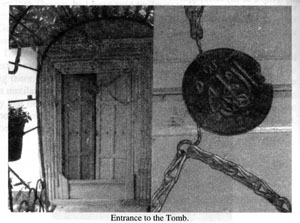
The Kashmir Tomb
The burial place of Jesus in Kashmir
is
known to the locals as
Rauzabal, meaning the Honored Tomb.
It is
known as the tomb of
Yuz Asaf, which may be of Buddhist derivation (see link) or possibly
from Yusu or Yehoshua (Jesus) the Gatherer. Local tradition states
that the entombed was a prophet of Ahle-Kitab, or People of the
Book, and his name was Isa – the Quranic name for Jesus. The
prophet Yuz Asaf came to Kashmir from the West (Holy Land) in the
reign of Raja Gopdatta (c 1st century A.D) according to the ancient
official documents held by the current custodian of the tomb. Some
of the most extensive research on the tomb has been conducted by
the now retired famous historian and former Head of Archaelogy for
State of Kashmir, Professor Fida Hassnain. The tomb
is
Jewish, as attested by the direction the grave
is
lying. Next to the grave
is
a
footprint engraved in stone, an artistic rendition of the wounds of crucifixion. Reed more!
There will be more!
Some
contemporary
scholars
repeatedly insist that the Messiah
ibn-e-Maryam
has
not
died,
rather he was raised alive to
heaven, and
is
present in heaven
with his physical, worldly body
and life. And with great boldness
and insolence they state that the
word tawaffi that has come in
reference to the messiah does
not mean death, rather
it
means
“to take fully”. Meaning, that the
body was taken along with the
soul. But to translate
it
in this
way
is
clear fabrication. The
Qur’an in its idiom has in every
place used this word to mean the
taking of the soul and death. This
same meaning
is
found in all
ahadith and sayings of the Holy
Prophet(sa). Ever since the Arabian Peninsula was inhabited and the Arabic language began,
it
cannot be shown through any ancient or
modern text that the word tawaffi has been used for taking the body. Rather, wherever the word tawaffa has been attributed as a verb to
Allah in regards to a human being,
it
has only ever meant causing death and taking of the soul and not in the sense of taking the body.
There
is
no Arabic dictionary that presents something contrary to this. There
is
no expression or saying attributed to the experts of the
language that
is
against this. Thus, there
is
not the slightest chance of a separate meaning.
If
anyone presents proof from the Holy Qur’an,
or any hadith of the Holy Prophet(sa), or poetry, odes or ancient or modern arabic prose that in any place where the word tawaffi as a verb
attributed to Allah
is
used regarding an animate individual, means anything other than causing death and taking the soul, that
is
to say
that
it
also means the taking of the body, then
I
swear by Allah the Magnificent an oath according to proper Islamic law that
I
will give such
a person one thousand rupees in cash by selling some portion of my property and will from hereon in admit his excellence in the sciences
of hadith and the Holy Qur’an. (Ruhani Khazain, vol. 3, Izala Auham, pgs. 602-603) Reed more!
Información sobre este tema en español
Copyright © 2020 TombofJesus.info
Powered by Nirvana & WordPress.